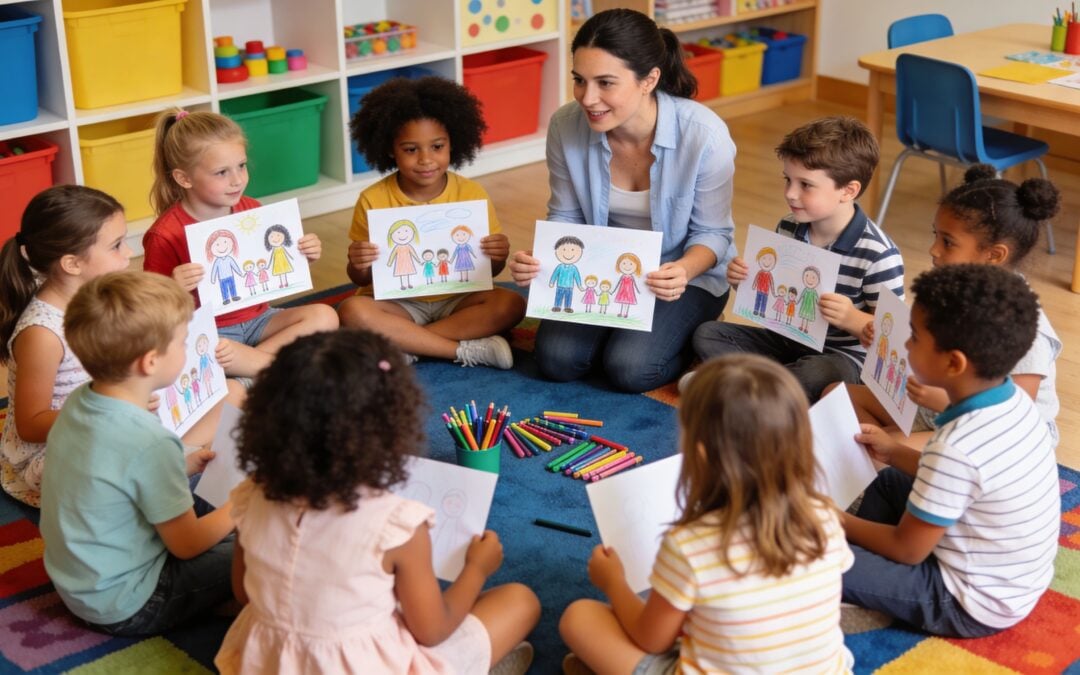
The first days of kindergarten can feel loud and tender at the same time. A child is holding a backpack almost as big as their body. A parent is smiling with watery eyes. A teacher is greeting everyone while noticing who clings, who wanders, who talks nonstop, and who says nothing at all.

That moment tells us something important. Before children can fully learn together, they need to feel safe together.

That’s why all about me kindergarten activities matter so much. They aren’t just cute first-week crafts. When we use them well, they help children say, “This is who I am,” and hear, “You belong here.” That shift builds the kind of classroom community where empathy, confidence, and calm problem-solving can start to grow.

The Magic of the First Few Weeks in Kindergarten

A kindergarten classroom in the first week is full of mixed signals. One child races to the block area. Another freezes at the doorway. Someone misses home. Someone else is ready to tell you about their dog, their cousin, and the missing tooth they had in June.

A friendly teacher greets children and parents at the entrance of a colorful kindergarten classroom.

Those first few weeks set the emotional tone for the whole year. Children are learning the room, the routines, the grownups, and each other. They’re also asking silent questions all day long.

  • Am I safe here
  • Will anyone play with me
  • Does my teacher know me
  • Is there room for my family, my language, my feelings, and my story

Why identity work comes first

When we start with all about me activities, we give children a simple way to enter the community. They don’t need advanced academic skills to participate. They just need a place to notice themselves and a structure for sharing small pieces of who they are.

That’s powerful in kindergarten.

A self-portrait says, “I can show you me.”
A name activity says, “My name matters here.”
A favorites chart says, “Other kids like things I like too.”
A family page says, “The people who care for me belong in this classroom story.”

Practical rule: If an activity helps a child feel seen before it asks them to perform, it’s doing important first-week work.

What teachers can do on day one

You don’t need a complicated unit to begin. Start with a few grounded routines that signal belonging.

  1. Greet each child by name if possible, even if you’re still learning pronunciations.
  2. Offer low-pressure choices such as drawing, stickers, or picture cards.
  3. Model your own sharing with a simple teacher page about your favorite snack, color, or pet.
  4. Name similarities out loud. “You both love pancakes.” “Three friends have baby sisters.”
  5. Protect the pace. Some children are ready to talk. Others need time.

If you’re building first-week routines around connection, this piece on building community in the classroom offers a helpful frame for thinking about belonging as a daily practice, not a single lesson.

The deeper goal

The magic isn’t the poster on the wall. It’s what happens while children make it.

They watch each other.
They listen.
They compare.
They laugh.
They realize that difference isn’t a threat.

That’s the beginning of community. And in kindergarten, community has to be built on purpose.

What Are All About Me Activities

When people hear “All About Me,” they often think of one worksheet with a face outline, a spot for favorite color, and maybe a box for age. That can be part of it, but a strong all about me kindergarten unit is much richer than a single page.

It’s an identity-based set of activities that helps children explore who they are, how they’re alike and different, and how they fit into the classroom community.

The core parts children usually explore

Most all about me activities revolve around a few familiar themes:

Self-portraits help children notice physical features, practice observation, and represent themselves visually.

Name exploration gives children repeated chances to see, trace, build, and say their names with pride.

Favorites and preferences make sharing easy. Favorite foods, colors, games, and books are often the safest entry points for conversation.

Family and important people invite children to describe the people who care for them, without forcing one narrow definition of family.

These pieces work because they’re concrete. A kindergartner may not be ready to explain identity in abstract language, but they can tell you, “My grandma makes rice,” or “I like red rain boots,” or “My baby brother cries a lot.”

More than a tradition

All About Me activities have been a foundational back-to-school tradition for over a decade. A 2016 study by Little et al. in Facilitating the Transition to Kindergarten found that they support this transition by building self-awareness, enhancing peer connections, and boosting confidence, with improved social integration rates by up to 25% in classrooms using such icebreakers, as noted through this Teachers Pay Teachers kindergarten All About Me resource overview.

That’s why I don’t treat these activities as filler. I treat them as early community curriculum.

What an all about me unit can include

A full unit often includes a mix of experiences rather than one product:

  • Drawing work: self-portraits, family pictures, favorite place drawings
  • Oral language: partner sharing, circle time prompts, teacher interviews
  • Early writing: name practice, labels, dictated sentences
  • Classroom displays: graphs, books, posters, shared charts
  • Home connection: family photos, caregiver questionnaires, take-home pages

If you want to extend the theme beyond school with hands-on projects, families often appreciate simple, low-pressure options like these easy crafts to do at home, especially when you frame them as conversation starters rather than art assignments.

A helpful way to think about it

An all about me unit works best when it answers three child-sized questions:

Question a child may be asking Classroom response
Who am I Activities about name, body, likes, feelings, strengths
Who are you Partner sharing, interviews, listening games
Do I belong here Group charts, class books, welcoming displays

Once teachers see that structure, planning gets easier. You’re not just collecting facts about children. You’re helping them build identity, language, and connection in ways they can manage.

Building More Than a Poster The SEL Benefits

If you’ve ever watched a kindergartner hold up a drawing and wait for the class to notice it, you’ve seen social-emotional learning in action. The child isn’t only sharing a paper. They’re taking a risk. They’re hoping to be received.

That’s why these activities matter so much. They help children practice the inner skills and relationship skills that make a classroom feel emotionally safe.

A hierarchical diagram showing SEL benefits including self-awareness, social awareness, and relationship skills for personal development.

Self-awareness starts with simple choices

Young children build self-awareness by naming what they notice about themselves. That might sound small, but it’s foundational.

When a child says:

  • “I feel nervous”
  • “I like building”
  • “I’m good at drawing”
  • “I don’t like loud sounds”

they’re practicing the habit of paying attention to their own experience.

A self-portrait supports that work. So does choosing a favorite song for a class chart. So does finishing the sentence, “I feel proud when…”

These are not extra moments. They are how children begin to understand themselves.

Children often share more when the prompt is specific and sensory. “What food makes you feel cozy?” gets deeper responses than “What’s your favorite food?”

If you’re looking at all about me kindergarten through an SEL lens, it helps to connect each activity to a specific skill. This overview of the benefits of social-emotional learning gives useful language for that connection.

A short visual can also help when you’re planning or explaining the purpose to families:

Social awareness grows when children listen to each other

Kindergarteners are still learning that other people have experiences different from their own. All About Me activities create many small openings for that realization.

One child draws two homes. Another says they live with an aunt. Another shares that they speak a different language with grandparents. Another says they hate strawberries while three classmates cheer because they hate them too.

That’s social awareness in real time. Children start to notice difference without fear and similarity without pressure.

Here’s what teachers can say to deepen that moment:

  • Name the pattern: “We have many different families in our class.”
  • Normalize difference: “Not everyone likes the same things, and that’s okay.”
  • Lift shared humanity: “Everyone wants to feel included when they talk.”
  • Invite curiosity: “What did you learn about a friend today?”

Relationship skills are built through structure

Sharing doesn’t automatically teach relationship skills. Structure does.

A child learns to wait while a peer talks. Another practices asking a kind question. Someone else learns to respond with interest instead of blurting out their own story. These are relationship moves, and kindergarteners need them modeled clearly.

A few supports make a big difference:

Activity SEL skill it supports Teacher move
Partner interview Listening and turn-taking Give one question at a time
Favorites graph Finding common ground Name shared interests aloud
Class book page share Speaking with confidence Let children pass if needed
Family drawing discussion Respect for differences Use inclusive language about caregivers

Psychological safety comes first

Children participate more freely when they know they won’t be embarrassed, corrected harshly, or forced to disclose more than they want. That’s psychological safety at the kindergarten level.

You build it when you:

  • Offer choice: draw, dictate, point, or speak
  • Avoid public pressure: never force a shy child to present
  • Respond warmly: thank children for sharing instead of evaluating the content
  • Use inclusive prompts: “Who lives with you?” works better than “Tell us about your mom and dad.”

This is one place where identity and belonging activities from organizations such as Soul Shoppe can fit naturally into a broader SEL approach, because they give schools structured ways to help students explore who they are and practice seeing one another with empathy.

A poster can decorate a room. A well-led all about me activity can change how children treat each other in that room.

A Step-by-Step Guide to Launching Your Unit

Teachers often ask whether an all about me unit should take one morning or stretch across several days. In practice, many classrooms slow it down on purpose. Data from educator blogs indicates that 70% of TK and kindergarten teachers extend All About Me activities into 10 to 14 day units, and those longer experiences are linked with 40% improvement in fine motor proficiency through repeated self-portrait work and a 30% reduction in isolation reports per teacher surveys, according to this Sharing Kindergarten overview of All About Me ideas.

You don’t need to do a full two weeks to benefit. A five-day launch gives children repetition, routine, and a gentler entry into sharing.

Day 1 My name and me

Start with names because names carry identity, comfort, and recognition.

Activity: Invite children to decorate their printed names with crayons, stickers, dot markers, or small collage pieces. Then let them build their names with magnetic letters, play dough, or letter tiles.

Circle prompt: “What do you like about your name?”
If that feels too abstract, ask, “Who says your name at home?” or “Does anyone have a nickname?”

Read-aloud idea: Choose a book centered on names, identity, or belonging.

For children who aren’t yet ready to talk in the whole group, let them whisper their answer to you or show it with a picture.

Day 2 My face and feelings

This is a good day for a first self-portrait. Keep the mood light. The goal isn’t realistic drawing. The goal is noticing features and connecting feelings to self-image.

Activity: Give children mirrors and invite them to look closely at their eyes, hair, skin tone, and smile. Offer multicultural crayons or markers if you have them. Ask them to finish one simple sentence such as “Today I feel…”

Circle prompt: “What face do you make when you feel excited?”
You can model several expressions and let children mirror them.

A mirror turns self-portrait work into observation, not guessing. That helps many children feel more successful.

Day 3 My family and home

This day needs the most thoughtful language. Use open prompts that welcome many family structures.

Activity: Children draw the people they live with or the people who help care for them. Some may include pets, grandparents, siblings, foster parents, or more than one household. All of that belongs.

Circle prompt: “Who helps take care of you?”
That question is often safer and more inclusive than asking children to label family roles.

Read-aloud idea: Pick a book that shows varied families and everyday home life.

Day 4 My favorite things

This is the easiest day for most children. It also creates quick bridges between peers.

Activity: Make a simple page with spaces for favorite food, color, game, animal, or place. Children can draw, dictate, or use picture choices. Turn some responses into class graphs.

Circle prompt: “What is one thing you love doing after school?”

This day works especially well for movement. Have children stand if they like apples, jump if they like playgrounds, or clap if they like painting.

Day 5 What makes me special

Now children are ready for a slightly deeper reflection. Focus on strengths, preferences, and kindness, not performance.

Activity: Create a final “All About Me” page or poster with sentence starters:

  • I am good at…
  • I feel happy when…
  • A friend can play with me by…
  • Something important about me is…

Circle prompt: “How can we help everyone feel included in our class?”

A simple weekly flow

Day Focus Main task SEL connection
Monday Name Decorate and build name Identity and recognition
Tuesday Self-portrait and feelings Draw self with mirror Self-awareness
Wednesday Family and home Draw caregivers and home life Belonging
Thursday Favorites Share likes and make graphs Connection
Friday Strengths and community Create final page and class discussion Confidence and inclusion

If you want to continue into a second week, repeat some formats with more depth. A second self-portrait later in the unit often shows visible growth in both drawing control and confidence.

Differentiated Activities for Every Learner

No kindergarten class is made up of one kind of learner. Some children talk before you ask the question. Some watch first and speak later. Some understand everything but don’t yet have the English words. Some know exactly what they want to say but struggle to get it onto paper.

That’s why all about me kindergarten activities need flexible entry points.

What adaptation really means

Adaptation doesn’t mean lowering the value of the task. It means removing barriers so the child can still do the meaningful part.

If the goal is self-expression, a child can meet that goal by drawing, pointing, dictating, using photos, choosing symbols, or speaking to a partner instead of the full group.

The structure matters here too. The Star of the Day protocol gives children a supported way to share themselves with peers. According to this Mrs. Wills Kindergarten article on All About Me activities, that routine is associated with a 35% to 50% reduction in isolation behaviors and uses teacher-guided interviewing to help children move from self-focused talk toward more relational speech.

Adapting All About Me Activities for Diverse Learners

Learner Profile Challenge Adaptation Strategy
English Language Learners Limited vocabulary for personal sharing Use picture cards, photo choices, gestures, and sentence frames such as “I like ___”
Children with motor-skill challenges Drawing or writing feels frustrating Offer stickers, stamps, pre-cut images, dictation, thicker tools, or digital drawing options
Shy or slow-to-warm students Whole-group sharing feels overwhelming Let them share with one peer, record their voice privately, or have the teacher present their page
Neurodiverse learners Sensory, communication, or processing demands vary Reduce visual clutter, preview prompts, offer clear routines, and allow alternative response modes
Children ready for more challenge Basic prompts feel too simple Add comparative questions, short dictated stories, or “three things about me” mini-books

If you support students with varied sensory and communication needs, this piece on how SEL supports neurodiverse students offers language that pairs well with identity-centered work.

Making Star of the Day feel safe

A spotlight routine only works when it stays predictable and gentle.

Try this pattern:

  1. Preview the child privately so they know what will happen.
  2. Use the same few questions each time.
  3. Invite classmates to notice commonalities, not just differences.
  4. Create a keepsake page with peer drawings or dictated compliments.
  5. Allow passing on any question.

The safest sharing structures are predictable, short, and never forced.

One child might answer, “I like watermelon.” Another child hears that and says, “Me too.” That sounds tiny to adults. To a child who felt alone five minutes ago, it can mean everything.

Sample Prompts and Templates You Can Use Today

Some all about me worksheets stay on the surface because the prompts stay on the surface. “Favorite color” is fine, but children often reveal much more when we make the question playful, sensory, or connected to feelings.

A stronger prompt gives the child somewhere to go.

Identity prompts that invite real thinking

Try questions like these during circle time, in small groups, or on a class book page:

  • About self: What is something your hands love to do?
  • About personality: What makes you laugh fast?
  • About comfort: What helps you feel calm at school?
  • About pride: What is something you’ve learned to do?
  • About belonging: What should friends know about you?

These questions still work for young children because they connect to lived experience, not abstract categories.

Family and feelings prompts

When I want children to go a little deeper without making the task heavy, I use prompts like these:

Theme Sample prompt
Family Who are the people you like to be with at home?
Home life What is something you like to do with your family?
Feelings What helps when you feel sad or worried?
Friendship How can someone be a good friend to you?
Celebration What is something your family enjoys together?

For older kinders or children who like reflecting out loud, prompts inspired by simple journaling work well too. This collection of self-discovery journal prompts can help teachers reshape basic worksheet questions into richer conversations.

A simple template that works

You don’t need a fancy printable. A strong all about me page can be made on plain paper with a few boxes and sentence stems.

Try this layout:

  • Top box for self-portrait
  • Left box for my name
  • Right box for people who care for me
  • Bottom left for things I love
  • Bottom right for how to be my friend

That last box is one of my favorites. Children say things like:
“I like gentle hands.”
“Play kitchen with me.”
“Ask me first.”
“I want you to be silly.”

Those are useful social cues for classmates.

A great template doesn’t just collect facts. It gives children language for connection.

One completed example

A child named Mateo might fill it out like this:

  • Self-portrait with curly hair and a giant smile
  • “My name is Mateo”
  • Drawing of grandma, dad, baby sister, and dog
  • “I love noodles, trucks, and soccer”
  • “Be my friend by asking me to play”

That single page tells the teacher a lot. Mateo may respond to movement, family talk, pretend play, and clear invitations from peers. A worksheet becomes a relationship tool when we read it that way.

Partnering with Families for Deeper Connection

Children don’t build identity only at school. They build it in kitchens, cars, apartment hallways, childcare pickups, weekend routines, and bedtime conversations. When schools invite families into all about me work, children get a powerful message. The adults in my life are connected, and my whole story is welcome.

A mother and her young daughter sitting at a wooden table drawing on a star shaped paper

Keep family involvement simple

Families are much more likely to participate when the request is easy to understand and quick to complete.

Good options include:

  • A one-page questionnaire with prompts like “What comforts your child?” and “What do you want us to know about your family?”
  • One photo from home printed or sent digitally
  • A short story or tradition the child enjoys
  • A family artifact such as a recipe card, song title, or favorite book

Avoid making it feel like homework. The goal is connection, not perfection.

Use accessible language

Some caregivers won’t have time for long forms. Some may prefer speaking over writing. Some may need translation support. Some may be cautious about sharing private family information.

A few practices help:

  • Use plain language
  • Offer choices instead of requirements
  • Invite, don’t demand
  • Make space for many family structures
  • Let caregivers respond in the language they use at home if possible

You can also ask families for practical insight that helps children settle:

“What helps your child feel safe when they’re in a new place?”

That one question often gives teachers useful strategies right away.

Low-effort ways to build the home-school bridge

Not every family can come to school, and that’s okay. Connection can still happen through small routines.

Try:

  1. A take-home conversation card with one question for dinner or bedtime
  2. A shared class slide deck where each family adds one photo and one sentence
  3. A classroom display made from family contributions
  4. A weekly message highlighting a prompt children discussed so caregivers can continue it at home

When families see that identity is handled with warmth and respect, trust grows. And when children hear similar messages at school and at home, they settle into belonging more easily.

Frequently Asked Questions

What if a child has a family structure that doesn’t fit typical worksheets

Change the language before the problem starts. Use prompts like “Who lives with you?” or “Who takes care of you?” instead of assuming every child has a mom-and-dad household.

Also review your materials. If a worksheet only allows one kind of family, remake it. A blank house box or open drawing prompt is often better than rigid labels.

What if a child refuses to share

Don’t force public participation. A child can still belong without speaking to the whole class on day one.

Try a ladder of participation:

  • draw first
  • whisper to the teacher
  • share with one partner
  • let the teacher read their words
  • present later if they choose

The goal is trust. Once a child feels safe, their voice usually comes.

How can I do all about me kindergarten in a virtual or hybrid setting

Keep it simple and visual. Children can hold up an object from home, draw on paper and show it on screen, or complete one slide with family help.

Short routines work best. Ask one prompt at a time, model your own answer, and give children choices for how to respond. They can speak, point, draw, or use a photo. What matters most is that each child has a way to be seen by the group.


Soul Shoppe offers programs and resources that help school communities teach practical SEL skills like self-awareness, empathy, communication, and belonging. If you’re looking for structured support around identity, connection, and psychological safety in classrooms, you can explore their work at Soul Shoppe.