

Building Trust in Relationships at School and Home

Building trust with a child isn't about grand gestures. It's built in the small, everyday moments—the consistent actions that create a deep sense of safety and predictability.
For students, this means knowing that the adults in their lives, both at school and at home, are reliable, fair, and truly have their back. It's the daily practice of making a child feel seen, heard, and valued for who they are.
Why Trust Is the Bedrock of Student Success

Trust isn’t just a "nice-to-have" in the classroom. It's the essential ingredient that allows a child's academic and emotional growth to take root. When kids feel genuinely safe with an adult, they’re far more willing to take the intellectual risks that learning requires—like raising a hand to ask a question they worry is "dumb" or tackling a math problem that feels impossible.
This sense of security is what we call psychological safety, and it has a direct line to a student's behavior and focus. A child who trusts their teacher is more likely to buy into classroom rules, collaborate with classmates, and engage in learning because they believe the environment is supportive and just. It's the foundation for creating a positive teacher-student relationship that fuels real growth.
To really see how these components work together, it helps to break them down. Here are the four pillars that uphold a trusting environment in any school.
The Four Pillars of Trust in a School Setting
| Pillar of Trust | What It Looks Like in the Classroom | Impact on Students |
|---|---|---|
| Reliability | "My teacher does what they say they will do." This means following through on promises, from grading papers on time to remembering a conversation. Example: If a teacher says, "We'll have 5 minutes of free draw time at the end of class," they make sure it happens, even if the lesson runs a little long. | Students feel secure and know they can count on the adults around them, which reduces anxiety. |
| Benevolence | "My teacher genuinely cares about me." This shows up in small acts of kindness, active listening, and showing interest in a student's life outside of academics. Example: A teacher notices a student is wearing a new soccer jersey and says, "Hey, I see your jersey! Did you have a game this weekend?" | Students feel valued as individuals, not just as learners, boosting their self-worth. |
| Competence | "My teacher knows their stuff and can help me learn." This is about clear instruction, managing the classroom effectively, and providing the right support. Example: When a student is stuck on a long division problem, the teacher offers a different way to think about it, like using manipulatives or drawing it out. | Students feel confident in the learning process and are more willing to ask for help when they struggle. |
| Honesty | "My teacher is truthful, even when it's hard." This means admitting mistakes, being transparent about classroom decisions, and being fair with consequences. Example: The teacher realizes they made a mistake on the answer key for a quiz. They announce it to the class, saying, "I made an error on question #5. Let's fix that together and I'll adjust your scores." | Students learn to trust the adult's integrity and are more likely to be honest in return. |
When you consistently demonstrate these four pillars, you're not just managing a classroom—you're building a community where every child feels safe enough to thrive.
The Power of Predictability and Reliability
Building trust with kids often comes down to one simple thing: consistency. A predictable classroom, where routines are clear and expectations are applied fairly, sends a powerful message that this is a safe and stable place.
- Teacher Example: Think of the teacher who greets every student at the door with a smile or a high-five. Or the one who uses the same quiet signal every single time. That dependability helps anxious kids feel grounded and secure.
- Parent Example: At home, it’s the parent who promises to be at the school play and shows up, no matter how small the role. That simple act of following through reinforces that their word means something.
This isn’t just a hunch; it’s a core human need. In fact, research shows that over 90% of U.S. adults believe trust and honesty are the most vital parts of any relationship—even more than shared interests. It’s a powerful reminder of how critical it is to actively nurture these bonds.
Trust is the emotional glue that holds relationships together. In a school setting, it’s what allows a child to put down their emotional armor and pick up a pencil, ready to learn.
Parents are a child's first and most important emotional anchor. When a kid comes home devastated over a fight with a friend, a parent who listens without jumping to conclusions and validates their feelings reinforces that home is the safest place to land. For example, instead of immediately saying, "Well, what did you do?" a parent might say, "That sounds so upsetting. I'm sorry that happened." This consistent emotional support is a cornerstone of trust, giving children the confidence they need to face the world.
Core Practices for Building Everyday Trust
Building trust with a child isn't about grand, one-time gestures. It’s about the small, everyday things that stack up over time. It’s the consistent, reliable, and empathetic actions that show a child they are psychologically safe with you.
Trust is forged in the quiet moments. It’s what happens when we choose to truly listen, to follow through on a small promise, and to prioritize the relationship over being “right.” This is something we’ve seen proven time and again in Soul Shoppe’s 20+ years of work in schools—empathy and consistency are the cornerstones of a child’s social-emotional strength.
Shift Your Language to Lead with Empathy
The words we choose can either build walls or open doors. When a child acts out, our first instinct is often to correct the behavior. But a trust-building approach starts by acknowledging the feeling behind the action. This small shift validates their inner world and keeps the lines of communication from snapping shut.
Instead of jumping to a conclusion that assigns blame, try leading with an observation.
- Instead of saying: "You always interrupt when others are talking."
- Try this: "I can see you have so many great ideas and you're excited to share them. It’s also important that everyone gets a chance to speak."
This empathy-first approach models respect and teaches self-awareness without a hint of shame. It sends a powerful message: I see your good intentions, even if we need to redirect the behavior.
Make Your Actions Predictable and Consistent
Consistency is the bedrock of feeling safe. For children, knowing what to expect from the adults around them calms their nervous system. It reduces anxiety and frees up mental space so they can actually focus on learning and growing. When your words and actions align, you become a dependable presence in their world.
"A child's trust is built on a simple promise: you are who you say you are. When we follow through, keep our word, and maintain predictable routines, we are silently telling them, 'You can count on me.'"
Here are a few ways to put this into practice:
- For Teachers: If you say you'll review a concept the next day, make sure it happens. If you establish a consequence for a specific behavior, apply it fairly and consistently to all students. For example, if the rule is "no phones during instruction," the consequence should apply to everyone equally, without exception.
- For Parents: If you promise to play a game after dinner, set a timer and honor that commitment. Following through on even the smallest promises shows your child they are a priority. For example, even if you're tired, saying, "Okay, like I promised, let's play one round of Uno," builds immense trust.
This level of predictability helps children feel secure. For more ideas on how to strengthen these bonds in the classroom, check out our collection of effective relationship-building activities.
Practice Transparency and Honesty
Being transparent doesn't mean sharing everything. It means being open about your reasoning and, when you make a mistake, owning it. This vulnerability doesn't make you look weak—it makes you look human. It shows kids that it’s okay to be imperfect and that accountability is a strength.
For example, a teacher might say, "We're going to have a substitute tomorrow. I know that can feel a bit strange, so I've left a detailed plan for Mrs. Davis and we'll pick right back up when I return on Wednesday." This transparency reduces student anxiety about the unknown.
Clear and honest communication is a non-negotiable for trust, whether you're a teacher, parent, or coach. For more practical strategies on this, this coach-parent communication guide offers some great, transferable insights. By being straightforward and open, you foster a partnership grounded in mutual respect.
Adapting Your Approach for Different Age Groups
Building trust with a six-year-old is a completely different ballgame than building it with a thirteen-year-old. While the heart of trust—reliability, empathy, and honesty—never changes, the way we show it has to. To connect with kids, you have to meet them where they are.
What a kindergartener needs to feel safe and seen is worlds away from what a middle schooler craves. Adapting your strategies shows them you get it. That respect for their stage of life is a massive trust-builder all on its own.
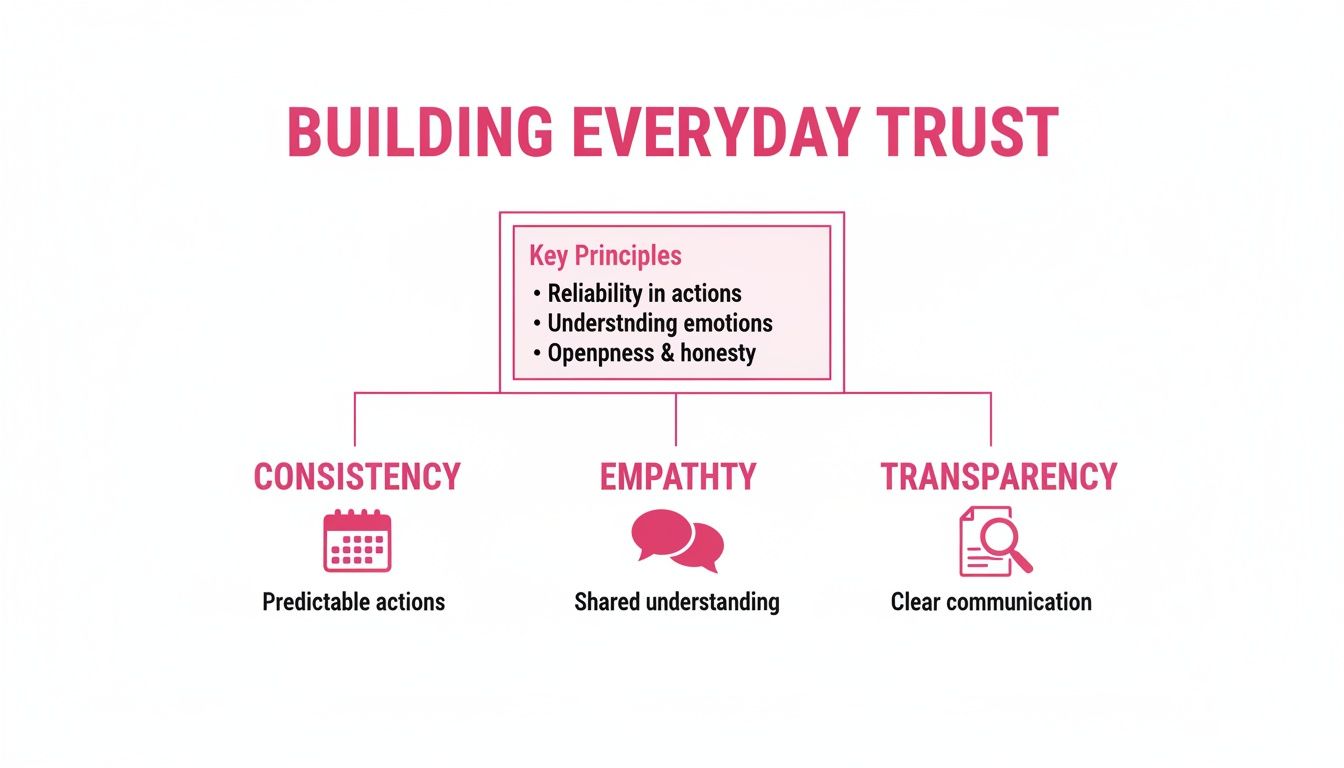
The three pillars of consistency, empathy, and transparency are universal. But let's break down what they look like in action across different age groups.
The table below gives a quick overview of how a child's primary trust needs evolve and how our actions can meet those needs.
Trust-Building Strategies by Age Group
| Age Group | Primary Trust Need | Teacher/Parent Action Example |
|---|---|---|
| K-2 (Ages 5–7) | Predictability & Safety | Sticking to a consistent morning routine. Clearly explaining what will happen next. Example: A parent uses a visual chart at home showing the steps for getting ready: 1. Get dressed, 2. Eat breakfast, 3. Brush teeth. |
| Grades 3-5 (Ages 8–10) | Fairness & Integrity | Applying rules equally to all students. Apologizing if you make a mistake. Example: A teacher uses a random name picker to call on students, ensuring everyone gets a fair chance to participate. |
| Grades 6-8 (Ages 11–14) | Respect & Autonomy | Knocking before entering their room. Asking for their opinion instead of giving direct advice. Example: A parent asks, "What do you think is a fair curfew for the school dance on Friday?" instead of just setting one. |
Thinking about these developmental needs helps us make sure our efforts to connect actually land the way we intend.
Building Trust with K-2 Students (Ages 5-7)
For our littlest learners, trust is all about predictability and physical safety. Their world can feel huge and chaotic, so they look to adults to be a calm, steady anchor.
Warmth, clear routines, and following through on tiny promises are the currency of trust here. It's about being a reliable presence in their often-unpredictable world.
- In the classroom: A first-grade teacher sees a student hanging back from a new activity. Instead of pushing, she kneels to his level, makes eye contact, and says, “This is new, huh? Let’s just try the first step together.” That small act communicates safety and partnership.
- At home: A parent sticks to the same bedtime routine every single night—bath, book, then lights out. This reliable sequence eases anxiety and reinforces that the parent is a source of comfort.
Connecting with Grades 3-5 (Ages 8-10)
By upper elementary, a child’s sense of justice and fairness is razor-sharp. They are watching. They’re noticing if your words match your actions, and they will absolutely call you on it if they don’t.
At this stage, keeping your promises is everything. They are old enough to remember what you said you’d do, and they’ll be tracking it.
Trust with a ten-year-old is often a matter of integrity. They are starting to grasp complex social rules and look to adults to model what it means to be fair, honest, and accountable.
For example, a teacher who applies classroom rules to every student—no favorites, no exceptions—earns deep respect. In the same way, a parent who promises to be at the soccer game and then actually shows up (and pays attention!) proves their child is a priority.
This is also a great age to signal that you trust them by giving them age-appropriate responsibilities. For example, a teacher can make a student the "tech helper" for the week, trusting them to pass out tablets. This simple act encourages them to trust you right back.
Earning Trust from Middle Schoolers (Ages 11-14)
Welcome to middle school, a whirlwind of social and emotional change. Tweens and teens are naturally pulling away from adults and turning toward their peers. Building trust now requires a delicate dance of respect, vulnerability, and guidance.
They are desperate for autonomy and have a built-in radar for being patronized or controlled. Small acts of respect go a very long way.
- Model vulnerability: This doesn't mean oversharing, but you can share an appropriate story about a time you struggled. Saying something like, "I remember feeling really left out in seventh grade, and it was tough," normalizes their feelings and makes you a real person, not just an authority figure.
- Respect their space: Knock before you enter their room. Ask permission before sharing a funny story about them with family. These gestures show you see them as individuals who deserve privacy.
- Act as a sounding board: When they come to you with a problem, resist the urge to jump in with a solution. Instead, ask open-ended questions like, "That sounds hard. What do you think you'll do?" or "How did that make you feel?" This empowers them to find their own solutions while knowing you're in their corner.