

Restorative Circles in Schools a Guide to Building Empathy
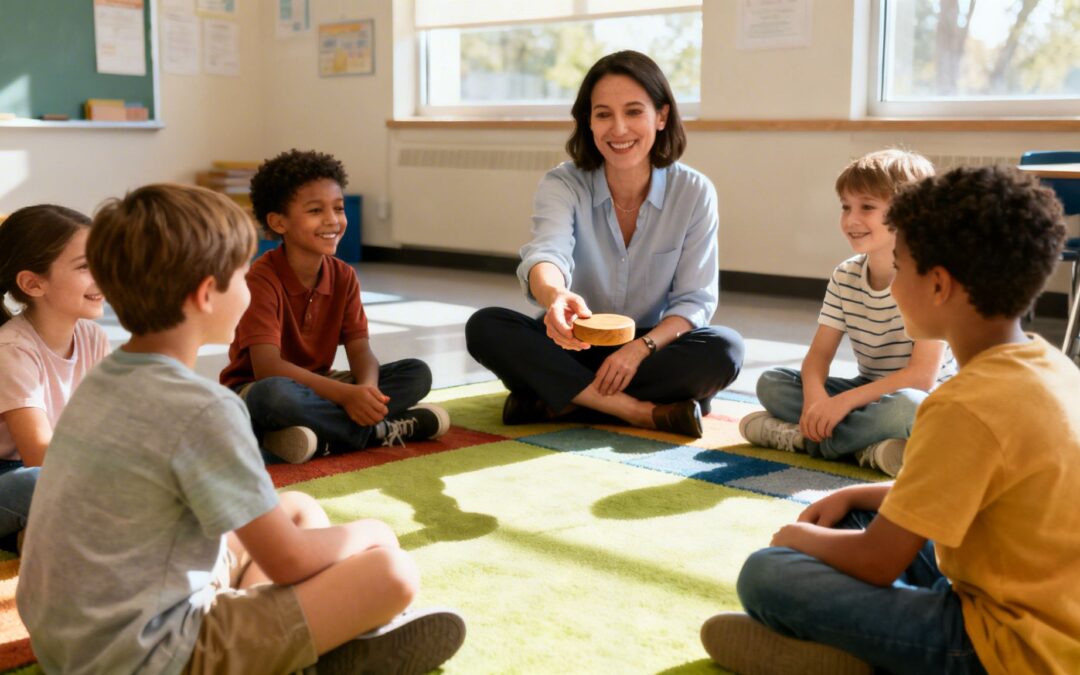
What if classroom conflict wasn’t something to be stamped out with punishment, but a chance for students to grow? That’s the idea behind restorative circles in schools. It’s a powerful shift away from focusing on consequences and toward repairing harm and rebuilding community. This simple method gives everyone a voice, turning tense moments into real opportunities for empathy and connection.
Moving from Conflict to Connection with Restorative Circles

Think about what happens when a problem pops up in a typical classroom. Maybe two students get into a heated argument. The usual response is often punitive—a trip to the office, detention, or lost privileges. This approach zeros in on punishing the behavior, but it rarely gets to the root of the problem or helps mend the relationship.
Restorative circles offer a completely different path. Instead of asking, “What rule was broken and who gets punished?” we start asking different questions:
- Who was harmed by this?
- What do they need to feel okay again?
- Whose job is it to help make things right?
This small change in framing shifts the entire goal from punishment to accountability and healing. The focus is now on making things right, not just making someone pay for being wrong. By bringing everyone involved into a structured conversation, circles help students see and understand the real impact of what they do.
A Tale of Two Responses
Let’s look at a common scenario: a fifth-grader keeps disrupting a math lesson by making loud jokes while you’re trying to explain a new concept.
The Traditional Response: You’ve given several warnings, and your frustration is mounting. You send the student to the principal’s office. They get a detention slip and a lecture about being respectful. The disruption is over for today, but the student feels misunderstood and resentful. The rest of the class just learned that acting out gets you removed, and no one ever found out why the student was being disruptive in the first place.
The Restorative Response: The teacher finds a calm moment to pull together a quick restorative circle. It includes the student who was being disruptive and a few classmates who were affected. Using a talking piece (an object that gives the holder the exclusive right to speak) ensures everyone gets heard without interruption. The teacher might ask, “What happened?” and “What were you thinking at the time?”
The disruptive student might share that they felt anxious about the math and used humor to cover it up. The other students might share that the jokes made it hard for them to concentrate. From there, the group works together on a solution. For example, the student could apologize and the group might agree on a quiet signal they can use with the teacher next time they feel lost or overwhelmed.
The restorative approach doesn’t let misbehavior slide; it tackles it head-on by making the community part of the solution. This process builds empathy and teaches priceless conflict-resolution skills that directly support social-emotional learning (SEL).
Beyond Discipline: A Tool for Community
While circles are fantastic for responding to harm, their real power lies in being proactive. Many schools use them for daily check-ins, celebrating successes, or even discussing academic topics. For example, a teacher might hold a 10-minute circle every Monday morning with the prompt: “Share one goal you have for this week.” These routine, low-stakes circles build the trust and safety needed for the more challenging conversations to work when conflicts eventually happen.
By practicing sharing and listening when things are calm, students develop the skills to navigate difficult moments with maturity and respect. This foundation is at the heart of the entire restorative movement in schools, which you can explore further by learning about what restorative practices in education are. It all leads to a classroom where every student feels seen, heard, and valued—the essential ingredients for a truly positive learning environment.
The Real Impact of Restorative Practices on Students and Schools

When you hear “restorative practices,” it’s easy to think only of conflict resolution. But the truth is, the benefits go so much deeper, reshaping the entire school climate in ways you can see and measure. It’s not just about students feeling better; it’s about creating an environment where they can actually learn and you can actually teach.
One of the first things schools notice is a dramatic drop in punitive discipline. When students have a structured process for addressing harm and mending relationships, the need for office referrals and suspensions plummets. For any teacher or administrator, this is a game-changer.
Just think about all the time spent on discipline paperwork and the instructional hours lost when a student is sent out of the room. Restorative circles give you that time back, redirecting it toward proactive community building and positive learning experiences.
Building a Foundation for Academic Success
It turns out a more connected school community is a more academically successful one. When students feel seen, heard, and respected, they have more mental and emotional space to focus on learning. Instead of worrying about peer conflicts or feeling misunderstood, they can engage fully with their lessons.
This creates a calmer, more predictable classroom where education can finally take center stage. And the data backs this up, showing a clear link between restorative approaches and better student outcomes.
Schools that effectively use restorative circles in schools often see a powerful ripple effect. Fewer disruptions mean more time for focused instruction, which leads to stronger academic performance for everyone. It’s a positive cycle that feeds itself.
This isn’t just theory. A landmark study from the Learning Policy Institute looked at restorative practices in 485 middle schools, with data from nearly 2 million students. The research found that as students were exposed more to restorative practices, they saw measurable gains on standardized tests in both English and math.
Those same students were also significantly less likely to be suspended. It’s powerful proof that social and academic progress are deeply connected. You can explore the impact of restorative practices in this comprehensive report.
From Numbers to Real-World Wins
So, what does this impact look like on a day-to-day basis? It shows up in real, observable changes that make school better for everyone.
- Fewer Classroom Disruptions: Teachers can spend far more time teaching and less time managing behavior because students are gaining the skills to solve their own problems.
- Reduced Administrative Burden: Principals and office staff are freed from a constant cycle of discipline and can focus on instructional leadership and school improvement.
- Improved Teacher Morale: Educators feel more supported and effective when they are part of a collaborative, problem-solving culture.
- Stronger Student Relationships: Students learn empathy and communication skills firsthand, which naturally reduces incidents of bullying and social isolation.
Imagine a school that used to deal with daily lunchtime conflicts. After implementing regular community-building circles, students start mediating their own disagreements. A small argument over a game no longer blows up into a major office referral. Instead, kids use the language and skills they practiced in the circle (“When you said that, it made me feel…”) to work it out right there on the spot.
This kind of shift doesn’t happen overnight, but the results are profound. By investing in relationships, schools build a resilient community where every member feels a sense of belonging and responsibility. See firsthand how our programs help schools measure these positive changes. This focus on connection is the key to unlocking not just better behavior, but a healthier and more successful school for everyone.
Laying the Groundwork for Successful School Circles
A powerful restorative circle doesn’t just happen. The real magic begins long before anyone sits down in that circle. Without thoughtful preparation, even the best intentions can fall flat, turning what could be a cultural cornerstone into just another passing initiative.
Getting this groundwork right starts with the adults in the building. Restorative practices thrive when they’re a shared mission, not a top-down mandate. For this to take root, teachers, staff, and administrators need to see and believe in its value first.
Start with a Pilot to Build Momentum
Instead of attempting a massive school-wide rollout from day one, try starting small. Launching a pilot program with a handful of enthusiastic educators is a fantastic way to build momentum.
This approach gives a few teachers the space to experiment, figure out what works, and become your school’s first restorative champions. Their genuine success stories will do more to convince skeptical colleagues than any district directive ever could.
Form an implementation team with these early adopters and an administrator to steer the process. They can plan the training, share resources, and provide that crucial peer-to-peer support. Research consistently shows that schools with a dedicated coordinator see much better results. This person becomes the go-to guide, ensuring everyone feels supported as they learn.
A common misstep is assuming a one-day training is enough. Real implementation is a journey of learning, practicing, and reflecting over multiple years. It starts with building a shared philosophy and foundational skills among the adults first.
This groundwork is what builds the safe, predictable environment students need to thrive. To learn more about this, check out our guide on how to create a safe space for students. When educators feel confident, they can lead circles that truly build community.
Co-Creating Your Circle Agreements
Once your pilot team is ready to go, one of the first and most important steps is setting your circle agreements, or norms. Here’s the key: these must be co-created with your students.
This simple act of shared ownership is a restorative practice in itself. It sends a powerful message that their voices are essential in shaping the classroom community.
A teacher might kick this off by saying, “We’re going to start having circles to get to know each other and solve problems together. What promises do we need to make so everyone feels safe enough to share their thoughts?”
Through brainstorming, students almost always land on the core tenets of a strong circle:
- Listen to understand, not just to reply. This fosters deep, active listening.
- What’s said in the circle stays in the circle. This builds the trust needed for honesty, with the clear exception that safety concerns are always brought to a trusted adult.
- Speak from the heart. This encourages students to share what’s real for them, not what they think they should say.
- You have the right to pass. No one should ever feel forced to speak. The circle is an invitation, not a demand.
Post these agreements where everyone can see them. They’ll serve as a constant reminder of the community’s shared commitments. Of course, how you introduce these ideas will change depending on your students’ ages. The table below offers some practical language and prompts you can adapt for your classroom.
Age-Appropriate Circle Prompts and Agreements
This table provides sample circle agreements and tiered talking points to introduce and facilitate restorative circles for different elementary and middle school grade levels.
| Grade Level | Sample Agreement | Introductory Script Snippet | Proactive Circle Prompt (Community Building) | Responsive Circle Prompt (Addressing Harm) |
|---|---|---|---|---|
| K–2nd | Use kind words and listening ears. | “In our circle, we use a talking piece. When you have it, it’s your turn to talk, and everyone else has their listening ears on.” | “Share about a time this week when you felt proud of yourself.” | “What happened at recess? How did it make your heart feel?” |
| 3rd–5th | Respect the talking piece. Listen from the heart. | “Today we’re starting something new called a circle. It’s a special time for us to share and listen so we can be a stronger team.” | “If you could have any superpower to help others, what would it be and why?” | “What were you thinking when the argument started? What do you think is needed to make things right?” |
| 6th–8th | Speak your truth. Lean into discomfort. | “Circles are a space for us to be real with each other. We’re creating our agreements together to ensure this is a place of respect.” | “Share about a challenge you’ve overcome and what you learned from it.” | “What was the impact of your actions? Who was affected, and what do they need to move forward?” |
Using these age-appropriate starting points makes it easier to introduce restorative circles in schools in a way that feels natural and effective for every student.
How to Lead a Restorative Circle with Confidence
Knowing the theory is one thing, but stepping into the center of a circle to actually lead one? That’s something else entirely. Real confidence comes from having a clear process and practical tools ready to go. This guide will walk you through the essential parts of leading a circle, giving you the language and techniques to create a space built on trust and respect.
At the very heart of every circle is the talking piece. This is just a designated object—maybe a special stone, a small stuffed animal, or even a decorated stick—that gives the person holding it the floor to speak. It’s a simple but powerful tool that slows conversations down, prevents interruptions, and ensures even the quietest voices are invited to share. How you model its use is everything.
Opening the Circle and Setting the Tone
Every restorative circle needs a clear, intentional beginning. This simple ritual signals to students that they’re shifting out of their regular classroom routine and into a special, focused space.
Your opening can be quick, but it should be consistent. You might start by welcoming everyone and briefly stating the purpose of today’s circle.
- For a proactive, community-building circle: “Welcome, everyone. In our circle today, we’re going to share a little bit about what makes us feel proud. The talking piece will move around, and remember, you always have the right to pass.”
- For a responsive circle addressing harm: “Thank you all for being here. We’re coming together today to talk about what happened at lunchtime so we can understand everyone’s perspective and figure out how to move forward in a good way.”
That initial moment sets the stage. It establishes safety and reminds everyone of the shared agreements you’ve already created together. A strong opening makes it clear this isn’t just another conversation.
Using the Talking Piece to Guide the Flow
The talking piece is so much more than a turn-taking tool; it’s a physical symbol of respect and listening. When a student is holding it, they have the group’s full, undivided attention. When they don’t have it, their job is to listen with an open mind.
As the facilitator, you’ll use the talking piece, too. This is crucial because it shows you’re a member of the circle, not an authority figure standing outside of it. Your first few shares are a perfect chance to model a little vulnerability and set a constructive tone.
Effectively leading these circles hinges on your ability to facilitate meaningful dialogue. Knowing some powerful topics for group discussion and how to frame your questions will make all the difference, as your prompts truly guide the entire conversation.
Proactive vs. Responsive Circle Scenarios
The way you structure your circle will change depending on its purpose. Is it a proactive circle meant to build community? Or a responsive one meant to repair it?
Scenario 1: A Proactive Morning Check-In
Imagine you want to build community in your 3rd-grade class. You open with, “Good morning! As the talking piece comes to you, share one thing you’re looking forward to this week.” This is a low-stakes prompt that’s easy for everyone to answer, and it builds a positive habit of sharing.
Scenario 2: A Responsive Lunchtime Conflict
Two 7th-graders, Sam and Alex, had a heated argument over a game that almost got physical. You gather them along with two other students who saw what happened.
Here, your prompts become much more focused:
- “What happened?” (Each person shares their perspective, one at a time, without being interrupted.)
- “What were you thinking and feeling at the time?” (This gets to the heart of the matter, uncovering the emotions that were driving the behavior.)
- “Who has been affected by this, and how?” (This broadens the view from a two-person fight to its impact on the community.)
- “What’s needed to make things right?” (Now the focus shifts to accountability, repair, and finding a solution together.)
This structured line of questioning keeps the circle from turning into a blame game. Instead, it guides students toward taking responsibility for the harm and fixing it.
Key Takeaway: A facilitator’s primary role is not to solve the problem for the students, but to hold the space and ask the right questions so they can solve it together. This empowers them with invaluable problem-solving skills.

The image above shows the typical journey a school takes when starting with circles. It’s a phased process that highlights just how critical training is for bridging the gap between getting buy-in and launching a successful pilot program.
Troubleshooting Common Challenges
Even with the best preparation, things will come up. Here’s how to handle a few common challenges with grace.
The Quiet or Reluctant Student: Never, ever force a student to speak. The “right to pass” is sacred. If a student passes, just say, “Thank you for listening,” and move the talking piece along. Later, you can gently invite them back in by saying, “We’ve heard from everyone else. Is there anything you’d like to add?” This low-pressure invitation often works once they’ve had time to listen and feel safe. Your patience and validation are key here—it’s all about active listening. For more ideas, check out our guide on practicing active listening with your students.
The Dominant Personality: Some students will naturally want to speak without the talking piece or go on for too long. Gently redirect them. “Thanks for your energy, Michael. Let’s make sure Maria has a chance to finish her thought.” You can also remind the group of the purpose: “Remember, the talking piece helps us make sure every single voice is heard.”
The Outcome: The goal of responsive restorative circles in schools is to reach an agreement on how to repair the harm. This isn’t about you, the facilitator, handing down a consequence. You might ask, “So, what can we agree on to make sure this doesn’t happen again?” The solution needs to feel relevant, respectful, and reasonable to everyone involved. For example, if a group of students made a mess, the agreement might be that they stay after to help the janitor, not that they lose recess for a week.
Having a dedicated person to lead this work can make a world of difference. A trial at River Ridge Elementary found that hiring a full-time restorative coordinator was a game-changer. They saw a 28% decrease in student suspensions and a 30% drop in office referrals, not to mention academic gains. You can dive into the full study on the Restorative School Communities model to learn more.
Closing the Circle
Just as you opened with intention, you need to close the same way. The closing provides a sense of finality and appreciation. It could be a simple go-around where each person shares one word about how they’re feeling, or you could offer a short, collective statement.
For example, you could say, “Thank you all for your honesty and courage today. Let’s take the feeling of respect we built in this circle with us for the rest of the day.” This seals the experience and helps students transition smoothly back into their regular activities.
How to Adapt Circles for Your School and Measure Success
Restorative circles aren’t a rigid, one-size-fits-all script. Their real power lies in their flexibility. They can be shaped to meet the unique needs of your school community, from a quick kindergarten check-in to a deep middle school problem-solving session.
Success isn’t just a feeling, either. It’s something you can—and should—measure. The most effective restorative circles in schools are the ones that are truly customized for the students sitting in them. A circle can be a space for celebrating growth, running academic check-ins, or navigating everyday peer disagreements.
Tailoring Circles to Fit Your Students
The secret to making circles work is adjusting their length and complexity to match your students’ developmental stage. A short, focused circle is almost always more powerful than one that drags on, especially for younger kids.
For example, a kindergarten class might kick off their day with a quick 10-minute circle. The prompt could be as simple as, “Share one thing that makes you happy.” This small routine builds the foundational skills of listening and sharing in a positive, low-stakes way.
On the other hand, a 45-minute circle with seventh graders can tackle something much more complex, like a group chat disagreement that spiraled over the weekend. The prompts would be more sophisticated, guiding students to reflect on the impact of their words and brainstorm a solution together.
Restorative practice is a mindset, not a script. The goal is to build and repair relationships, and how you do that should look different in a first-grade classroom than it does in an eighth-grade one.
The versatility of circles is one of their biggest strengths. Think about how you could use them in different situations:
- Academic Circles: Before a big test, a teacher could hold a circle and ask, “What’s one thing you feel confident about for this test, and one thing you’re nervous about?” This helps bring anxieties into the open and lets classmates offer support and encouragement.
- Celebration Circles: When a big project wraps up, a circle is a great way to celebrate effort and growth. A prompt like, “Share one thing you’re proud of that a classmate did during this project,” builds a powerful sense of community and appreciation.
- Problem-Solving Circles: When the whole class seems to be struggling with something—like keeping the room tidy—a circle can be used to solve the problem together. “What’s our shared responsibility for our classroom, and what’s one thing we can all agree to do to help?”
Measuring the Impact of Restorative Circles
To know if your restorative initiatives are actually working, you need to look beyond gut feelings. Collecting and analyzing real data gives you a clear picture of your program’s impact and helps you make the case for continued investment.
This means shifting from just sharing feel-good stories to tracking concrete metrics. Administrators can use this data to evaluate the success and return on investment (ROI) of their school’s programs, proving that they are creating real, sustainable change.
Start by tracking a few key performance indicators:
- Office Referral Rates: A noticeable drop in the number of students sent to the office for discipline is one of the clearest signs of success.
- Suspension and Expulsion Data: Keep an eye on both in-school and out-of-school suspensions. The goal is a significant reduction, which means more students are in class where they can learn.
- Student Climate Surveys: Use regular, simple surveys to ask students about their sense of safety, belonging, and connection to their school community.
- Attendance and Truancy Rates: A more positive school climate almost always leads to better attendance because students feel more connected and want to be at school.
But the data doesn’t always tell a simple story. A randomized trial in Pittsburgh Public Schools, for example, found that restorative practices improved school climate and significantly cut down on days lost to suspension in high schools. Yet, the same study showed no significant impact on suspension rates for middle schoolers, which tells us that results can vary by age and depend on thoughtful implementation. You can learn more about these nuanced restorative practice findings.
This is exactly why consistent and faithful implementation is so vital. When restorative practices are rolled out inconsistently or without proper training and buy-in from everyone, the results will be mixed at best. Real success comes from a whole-school commitment to the philosophy behind the practice.
Common Questions About Restorative Circles
When schools start exploring restorative practices, questions always come up. That’s a good thing! It means you’re thinking deeply about how to build a stronger, more connected school community. Moving away from traditional discipline isn’t always easy, so let’s walk through some of the most common questions we hear from educators just like you.
How Much Time Do Restorative Circles Take?
This is probably the number one concern, and it’s a valid one. The reality is, circles are incredibly flexible.
Community-building circles—the ones you run to build trust and connection—can be surprisingly quick. Many teachers weave a simple 10- to 15-minute circle into their morning routine. It’s a small daily investment that pays huge dividends when conflict eventually pops up.
Responsive circles, the kind used to address a specific issue, do take more time. But think about the time you’re already spending on that conflict. The hours spent on phone calls home, filling out paperwork, and dealing with the same unresolved issues day after day. A responsive circle is time spent teaching crucial skills and actually solving the problem, not just putting a band-aid on it.
What If Students Don’t Want to Participate?
A restorative circle is an invitation, never a demand. In fact, the “right to pass” is one of the most important parts of making a circle feel genuinely safe.
If you force a student to share before they’re ready, you’ve already lost their trust. The goal isn’t compliance; it’s connection. When a student chooses to pass, just thank them for being a good listener and move the talking piece along. Nine times out of ten, a student who passes at the beginning will feel safe enough to share by the time the circle comes back around to them.
As a facilitator, your job is to make the circle a comfortable space. You can do this by modeling vulnerability yourself and starting with fun, low-risk prompts. When a student chooses to pass, they’re practicing autonomy. Respecting that choice makes the circle stronger for everyone.
For instance, if a student seems hesitant, you might say, “Thanks for listening while others share. We’ll come around again at the end in case you think of something you want to add.” It’s a low-pressure way to honor their choice while keeping the door open.
Do Restorative Circles Replace Consequences?
This might be the biggest myth out there. Restorative practices don’t get rid of consequences; they make them meaningful. The entire focus shifts from punishment (which is about making someone suffer) to accountability (which is about making things right).
A circle allows everyone involved to understand the real impact of what happened. From that shared understanding, the group works together to decide what needs to happen to repair the harm. These aren’t random punishments—they are logical consequences that connect directly back to the action.
Here’s what that looks like in practice:
- Instead of detention for writing on a desk, a student might agree to help the custodian clean desks after school.
- After an argument with hurtful words, the students might create a classroom poster about respectful communication.
- A student who kept disrupting class for attention could be asked to lead the morning greeting the next day, giving them a positive way to be seen.
In every case, the student is held accountable by taking direct action to fix what they broke.
Can Circles Be Used for Serious Issues Like Bullying?
Yes, but this is where you need to be extremely careful and ensure you have a highly skilled facilitator. For something as sensitive as bullying, the top priority has to be the physical and emotional safety of the person who was targeted. A poorly run circle can do more harm than good and easily re-traumatize a student.
Before even considering a group circle, the facilitator absolutely must hold separate pre-meetings with everyone involved. This is non-negotiable. You have to gauge their readiness and make sure they feel truly safe to participate. For severe incidents, circles are just one piece of a much larger safety and support plan, not the entire response. The goal is to create a path toward healing, not a forced confrontation.
At Soul Shoppe, we believe in equipping schools with the tools to build connected, empathetic communities where every child can thrive. Our programs and coaching provide the practical skills and support needed to implement restorative practices effectively.
Ready to move from conflict to connection? Explore how Soul Shoppe can support your school’s journey.