

A Practical Guide to Social Skills Training for K-8 Success
What Is Social Skills Training and Why It Matters Now
Social skills are the essential foundation upon which friendships, academic success, and future opportunities are built. Think of them as the sturdy frame of a house—without that solid structure, everything else is shaky. Social skills training is all about giving children a practical toolkit to navigate their world confidently. It helps them read social cues, communicate with respect, and build real connections.
In a world where digital interaction so often takes the place of face-to-face connection, these skills have become more critical than ever. The ability to cooperate, listen, and manage emotions isn’t a “soft skill” anymore; it’s a non-negotiable part of a child’s development. You can explore the bigger picture of this growth in our guide on what is social-emotional development.
Building the Foundation for Future Success
Social skills training goes way beyond just teaching good manners. It’s about equipping students with the tools to understand their own feelings and, just as importantly, empathize with what others are feeling. This isn’t about memorizing rigid rules; it’s about building genuine emotional intelligence.
A teacher might see a classroom disagreement over a shared toy not as a problem to be punished, but as a perfect teaching moment. Instead of making accusations, students learn to use “I-statements” to express themselves.
Practical Example: During a group activity, a student feels their idea was ignored. Instead of saying, “You never listen to me!”, the teacher can guide them to say, “I feel frustrated when my idea isn’t heard because I want to help the team.” This simple shift empowers children to solve problems together without placing blame.
Social skills are the bedrock of a positive school climate. When students feel seen, heard, and understood, they are more engaged, more resilient, and better prepared to learn. Fostering these skills creates a ripple effect, improving everything from classroom behavior to academic outcomes.
Preparing Students for a Changing World
The importance of these skills extends far beyond the playground. The global market for soft skills training is booming, hitting USD 26 billion in 2023 and projected to reach USD 38 billion by 2032. Employers know that skills like teamwork, communication, and creative problem-solving are essential for success.
With experts predicting that nearly 39% of core worker skills will change by 2030, social and emotional learning is a crucial investment in our kids’ futures.
Ultimately, social skills training is about fostering connection and building resilience. By giving students a shared language for empathy and respect, we create safer, more supportive learning environments where every single child has the chance to thrive.
Understanding the Core Components of Social Skills
Social skills training isn’t about making kids memorize a list of rules for how to act. It’s much deeper than that. It’s about building a practical, intuitive foundation that helps children connect with others and navigate their world with confidence.
To make it simple, we can break these abilities down into three core pillars: Connecting with Others, Understanding Yourself, and Navigating Social Situations. Think of them as the three legs of a stool—if one is wobbly, the whole thing feels unstable. A child needs all three to feel balanced and secure in social settings.
Connecting With Others
This first pillar is all about looking outward. It covers the skills needed to build relationships and truly understand the people around us. Key pieces here include empathy—the ability to feel with someone—and active listening, which is about hearing to understand, not just waiting for your turn to talk.
For a student, this is so much more than just being quiet while a classmate is speaking. It’s making eye contact, nodding, and maybe even rephrasing what they heard to show they were really tuned in.
Practical Example: During a group project, one student practices active listening by saying, “So, if I’m hearing you right, you think we should start with the research part first? That’s a good idea. We could also…” This simple step shows they valued their peer’s input before jumping in with their own thoughts.
Understanding Yourself
The second pillar turns the focus inward. Before a child can really manage their relationships with others, they need a solid handle on their own internal world. This comes down to self-awareness (knowing what you’re feeling and thinking) and emotional regulation (managing those feelings in healthy ways).
This is where a child learns to identify that their stomach is fluttering because they feel nervous, not just because it hurts. From there, they can start using strategies to calm those feelings instead of letting them take over and run the show.
Practical Example: A student feels a surge of frustration after losing a board game in class. Instead of yelling or knocking over the pieces, they remember a technique they learned. They walk over to the classroom’s “calm-down corner” for two minutes, take a few deep breaths, and then rejoin the group, ready to move on.
A groundbreaking 2023 OECD survey of 130,000 students found that schools with structured social-emotional learning programs saw remarkable benefits. Students in these environments reported 25% higher feelings of psychological safety and belonging, and they even showed an 11% gain in achievement scores. You can learn more about these findings on nurturing social and emotional learning.
Navigating Social Situations
Finally, the third pillar brings the internal and external worlds together. This is where kids apply their self-awareness and empathy to handle real-world interactions. The core skills here are respectful communication and collaborative problem-solving. This is all deeply rooted in the principles of social learning, which explains how we pick up new behaviors by watching and interacting with others.
This pillar helps children handle everything from asking to join a game on the playground to working through a disagreement with a friend. It gives them a kind of script for navigating those tricky moments with confidence and respect. For a deeper look at these skills, check out our guide on the five core SEL competencies explained.
This chart shows just how much the social skills market is expected to grow, which really underscores how critical these abilities are for preparing students for the future.
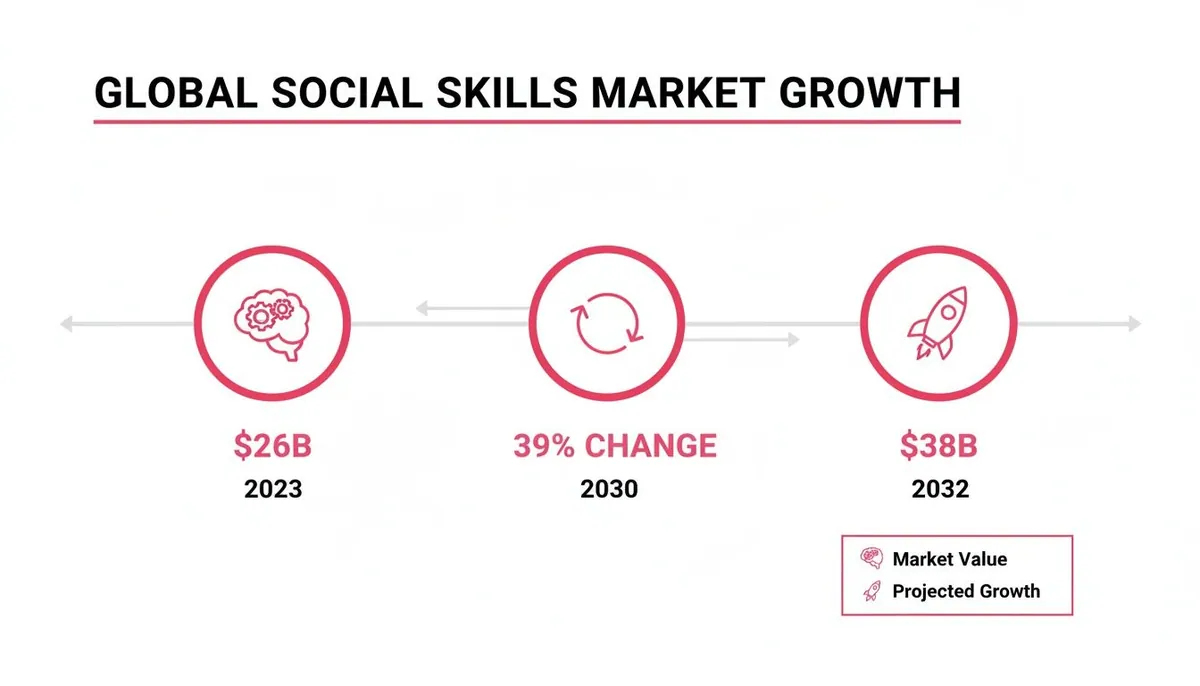
The data points to a major trend: what starts as social skills training in the classroom becomes a highly valued asset in the global workforce.
How to Integrate Social Skills Training in the Classroom
Let’s be honest: the thought of squeezing another subject into an already packed school day can feel overwhelming. But what if social skills training wasn’t “another thing” to teach? What if it was a new lens for seeing your entire day?
The most powerful way to build social skills is to make them part of the very fabric of your classroom culture. This means moving beyond one-off lessons and weaving skill-building moments into the routines you already have. When you do this, you create a shared language around respect, empathy, and problem-solving that students start to use naturally.
Transform Morning Meetings into Skill-Building Sessions
Your daily morning meeting is the perfect launchpad. Before you even get to the day’s agenda, you can dedicate just five or ten minutes to a specific social skill. It sets a positive, intentional tone for everything that follows.
This small daily practice grounds students and builds community in a low-stakes, supportive way. Over time, these brief sessions compound, creating a powerful foundation of social competence.
Practical Example: Teaching “I-Statements”
An “I-Statement” is a simple tool that helps kids express their feelings without blaming anyone else. You can introduce it with a quick morning meeting agenda:
- Introduce the Goal (1 min): “Today, we’re going to learn a way to share our feelings without starting an argument. It’s called an ‘I-Statement.'”
- Model the Skill (2 min): “So, instead of saying, ‘You took my crayon and made me mad,’ I could say, ‘I feel frustrated when my crayon is taken because I wasn’t finished.’ See how I focused on my own feeling?”
- Group Practice (2 min): Have students turn to a partner and practice turning a “You-Statement” (like, “You’re being too loud”) into an “I-Statement” (like, “I feel distracted when it’s loud because I’m trying to read”).
Leverage Teachable Moments Throughout the Day
Some of the most profound learning doesn’t happen on a schedule. A disagreement on the playground or a miscommunication during group work isn’t a disruption—it’s a live-action coaching session for social skills.
When you spot a social challenge unfolding, stepping in to guide students through it in real-time makes the lesson stick. It shows them how to apply these skills precisely when they need them most.
Practical Example: A Playground Disagreement
Imagine two fourth-graders, Alex and Ben, arguing over who was first in line for the swings. Instead of just sending them to the back of the line, you can turn this into a teachable moment.
- Step 1: Stop and Breathe. Approach calmly. “Okay, let’s pause for a second. Both of you take one deep breath.” This simple act helps lower the emotional temperature.
- Step 2: Guide with Questions. “Alex, can you tell Ben how you’re feeling using an ‘I-Statement’?” Alex might try, “I feel upset because I thought I was next.”
- Step 3: Encourage Active Listening. “Ben, what did you hear Alex say?” This simple question ensures Ben is listening to understand, not just waiting for his turn to talk.
- Step 4: Brainstorm Solutions. “What are two ways we could solve this so it feels fair to both of you?” Maybe they decide to take turns for five minutes each or even swing together.
By reframing everyday conflicts as learning opportunities, educators empower students to become independent problem-solvers. This process builds a resilient classroom community where challenges are seen as a chance to grow together, not as a source of division. To learn more, check out our guide on how to build classroom community.
Use Structured Activities to Reinforce Concepts
While teachable moments are pure gold, structured activities give students a safe space to practice without the pressure of a real conflict. These planned exercises can be fun, engaging, and easy to adapt for different age groups.
Think of these activities as the practice drills that help turn a conscious, clunky effort into an automatic, natural skill.
Here are a few ideas you can use tomorrow:
- For Younger Students (K-2): Emotion Charades. Write different emotions (happy, sad, frustrated, surprised) on cards, maybe with little cartoon faces. A student picks a card and acts out the feeling without words while the class guesses. This builds their emotional vocabulary and helps them read nonverbal cues.
- For Older Students (3-5): Collaborative Problem-Solving. Put a real-life challenge on the board, like: “Our class has too much leftover trash after lunch. In your groups, come up with three solutions we could all try.” This gets them working as a team, listening to different ideas, and finding a consensus.
- For Middle Schoolers (6-8): Perspective-Taking Scenarios. Present a short scenario like: “A new student joins your class and eats lunch alone. What are three possible reasons why they might be sitting alone, and what is one small thing you could do to make them feel more welcome?” Discussing their answers helps them challenge assumptions and practice empathy.
How to Reinforce Social Skills at Home
The skills a child picks up in a classroom are just one piece of the puzzle. For social skills to truly stick, they need to be practiced in the one place kids feel safest and spend most of their time: at home. Building a bridge between school and home life reinforces what your child is learning, showing them that these skills matter everywhere, not just in front of a teacher.
The great news is this doesn’t mean you need to run formal lessons or set up complicated activities. The most powerful social skills training happens naturally, woven into the simple, everyday moments you already share as a family. These low-prep, high-impact strategies can turn routine interactions into powerful learning opportunities.
Turn Dinnertime into Connection Time
Think of the family dinner table as the perfect social skills laboratory. It’s a natural time to disconnect from screens and actually reconnect with each other. By asking thoughtful questions, you can steer conversations that build empathy, perspective-taking, and the art of listening.
Instead of the classic “How was your day?”—which almost always gets a one-word answer—try using more specific prompts to get the ball rolling. The goal is to encourage storytelling and reflection.
Dinner Table Conversation Prompts:
- To Build Empathy: “What was one kind thing you saw someone do for someone else today?” or “Tell me about a time you felt really proud of a friend.”
- To Practice Perspective-Taking: “If you could switch places with any character from a book or show, who would it be and why?”
- To Encourage Self-Awareness: “What was the hardest part of your day? What was the easiest part?”
These kinds of questions create a space where sharing feelings is normal and listening to others is an expected part of the routine. If you’re looking for more ways to nurture this crucial skill, check out our guide on how to teach empathy.
Model Healthy Conflict Resolution
Kids are always watching. They learn so much more from what we do than from what we say. One of the most important lessons you can teach is how to disagree respectfully, and the best way to teach it is to model it yourself.
This doesn’t mean you need to stage major arguments in front of your kids. It’s actually about handling the small, everyday disagreements with grace and respect.
Practical Example: You and your partner disagree on what movie to watch. Instead of getting frustrated, you can model a healthy compromise out loud. You could say, “Okay, I see you really want to watch the action movie, and I’m more in the mood for a comedy. How about we watch your pick tonight, and we can watch mine tomorrow?”
This brief exchange teaches volumes. It shows that it’s okay to have different opinions, that listening to another person’s perspective matters, and that finding a solution together is the real goal. You’re demonstrating that conflict doesn’t have to be a scary thing; it can actually be productive.
Use Screen Time Productively
Let’s be real, screen time is a part of daily life in most homes. Instead of seeing it as just a passive activity, you can turn movies, TV shows, and even video games into active social learning moments. The characters and their stories provide perfect, low-stakes examples of complex social situations.
The key is to chime in with a few thoughtful questions during or after the show. This simple step transforms passive watching into an active, reflective experience that builds critical social awareness.
Questions to Ask During a Movie or Show:
- “How do you think that character felt when their friend said that?” This question nudges your child to step into a character’s shoes and practice empathy.
- “What could they have done differently in that situation?” This encourages critical thinking and problem-solving, letting them brainstorm better social strategies from the sidelines.
- “Have you ever felt like that character before?” This helps them connect what’s happening on-screen to their own real-life experiences, deepening their self-awareness.
By weaving these small practices into your daily life, you create a supportive home environment where social skills aren’t just taught, but lived. This partnership between school and home is what helps children take these crucial skills and apply them with confidence in every part of their lives.
Choosing the Right Social Skills Program for Your School
For school leaders and SEL coordinators, picking a social skills program can feel like walking through a crowded marketplace. Every option promises big results, so how do you find the one that will actually make a real, lasting difference in your school’s culture? The trick is to look past the marketing noise and use a clear, thoughtful framework to weigh your options.
A great social skills training program is more than just a purchase; it’s an investment in your students’ long-term happiness and academic growth. To make sure that investment pays dividends, you need a partner who offers more than just a box of lessons. You need a program built on a solid foundation, designed to weave right into the fabric of your school community.
Is the Program Grounded in Research and Evidence?
The first and most important question to ask is simple: is this program based on real evidence? This means its methods are rooted in proven research about how kids learn and develop socially and emotionally. A program without this foundation is like a house built on sand—it might look good at first, but it won’t hold up over time.
Look for programs that can clearly explain their “why.” Do they pull from established frameworks in child development and psychology? A research-backed program ensures you aren’t just chasing the latest trend but are putting strategies in place that have a real history of success.
A program’s philosophy should be transparent and easy to grasp. If you can’t see the ‘why’ behind the ‘what,’ it’s a red flag. The best programs are built on a deep understanding of childhood development and social learning principles.
Does It Prioritize Hands-On Learning?
Kids learn social skills by doing, not by filling out worksheets. The most effective training gets students on their feet, engaging in hands-on activities where they can practice communication, teamwork, and conflict resolution in the moment.
Think of it like learning to ride a bike. You can read a manual about balance and pedaling all day, but you only truly learn when you get on and start wobbling. The same goes for social skills. Look for programs that are packed with role-playing, group challenges, and guided practice instead of just passive learning.
Practical Example: A program that uses interactive games to teach empathy is miles more effective than one that just defines the word. An activity where students have to build something together without talking, for instance, forces them to rely on nonverbal cues and develop a much deeper awareness of what their peers are thinking and feeling.
Does It Support Your Staff and Engage Families?
A program is only as good as the people who bring it to life every day. Any curriculum you consider should come with robust training and ongoing support for your teachers and staff. This is critical for making sure everyone feels confident and equipped to use the program’s language and strategies consistently across the entire school.
Just as important is a real plan for family engagement. When parents and caregivers are given tools to reinforce the same skills at home, it creates a powerful, unified community approach. That bridge between school and home is what makes the learning stick. As you explore programs, don’t forget to look into funding options, including specific special education grants for teachers that can help make it happen.
Finally, think about how technology can support your work. According to the 2023 Coursera Global Skills Report, the demand for soft skills training online is massive, and this trend is absolutely reflected in K-12 education. Well-designed digital tools can help equalize access to high-quality SEL, with schools using them seeing 20-30% better emotional regulation outcomes. You can read the full report to learn more about global skills trends.
How to Know If It’s Working: Measuring Growth in Social Skills
So, you’re putting in the effort to teach social skills. How can you tell if it’s actually making a difference? The good news is, you don’t need complicated spreadsheets or formal assessments. Moving beyond a gut feeling is more about knowing what to look for and celebrating the small wins that signal real, lasting change.
The goal isn’t perfection; it’s progress. When you can spot how new skills in empathy, confidence, and problem-solving are starting to take root, you’ll know what’s working and where a child might need a little extra support.
Tracking Progress in the Classroom
For educators, measuring social skills can be woven right into the fabric of the school day. It’s all about observing patterns and gathering simple, practical insights that paint a clear picture of student growth.
Here are a few straightforward ways to do it:
- Simple Observation Checklists: During group projects or playtime, keep a basic checklist handy. Did a student really listen to a peer’s idea without interrupting? Did they offer to help someone who was stuck? Ticking these boxes over time shows you which skills are sticking.
- A Dip in Disciplinary Data: Take a look at the trends in playground squabbles or classroom disagreements. A noticeable drop in incidents over a few months is a powerful sign that students are starting to use their new conflict resolution tools on their own.
- Before-and-After Pulse Checks: Use simple, anonymous surveys to get a feel for the classroom climate. Asking questions like, “Do you feel like your ideas are respected here?” or “Do you know who to ask for help when you’re upset?” can reveal a lot about their sense of belonging and psychological safety.
Seeing the Skills Come to Life at Home
For parents, success often shows up in those subtle but powerful moments when you aren’t looking. It’s about noticing when your child uses a new skill without being prompted, especially when their emotions are running high.
Keep an eye out for these concrete signs of progress:
- Independent Problem-Solving: You overhear your kids working through a fight over a video game themselves, using calm words instead of shouting. That’s a huge win.
- Using “Feeling” Words: Instead of a meltdown, your child says, “I’m so frustrated that this won’t work!” This shows a massive leap in their ability to recognize and name their own emotions.
- Spontaneous Empathy: Your child sees a friend looking sad at the park and walks over to ask if they’re okay. This is when you know the lessons on empathy are becoming a natural, heartfelt response, not just a rule they’re following.
Ultimately, the most important metric is a child’s growing confidence in social situations. When you see them willingly join a group, speak up for themselves respectfully, or bounce back from a minor social fumble, you know the training is making a real impact.
Celebrating these small, consistent steps is everything. Recognizing that your child chose to take a deep breath instead of yelling is just as important as them making a new friend. This focus on gradual improvement makes the journey of social and emotional learning a positive and empowering one for everyone.
Common Questions About Social Skills Training
Even with the best intentions, diving into social skills training can bring up a few questions for parents and educators alike. Let’s walk through some of the most common ones to help you feel confident and clear as you get started.
How Early Can Social Skills Training Begin?
Social learning starts the day a child is born, but more structured training can begin as early as preschool. At this age, it’s all about the fundamentals: sharing, taking turns, and listening when a friend is talking. These early experiences lay the essential groundwork for navigating more complex social situations down the road.
Practical Example: A preschool teacher might use a puppet to model how to ask for a toy instead of just grabbing it. The puppet could say, “May I have a turn with the blue block, please?” This simple, playful demo makes a big concept easy for a three-year-old to grasp and try out themselves.
Is Social Skills Training Only for Children with Diagnosed Needs?
Absolutely not. While it’s a critical support for children with developmental challenges like Autism Spectrum Disorder (ASD), social skills training benefits every child. In a world full of screens, all kids need direct guidance on how to read social cues, handle their emotions, and work through disagreements. It’s a universal life skill.
Think of social skills training like learning to read or do math. Some students might need more intensive support, but it’s a core competency that helps every single learner succeed, both in the classroom and out in the world.
What if a Child Resists or Doesn’t Seem Interested?
It’s completely normal for a child to push back, especially older students who might feel singled out. The key is to make it feel relevant and empowering, not like a punishment. Frame it as learning “people skills” that will help them make friends, nail that group project, or even handle tricky situations online.
Connecting the skills to their own goals is a game-changer.
- For the child who wants more friends: Focus on simple conversation starters or how to join a game on the playground. For example, practice saying, “That looks fun! Can I play next time there’s an opening?”
- For the student who dreads group work: Practice active listening and how to share ideas without talking over others. For example, role-play phrases like, “That’s a great point. To build on that, we could also…”
- For the kid who gets frustrated easily: Introduce a simple calming tool, like the STOP method (Stop, Take a breath, Observe, Proceed), to help them feel more in control of their reactions. For example, have them practice STOP when a puzzle piece doesn’t fit or a video game level is too hard.
When kids see—through consistent and positive reinforcement at school and home—that these skills make their lives easier and more fun, the resistance will start to fade.
At Soul Shoppe, we give schools and families the tools and support to build emotionally intelligent, resilient communities. Our programs transform school culture from the inside out by teaching a shared language of empathy and respect. Learn more about how Soul Shoppe can support your students.