

Building resilience in children: Practical strategies for parents and teachers
When we talk about building resilience in children, what we’re really talking about is giving them the tools to handle life. It’s about teaching them how to navigate challenges, adapt to curveballs, and bounce back when things don’t go their way. This isn’t about making them tough; it’s about fostering their ability to cope with stress, solve problems, and keep a positive outlook, all grounded in strong relationships and a belief in themselves.
Why Building Resilience in Children Is More Critical Than Ever

Today’s kids are navigating a world filled with pressures we never faced—from intense academic expectations to the constant buzz of social media. While we can’t shield them from every bump in the road, we can equip them with the skills to manage adversity when it arrives. Building resilience isn’t about creating an unbreakable shield. It’s about teaching them how to bend without breaking.
This is not some innate trait that some kids are born with and others aren’t. Resilience is a skill set, one that’s developed through practice, guidance, and supportive relationships. It’s the foundation that allows a child to try again after failing a test, work through a friendship dispute, or cope with a big disappointment.
The Growing Need for Resilience Skills
The data paints a clear picture: our kids need these skills more than ever. The youth mental health crisis has been accelerating for years. Even before the pandemic, feelings of persistent sadness and hopelessness among high schoolers had climbed by about 40% in a decade. These challenges, amplified by the pandemic effects on children, make proactive support an absolute necessity.
Fortunately, we know that targeted efforts make a real difference. One large-scale analysis showed that students who participated in resilience programs were 11% more likely to graduate from college and reported fewer mental health struggles down the line. You can explore more data on the youth mental health crisis in a report from the Pew Research Center.
Resilience is the capacity to prepare for, recover from, and adapt in the face of stress, challenge, or adversity. It’s a journey, not a destination, built through small, consistent actions over time.
So, what does this foundation actually look like in practice? It really comes down to three core pillars:
- Strong Connections: The single greatest predictor of resilience is a stable, caring relationship with at least one adult. For example, a teacher who checks in with a student after they seemed upset, or a parent who listens without judgment after a tough day, provides that essential sense of safety.
- Emotional Awareness: Kids need the vocabulary and confidence to identify what they’re feeling and express it constructively. For instance, being able to say, “I’m feeling frustrated because I can’t get this math problem,” is the first step toward managing that feeling.
- Problem-Solving Skills: We need to empower kids to see challenges as solvable situations, not insurmountable walls. A practical example is helping a child brainstorm ways to deal with a lost library book instead of just paying the fine for them. This builds confidence and a sense of control.
This guide moves beyond theory to give you actionable, age-appropriate strategies for both the classroom and home. You’ll find practical examples and routines to help you nurture these core pillars and empower the children in your life to thrive.
Fostering the Strong Connections That Build Resilience
When you boil it all down, there’s one thing that matters more than anything else for building resilience in children: a stable, caring relationship with a supportive adult. This connection is the anchor. It’s the emotional safety net that gives kids the courage to take risks, mess up, and bounce back. It’s the consistent presence that sends the message, “You are safe, you are seen, and you matter—even when things are hard.”
Without that foundation, all the other strategies can fall flat. A child who feels disconnected or invisible will have a tough time absorbing lessons about managing their emotions or solving problems. But a child who feels securely attached has a powerful buffer against stress, which makes every other resilience-building effort that much more effective.
Creating Connection in the Classroom
As a teacher, building these bonds can feel like a tall order with all the curriculum and classroom management demands. But it’s the small, intentional actions that create a real sense of belonging and safety for every student. The goal isn’t to be every child’s best friend; it’s to be a consistently caring and predictable adult in their world.
A simple but powerful routine to try is the “two-minute connection.” The idea is to spend just two minutes a day for 10 consecutive days having a non-academic, personal chat with a specific student. You could ask about their weekend, their favorite video game, or their pet. This small investment shows you’re genuinely interested and can completely change how a student feels about school. To dig deeper into building these bonds, you can explore the power of a positive teacher-student relationship.
Another great tool is the “I Wish My Teacher Knew” box. It’s just a simple, anonymous drop-box where students can share anything they want you to know, from struggles at home to excitement about a new hobby.
Imagine this: a teacher notices Maria, one of her brightest students, has become withdrawn. Instead of calling her out in front of everyone, the teacher leaves a kind, private note on her desk. The next day, a slip of paper appears in the “I Wish My Teacher Knew” box: “My grandma is sick.” This little note opens the door for a compassionate, private check-in, reinforcing that the classroom is a safe place to be vulnerable.
Nurturing Strong Bonds at Home
At home, the daily rhythm of life is packed with chances to strengthen connections. Grand gestures are nice, of course, but it’s the consistency of small moments that builds a truly resilient family. One of the most powerful things you can do is commit to dedicated, device-free time every single day.
It doesn’t have to be long—even 15-20 minutes of focused attention can make a world of difference. Just put the phones away and be fully present with each other. A practical example could be shooting hoops in the driveway after school or reading a chapter of a book together before bed.
Here are a few conversation starters for dinner time or car rides that get you past the classic “How was your day?”:
- What was the best part of your day? What was the hardest part?
- Did anyone do something kind for you today? Did you get to do something kind for someone else?
- If you could make one rule that everyone in the world had to follow, what would it be?
- Tell me about a time today you felt proud of yourself.
Questions like these open the door to real conversations and show your child you’re genuinely interested in their inner world, not just their grades.
When a conflict pops up, like a disagreement with a friend, try using it as a chance to connect instead of just jumping in to solve it. Rather than immediately offering solutions, coach them through it. You could start with something like, “That sounds really frustrating. What do you think you want to do about it?” This simple shift validates their feelings and empowers them to think through solutions on their own, all while knowing you’ve got their back.
Ultimately, that feeling of being unconditionally supported is the true bedrock of resilience.
Developing Emotional Literacy and Self-Awareness in Kids
Before a child can manage a big feeling, they first have to know what that feeling is. This is where emotional literacy comes in—it’s the ability to recognize, understand, and label our own emotions, and it’s a non-negotiable first step in building resilience. It turns a confusing internal storm into something specific we can actually work with.
When kids can put a name to what they’re feeling, they gain an incredible sense of control. Just the simple act of naming it creates a little space, letting them observe the emotion instead of being totally swept away by it. For example, helping a child move from “I hate school!” to “I feel nervous about the spelling test” is a huge step in self-awareness.
Practical Tools for Naming and Taming Emotions
For younger kids, feelings are often huge, abstract concepts. That’s why visual and tangible tools are so effective; they make emotions more concrete and easier to talk about. These tools are fantastic for a classroom “calm-down corner” and just as useful in a family living room.
Two of our favorites are:
- Feelings Wheels: These are colorful charts showing a whole range of emotions, usually with expressive faces to match. A child who is struggling to find the words can simply point to the face that matches how they feel, opening the door for a conversation.
- Emotion Thermometers: This visual helps kids rate the intensity of their feelings, from a calm green at the bottom to an explosive red at the top. It’s a powerful way to show them that feelings like anger or excitement aren’t just on/off switches—they exist on a spectrum.
Imagine a teacher sees a student getting agitated during group work. Instead of just saying, “Calm down,” she could quietly ask, “Can you show me on the emotion thermometer where you are right now?” This validates the child’s feeling and starts a dialogue about what’s going on.
This infographic breaks down some key strategies both teachers and parents can use to build this skill.
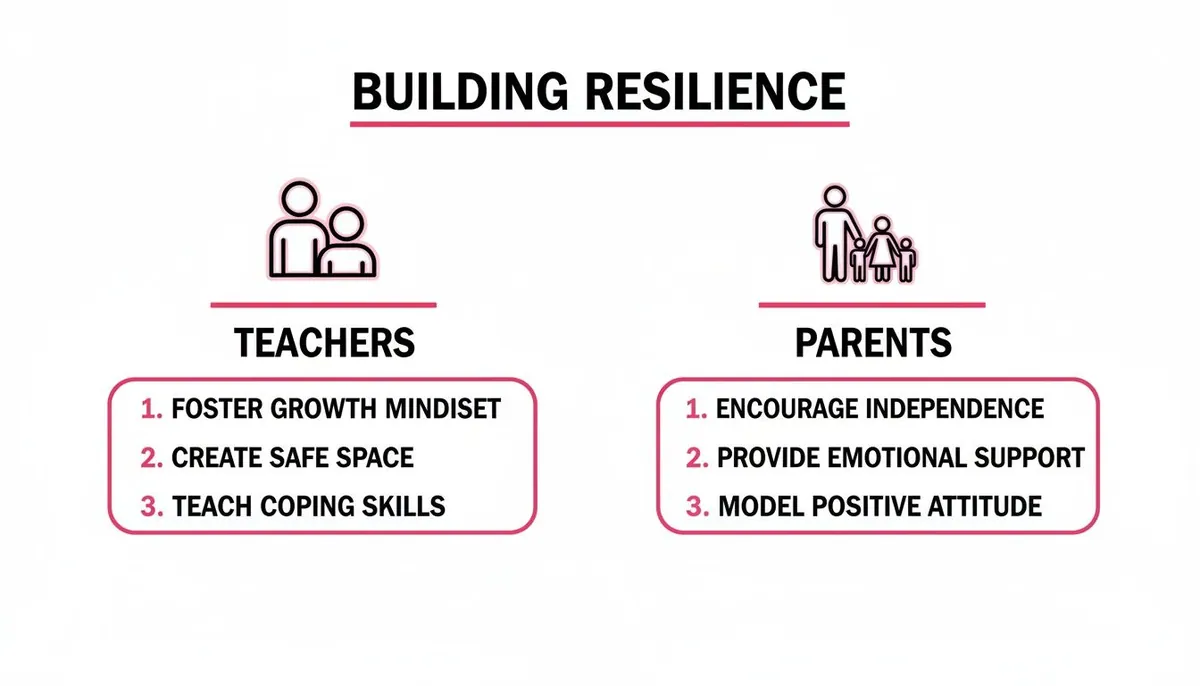
As the visual shows, building resilience is truly a team effort. It works best when the strategies at home and school are consistent and aligned.
Age-Differentiated Strategies for Emotional Growth
A child’s ability to understand their inner world changes dramatically between kindergarten and middle school. Our strategies have to evolve right along with them. A one-size-fits-all approach just doesn’t cut it for a skill as personal as emotional intelligence.
While the focus here is on K-8, the foundational principles of validating emotions and providing tools apply even earlier. For those with younger children, you might find helpful parallels in resources covering strategies for handling toddler tantrums and power struggles.
The goal isn’t to prevent children from feeling sad, angry, or anxious. It’s to give them the confidence and the skills to navigate those feelings without getting stuck in them.
This process is about more than just naming feelings; it’s about connecting them to thoughts and actions. As kids mature, they can start to see what triggers their emotions and how their reactions impact themselves and others. For a deeper look at this, explore our guide on teaching emotional intelligence.
To make this practical, we’ve broken down some activities tailored to different developmental stages. The table below offers a clear roadmap for both parents and educators.
Age-Appropriate Activities for Building Emotional Literacy
Here are a few ways to bring these concepts to life in the classroom and at home, matching the activity to the child’s developmental stage.
| Age Group | Core Skill Focus | Classroom Activity Example | Home Activity Example |
|---|---|---|---|
| K-2 | Identifying & Naming Emotions | “Name It to Tame It” Story Time: Read a book where a character has a strong emotion. Pause and ask, “How do you think the bear is feeling right now? What clues tell us that?” | Feelings Check-in: Use a feelings chart at breakfast. Ask, “Which face shows how you’re feeling as we start our day?” |
| 3-5 | Managing Triggers & Impulses | “Box Breathing” Practice: After recess, guide the class through a simple 2-minute box breathing exercise to help them transition calmly. Count to 4 for inhale, hold, exhale, and hold. | Create a “Calm-Down Kit”: Work together to fill a box with items that help your child self-soothe, like a stress ball, a favorite book, or a small notepad for drawing. |
| 6-8 | Connecting Thoughts & Actions | “Think-Feel-Do” Journaling: Provide a simple prompt: “Write about a time you felt frustrated. What was the thought in your head? What did you feel in your body? What did you do?” | Reflective Conversations: When they share a problem, ask questions like, “What was going through your mind when that happened? How did that feeling influence your next step?” |
By using these age-appropriate strategies consistently, we help kids build a strong internal toolkit. They learn that their emotions are signals to listen to, not sentences they’re stuck with. This awareness is the bedrock of self-regulation and a key ingredient for lifelong resilience.