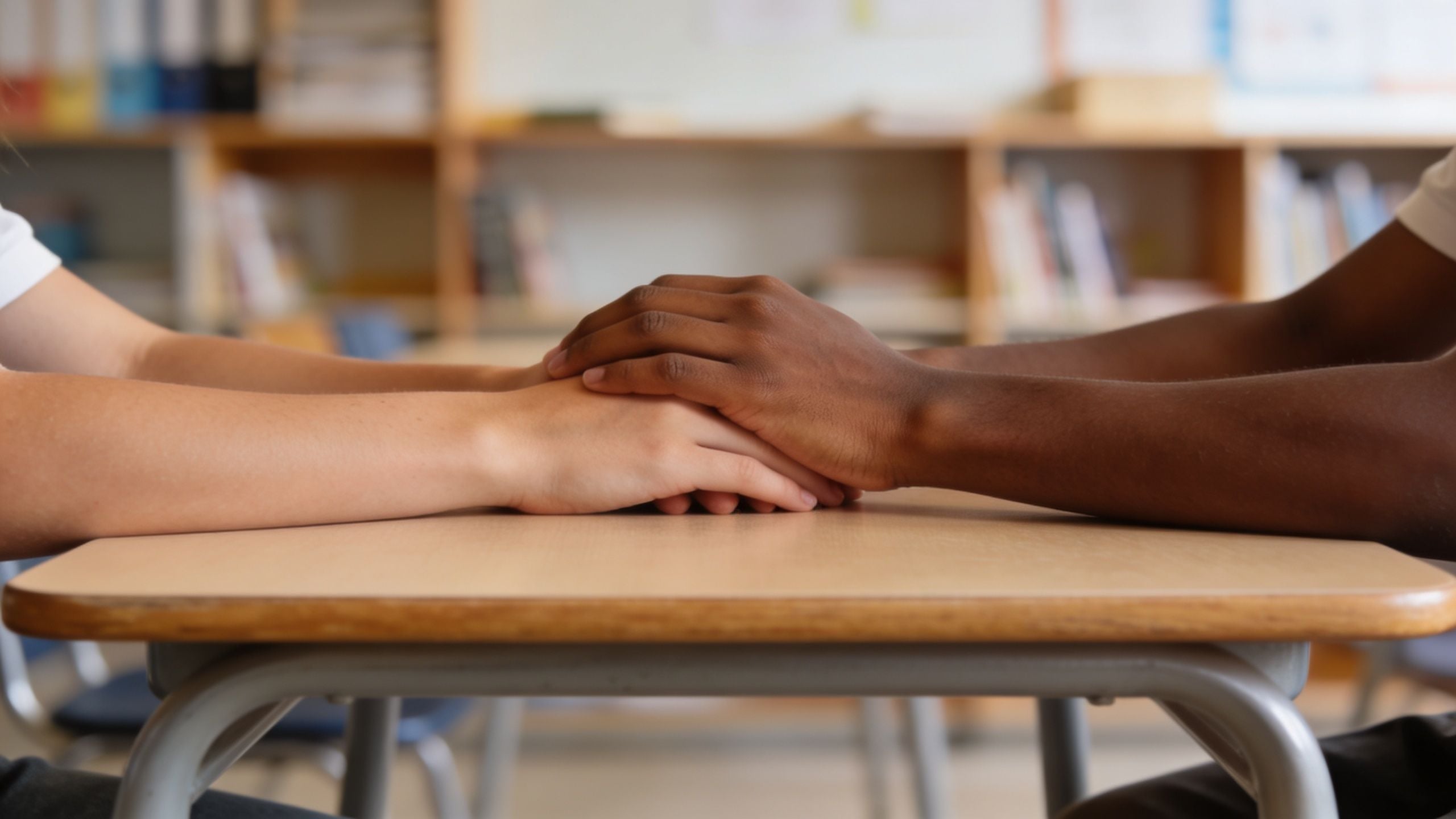

A child stands beside the classroom door after another student hugs them without asking. At home, a caregiver notices a child agreeing to every request, then becoming quiet and irritable. In both situations, something feels wrong, but the child may not yet have the words to explain it.
A healthy boundary is a clear limit that protects safety, autonomy, time, emotions, or relationships without rejecting connection. It can sound like, “Please stop,” “I need some space,” or “I'm not available for that right now.” Boundaries also belong to adults. A teacher can protect a professional role, and a parent can decline an unreasonable demand without withdrawing love.
Clear boundaries help children practice self-regulation, empathy, and assertive communication. They also make classrooms and homes more predictable, which supports psychological safety. The need for this teaching is practical. In a 2023 survey highlighted by Our Watch's research record, many surveyed young people misidentified controlling or coercive behavior as healthy, and only 22% felt completely confident taking action when they felt unsafe, uncomfortable, or disrespected.
The following examples of healthy boundaries are organized around everyday relationships and developmental settings. Each one gives adults a script, a teaching tactic, and observable cues that signal a limit needs attention.
1. Establishing Clear Communication About Screen Time and Device Use
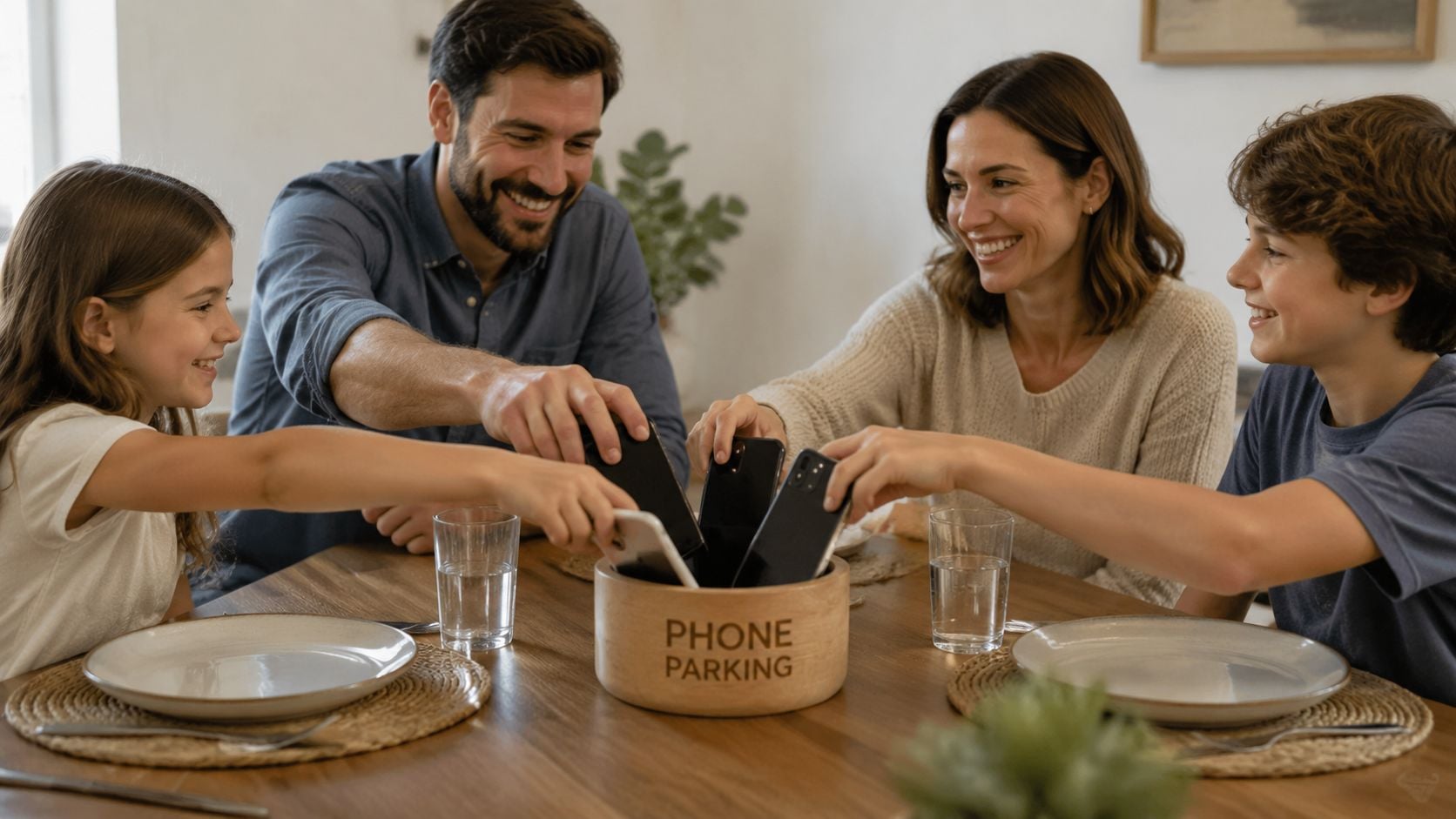
At dinner, a child reaches for a tablet while a caregiver checks messages under the table. In class, several phones interrupt a group discussion. These moments show why device boundaries work best when everyone understands when, where, and why screens are permitted. The purpose is shared attention, not treating technology as bad.
A teacher might say:
“Phones go in the parking area during our discussion. You can collect yours when the activity ends so everyone has a fair chance to listen and contribute.”
At home, an adult can say, “We keep dinner tech-free so we can talk and notice one another. That rule applies to grownups too.” A school may also set screen-free classroom days for hands-on collaboration, reading, movement, and conversation.
Teach the reason and model the limit
Invite children to choose one device-free time or zone. Explain that the agreement can support sleep, learning, face-to-face connection, and mental health. Adults must follow it as well. Clear, kind communication about limits is a skill adults can strengthen through assertiveness training for expats, then model in everyday family and school conversations.
Use practical supports:
Start small: Choose dinner, homework, or morning arrival instead of changing every device habit at once.
Use reminders: A timer, visual schedule, or classroom signal makes transitions less dependent on willpower.
Name the next step: Say, “You have five minutes left, then the tablet returns to the charging station.”
Notice repeated arguments during transitions, hidden devices, anxiety when access ends, or difficulty joining meals and lessons without checking a screen. These cues show that the agreement may need clearer wording, more practice, or stronger adult modeling.
2. Setting Limits on Emotional Labor and Parentification
Children need emotional support, but they shouldn't become a parent's confidant, conflict mediator, or emotional regulator. A child can know that a caregiver is worried without being asked to solve adult problems. The same principle applies at school. Teachers can be warm and authentic without processing divorce, financial distress, or other private struggles with students.
A parent who has had a difficult workday might say:
“That's an adult problem I'm working on with a grown-up helper. You didn't cause it, and you don't need to fix it. I'm glad you told me about your day.”
If money is tight, a teenager may hear, “We're being careful with spending this month,” rather than receiving frightening details about adult finances. A teacher can say, “I'm having a hard day, so I'm going to take a quiet breath before we begin,” without making the class responsible for the teacher's emotional recovery.
Support without transferring responsibility
Adults need their own support network, whether that means a friend, therapist, family member, support group, or another trusted adult. Trauma-informed parenting guidance can help caregivers think about safety, regulation, and the difference between sharing appropriately and oversharing.
Teach children that caring and carrying are different. They can listen, offer kindness, or get a trusted adult, but they don't need to manage a sibling's behavior or settle a parent's argument.
Look for signs such as a child monitoring an adult's mood, apologizing for ordinary needs, trying to mediate conflict, keeping secrets to protect a caregiver, or seeming unusually responsible for everyone's feelings. Teachers may notice a student repeatedly asking whether an adult is okay instead of focusing on age-appropriate work.
Respond with reassurance and a clear return of responsibility: “You noticed I was upset, and that was caring. The adults will handle this. Your job is to get ready for school.”
3. Respecting Privacy and Appropriate Physical Boundaries
Children's bodies, personal space, and private moments deserve respect. Asking before touching teaches autonomy in ordinary situations, including hugs, hair adjustments, clothing corrections, physical demonstrations, and comfort. Respect doesn't remove adult responsibility for safety. It gives children language to identify comfort and discomfort while adults remain attentive.
A teacher supporting a distressed student might offer choices:
“Would you like a high-five, a thumbs-up, or some space?”
“Is it okay if I sit beside you?”
“You can tell me to stop if you don't want a touch.”
A parent can knock on a teenager's closed bedroom door and wait before entering. A coach can ask, “Is it okay if I help adjust your posture?” before physical guidance. When visiting relatives, a caregiver might say, “You can wave, shake hands, or just say hello. You don't have to hug.”
Practice short, usable language
Younger children can rehearse “Please stop,” “I need some space,” and “I'm not comfortable with that.” Adults can use role-play based on ordinary situations, such as a sibling grabbing a toy or a classmate attempting an unwanted hug. The Child Mind Institute's boundary activity gives adults a practical prompt for asking children how they could respond when someone hugs without permission.
Children also need to learn that other people's limits matter. Model asking, accepting “no,” and choosing another greeting. Don't say, “But they love you,” to override a child's physical boundary. Love doesn't create automatic permission.
A physical-boundary lesson should include anatomically correct names for body parts, the concept that private parts aren't for other people to touch, and a clear instruction to tell a trusted adult if something feels unsafe. Pay attention when a child freezes, pulls away, avoids a person or setting, becomes distressed during greetings, or repeatedly says “no” while adults continue. Those are cues to pause and listen.
Before showing a visual reminder, let children know that asking first is part of respectful care.

A third-grade class is spread across the blacktop, searching for shapes that match a geometry card. Nearby, a kindergarten group sits beneath an oak tree, passing around a pinecone and describing its texture. At the garden beds, fifth graders measure soil, compare plant growth, and argue cheerfully about which row needs more water. These moments look ordinary, but they carry more educational weight than a simple break from class.
Outdoor learning means any structured academic, social, or reflective experience outside the classroom walls. It can happen in a schoolyard, courtyard, neighborhood, garden, nature area, or local park. The setting changes, but the purpose remains clear: students use movement, observation, conversation, and real materials to understand ideas and practice skills.
K–8 students are especially ready for this approach. They're curious, sensory-driven, and still learning through their bodies as much as through explanations. A lesson outside can give a child who struggles with a worksheet another way to count, describe, collaborate, or demonstrate understanding.
The strongest outdoor learning benefits aren't limited to one subject. Research connects well-designed outdoor experiences with engagement, ownership of learning, social development, self-concept, wellbeing, and physical activity. Academic improvement appears in some settings, but the most consistent gains often involve attention, regulation, cooperation, and meaningful participation.
The practical question for educators isn't whether every lesson should move outdoors. It's how to design outdoor experiences that are accessible, purposeful, repeatable, and connected to curriculum and social-emotional learning. The examples below pair research evidence with activities a teacher or caregiver can run with minimal preparation.
Why Outdoor Learning Matters for K–8 Students
The blacktop math hunt works because students aren't only hearing about shapes. They're finding rectangles in fences, counting angles in playground equipment, and explaining their reasoning to a partner. The kindergarten circle works because the oak tree gives children a shared object of attention, while the fifth-grade garden task turns measurement into a decision with visible consequences.
These activities also change the social rhythm of the school day. Students move between stations, negotiate materials, ask questions that arise naturally, and see classmates contribute in different ways. A child who rarely speaks during whole-group instruction may become the careful observer who notices a bird nest, identifies a pattern, or helps a partner balance a structure.
Outdoor learning is more than recess
Recess gives students valuable unstructured time, but outdoor learning adds an intentional objective. A teacher might ask students to record evidence of erosion, write sensory descriptions, compare perimeter measurements, or practice a conflict-resolution routine during a team challenge. The lesson can be playful, but it still has a learning target and a way to notice progress.
That distinction matters for families, too. A neighborhood walk can become an informal science lesson when a child tracks cloud changes, a language lesson when they create a story from observed details, or a self-management exercise when they pause to identify sounds and body sensations.
A 2022 systematic review of learning in natural outdoor settings found consistent benefits across several domains, including increased engagement and ownership of learning, stronger social and collaborative skills, and improved self-concept, with some evidence of academic improvement in the review of outdoor learning research. The review treats outdoor learning as an educational strategy, not just recreation.
A multidimensional case for K–8 schools
Outdoor experiences can support reading, science, math, physical development, and SEL at the same time. Students may read a field guide, estimate the height of a tree, cooperate on a shelter design, and reflect on frustration during one carefully planned activity.
That range makes outdoor learning especially useful when schools want to strengthen the whole child without creating a separate program for every need. It also raises an important equity question: who has safe, welcoming access to nature outside school, and who depends on school to provide it?
The most effective plans treat outdoor learning as part of the school's instructional design. They make room for access needs, define clear supervision routines, and give teachers practical activities that can be repeated rather than relying on occasional field trips.
What the Research Says About Outdoor Learning Benefits
The research is encouraging, but it's more precise than the phrase “nature helps children learn.” Evidence points to several outcome areas, and the strength of the result depends on the program's design, duration, learner age, and intended outcome.
Academic outcomes need context
A historical review of environmental education in California reported that secondary students from 11 Californian schools who participated in outdoor environmental learning scored higher in 72% of academic assessments, including reading, science, math, attendance rates, and grade-point averages, than students from traditional schools in the reviewed outdoor-learning evidence. That finding is important, but it shouldn't be treated as a promise that every outdoor lesson will produce broad academic gains.
Outdoor instruction can make academic content more concrete. Students can measure actual garden beds, use descriptive language for changing weather, or read informational text before checking evidence outside. Research summarized in school-learning reviews also reports that one outdoor-learning intervention left children more focused and on-task during later indoor lessons, with almost half the number of teacher redirects in this evidence review of outdoor learning.
Social, emotional, physical, and cognitive outcomes
The wider evidence base includes social cooperation, confidence, wellbeing, environmental awareness, physical skills, cognitive skills, and risk-management skills. A review of Forest School research identified gains across seven major outcome areas, showing why schools shouldn't judge outdoor learning only by test performance through the systematic review of Forest School research.
A separate review found that children's time outdoors is consistently linked to higher physical activity and better cardiorespiratory fitness, while more time outside is associated with lower sedentary behavior in the review of children's outdoor time. Recent evidence also emphasizes stress reduction, attention, self-regulation, sleep, physical activity, and cognition as especially credible areas of benefit in the review of nature exposure and outdoor activity.
Domain
Reported outcome
Typical magnitude
Academic
Higher performance across 72% of assessments in the cited California review
Broad but context-dependent
Engagement
Greater engagement and ownership of learning
Consistent qualitative and measurable benefits
Social-emotional
Stronger cooperation, confidence, self-concept, and wellbeing
Multidimensional gains
Attention
Fewer teacher redirects after one outdoor-learning intervention
Almost half the number of redirects
Physical
More physical activity and less sedentary behavior with more outdoor time
Consistent association
Forest School
Gains across seven outcome areas
Benefits vary by design and learner
For educators exploring the field, resources on starting environmental education programs can help translate broad principles into school-based planning. Teachers should still read results carefully. Self-selected participants, short intervention windows, inconsistent definitions of outdoor learning, and differences in age or baseline need can limit how confidently one program's result transfers to another school. A 2022 systematic review and a later mixed-methods synthesis both point toward structured, repeated, nature-specific experiences rather than one-off outdoor lessons as the more credible path to sustained benefits in the systematic review of outdoor learning. For additional SEL research framing, educators can consult Soul Shoppe's research resources.
Social-Emotional Growth in Outdoor Settings
Outdoor settings give children real social problems to solve. They must decide who carries the bucket, how a group crosses a muddy patch, whether a structure is stable, or what to do when two students want the same materials. Those moments create practice opportunities that a teacher can observe and coach in real time.
Three features make this setting especially useful for SEL: sensory richness, physical movement, and informal peer interaction.
Novelty can reset attention
A change in surroundings gives students new details to notice. The sound of traffic, the texture of bark, the movement of clouds, or the pattern of shadows can help children shift attention away from a difficult indoor routine. In CASEL-aligned terms, this supports self-awareness and self-management, because students can notice their internal state and choose a response.
A teacher might see a student pause before grabbing a material, name that they're frustrated, and ask for a turn without prompting. That self-correction is more useful than a quiet line held together only by adult reminders.
Movement supports regulation
Walking, carrying, balancing, digging, and stretching give students appropriate ways to use physical energy. Movement doesn't solve every behavior challenge, but it can help children return to a calmer state before discussion or written work.
Use a simple regulation cue: “Notice your feet, slow your breathing, and choose your next safe step.” This connects body awareness to self-management without turning the activity into a lecture.
Peer interaction builds belonging
Outdoor tasks often create informal groupings based on interest or role. One student may observe, another may build, and another may record. These flexible roles can interrupt fixed classroom hierarchies and give quieter students a meaningful way to contribute.
The teacher's job is to name the skill, not dominate the interaction. Ask, “How did your group decide?” or “What helped both people get heard?” Those questions connect the experience to relationship skills, social awareness, and responsible decision-making. Activities focused on empathy and listening can also draw from these empathy-building activities.
Conflict resolution becomes concrete outdoors. When students disagree over space or materials, guide them to describe the problem, hear each perspective, generate options, and test a fair solution. Over time, teachers may notice more equitable turn-taking and faster de-escalation because students have rehearsed those moves repeatedly.
Practical rule: Don't remove every manageable disagreement. Coach students through safe, respectful problem-solving so the outdoor setting becomes a rehearsal space for community life.
Equity and Access Considerations
Outdoor learning can widen opportunity, but only when schools design for students who face the greatest barriers. A child with a large yard, reliable transportation, and outdoor clothing may already receive nature exposure outside school. Another child may depend on the schoolyard for every safe chance to explore plants, weather, movement, and open space.
Urban schools may have limited green areas, but they can still use courtyards, sidewalks, rooftops where permitted, shaded blacktops, community gardens, and neighborhood walks. The educational value comes from purposeful observation and participation, not from having a forest on campus.
Accessibility must be planned before the activity is announced. Students with mobility disabilities may need firm, navigable pathways, reachable materials, and roles that don't depend on uneven terrain. Students with sensory sensitivities may need quiet zones, advance notice about textures or sounds, flexible clothing, and the option to observe before joining.
Weather and health needs also shape participation. Schools should provide shade, water, weather gear, sunscreen routines aligned with family and school policies, and allergy-aware plant choices. Families without transportation shouldn't be excluded from meaningful off-campus experiences, so bus-supported trips and partnerships with local parks can matter.
Barrier
Who it affects
School planning response
Limited green space
Students in dense urban areas
Use courtyards, gardens, sidewalks, and schoolyard investigations
Uneven terrain
Students with mobility disabilities
Provide accessible pathways, reachable materials, and alternative roles
Weather exposure
Students sensitive to heat, cold, rain, or sun
Plan shade, water, gear, indoor alternatives, and clear weather rules
Allergens
Students with allergies or respiratory needs
Select plants carefully, review health plans, and offer low-trigger locations
Missing clothing or equipment
Families with limited resources
Maintain shared weather gear, spare clothing, and washable materials
Transportation limits
Students unable to reach parks independently
Use school buses, nearby sites, and community partnerships
The 72% academic-assessment finding from the California review should not lead schools to assume all students receive the same benefit. Access, program quality, baseline need, and duration influence outcomes. Equity is a design question: who can enter the activity, who can participate fully, and whose knowledge gets recognized?
Sample Outdoor Activities Tied to SEL Objectives
The best activities are short enough to repeat and open-ended enough to reveal student thinking. A clipboard, chalk, natural materials, and a clear prompt can support meaningful work in a schoolyard or courtyard.
Sound Mapping
Grade band: K–8 Materials: Paper, pencils, clipboards SEL objective: Self-awareness How to run it: Students sit or stand safely in one place and mark sounds with symbols or words. Younger children can draw; older students can distinguish near and far sounds or describe how each sound affects their body.
Facilitation prompt: “What did you notice first, and what changed when you paid closer attention?” Debrief: “Which sound helped you feel settled, and which one made it harder to focus?”
This activity works well before reading or independent writing because it gives students a quiet transition into attention.
Nature Trust Walk
Grade band: K–5, adapted for older students Materials: Cones or a clearly marked path SEL objective: Relationship skills How to run it: Pair students. One partner gives verbal directions along a simple, accessible route while the other walks with eyes open and focuses on listening. Switch roles, then discuss how the directions felt.
Facilitation prompt: “What made the instructions clear and respectful?” Debrief: “How did your partner show that they were listening?”
Keep the route familiar and never require blindfolds. The goal is communication, not discomfort.
Weather Problem-Solving Stations
Grade band: K–8 Materials: Weather cards, chart paper, simple observation tools SEL objective: Responsible decision-making How to run it: Groups rotate through prompts such as choosing clothing for conditions, protecting a paper structure from wind, or deciding whether a planned activity needs modification.
Facilitation prompt: “What evidence supports your choice?” Debrief: “What would you change after seeing the result?”
This links science reasoning with practical judgment. Families can use the same routine before a walk or outdoor play.
Group Habitat Build
Grade band: K–8 Materials: Sticks, leaves, cardboard, string, or reusable blocks SEL objective: Teamwork and social awareness How to run it: Groups design a shelter or habitat for a fictional small animal. Assign rotating roles, but let students negotiate details.
Facilitation prompt: “Whose idea haven't we tested yet?” Debrief: “How did your group respond when the first plan didn't work?”
For more sensory-based variations, teachers and caregivers can adapt ideas from this five-senses activity resource. Families seeking structured movement opportunities beyond school can also explore a summer camp for active kids as one possible community option.
Reflection Circle
Grade band: K–8 Materials: A designated sitting spot and optional reflection cards SEL objective: Self-management How to run it: Students sit in a circle and complete one sentence: “I noticed,” “I contributed,” “I found difficult,” or “Next time I will.” Passing is allowed.
Facilitation prompt: “What choice helped you stay engaged?” Debrief: “What will you carry into the next classroom activity?”
The circle turns an outdoor experience into transferable learning rather than leaving the SEL lesson implicit.
Implementation Tips for Schools and Classrooms
Sustainable outdoor learning depends less on elaborate spaces than on dependable routines. Teachers are more likely to use the schoolyard when they know when they're going, what students will do, how safety will work, and where materials are stored.
Build a repeatable schedule
Start with short outdoor blocks connected to existing lessons. A class might take vocabulary outside for observation writing, move a math rotation to the blacktop, or use a garden bed during a science unit. The visual implementation guide suggests integrating 20–30 minute outdoor blocks across morning, midday, and afternoon routines [in the implementation infographic below].
Create a shared calendar so classes don't compete for the same area. Store clipboards, chalk, magnifiers, measuring tools, and weather gear in labeled bins near the exit. Chalk circles, tree-shaded benches, and movable tubs can turn an ordinary yard into a set of learning zones without major construction.
Agree on safety before the first lesson
Staff should define simple rules for rain, temperature, air quality, lightning, supervision, allergies, water, sunscreen, and clothing. Permission slips should explain the regular routine, while individual health plans guide specific accommodations.
Paraprofessionals can serve as outdoor co-teachers when they receive activity guides, communication prompts, and safety protocols. A short staff meeting can establish:
Purpose: Identify the curriculum and SEL objective.
Place: Select an accessible area and a backup location.
People: Assign supervision zones and support roles.
Materials: Prepare one labeled bin per activity.
Health: Confirm water, medication, allergy, and weather procedures.
Evidence: Decide what teachers will observe or collect.
Extend lessons instead of doubling preparation
Take the same anchor text outdoors and ask students to find evidence in the environment. Use the same math vocabulary while measuring real objects. Bring indoor writing prompts outside, then return for drafting and revision.
Parent volunteers can support observation stations, material management, or garden care when school policies allow. Local parks, libraries, and environmental organizations may offer locations or expertise. These partnerships expand capacity, but schools should keep the learning target and access expectations under school control.
Outdoor learning becomes sustainable when it feels like a familiar teaching move, not a special event that requires a new plan from scratch.
Measuring Impact and Bringing It All Together
Administrators don't need a complicated research project to determine whether outdoor learning is helping. They need a small set of shared measures, a baseline, and a regular review cycle that combines numbers with what teachers and students report.
Choose measures across academic participation, SEL, and physical experience. Track enough to notice patterns, but not so much that teachers spend the lesson recording data instead of teaching.
Metric
Domain
Data source
Cadence
Outdoor lesson attendance
Access and participation
Attendance records
Reviewed regularly
Time-on-task observations
Engagement
Walkthrough form
During selected lessons
Formative assessment changes
Academic learning
Existing grade-level checks
At baseline and review points
Self-regulation rubric
SEL
Teacher observation
Repeated classroom cycle
Peer-conflict referrals
SEL and belonging
Referral or behavior records
Reviewed regularly
Outdoor minutes
Physical access
Class or school log
Weekly
Student reflection themes
Wellbeing and voice
Journals or exit slips
After selected activities
A useful process begins with a baseline using tools the school already has. Record current outdoor participation, observe attention during a familiar lesson, review existing formative data, and ask teachers to tally how often students attempt a conflict-resolution strategy outdoors.
After a 90-day implementation period, repeat the same measures using a practical outcome-measurement approach. The purpose isn't to claim that outdoor learning caused every change. It's to compare patterns, identify which activities students access, and determine whether particular learners need different supports.
A one-page dashboard can include a few numbers, two student reflection themes, a teacher observation, and an access note. For example, leaders might see that students participate regularly but need more shade, or that group builds create strong collaboration while weather stations produce richer academic discussion.
Return to the blacktop math hunt. Its value isn't that every child will suddenly master geometry. Its value is that students can move, notice, explain, cooperate, and receive feedback in a setting that makes learning visible. With honest measurement and thoughtful design, outdoor learning becomes a practical equity lever that strengthens academic participation, regulation, belonging, and the daily K–8 experience.
Soul Shoppe helps schools build the connection, safety, empathy, and conflict-resolution skills that make outdoor learning more inclusive and productive. Visit Soul Shoppe to explore interactive SEL programs, workshops, coaching, and practical tools for students, educators, and families.
Monday morning tells the truth fast. A child who drifts past the front office with shoulders tight, a teacher who greets one class warmly and another with visible fatigue, a principal who spends the first five minutes calming one hallway while another moves with easy rhythm, all of it reveals school culture and climate before a single spreadsheet opens.
That's why this topic matters to tired teachers and worried parents alike. You can feel it in the handoff at the door, the way adults correct behavior, whether students sit alone or join a group, and whether the building sounds safe or strained. By the end of the day, those small moments add up into patterns that shape learning, attendance, and trust.
A Monday Morning That Shows You Everything
At 8:05 a.m. in a K-8 hallway, the scene is already speaking. One aide stands at the door and greets students by name. A seventh grader slows down, looks up, and walks over to a cluster of classmates. Another student keeps his backpack zipped tight and heads straight to an empty table, scanning the room before he sits.
You don't need a consultant's report to read that hallway. You can see adult welcome, peer connection, and student caution all at once. The school may have the same schedule, the same curriculum, and the same building as last year, but the lived experience can still feel completely different from one wing to another.
What the hallway is really showing
The first clue is the adult tone. If the handoff from parent to staff feels rushed, suspicious, or inconsistent, students notice. If a teacher's voice changes between classes, or if one grade level gets patient correction while another gets sharp reminders, students learn very quickly which spaces feel steady and which ones don't.
The second clue is student choice. A child who heads to a friend group, a trusted adult, or a calm corner is reading the room. That decision tells you something about belonging, not just behavior.
Practical rule: if a hallway looks orderly but students are avoiding eye contact, that's not the same thing as a healthy climate.
The rest of this guide keeps that Monday-morning lens. It separates the words people often blend together, shows the four climate spheres schools can observe, and walks through what administrators, teachers, and families can do with the data they already have. It also gives a short starter plan, so this doesn't stay a theory exercise until spring.
What School Culture and Climate Actually Mean
The cleanest way to separate the two is simple. Culture is the school's shared beliefs, values, norms, and traditions. Climate is the day-to-day tone people experience. One is the school's deep operating system, the other is what students, staff, and families feel when they walk the halls, sit in class, or call the office.
That distinction matters because culture shapes climate through values, unspoken norms, and expectations. If a school says it values respect but adults interrupt students constantly, the climate reveals the true story. If a school says it values high standards, but only some classrooms hold those standards consistently, students learn that the norm depends on who is in the room.
A classroom example that makes the difference stick
Think about one classroom where the culture says, “We greet each other, we resolve conflict respectfully, and we keep standards high.” That culture shows up in routines, language, and expectations. The climate shows up in whether students feel safe enough to ask for help, whether they speak up without fear of ridicule, and whether the teacher's corrections sound fair or personal.
If you want a quick self-check during an observation, ask three questions. Do the adults sound like they share the same norms? Do students act like they trust the room? Do the routines feel consistent enough that a newcomer could predict what happens next?
A lot of improvement work stalls because people use the two terms interchangeably. That creates vague goals like “make the culture better,” which sound right but don't guide action. A clearer move is to define the culture you want, then inspect the climate you're creating.
For a practical side note on protecting adult capacity while changing habits, tips for finding balance in Florida offers a useful lens on burnout and balance. That lens matters in schools too, because stressed adults rarely build steady climates.
And if you want a classroom-level companion piece, the internal guide on what is classroom climate fits neatly beside this distinction.
The Four Spheres Every School Climate Has
School climate becomes easier to work with once you stop treating it like one soft feeling. The OECD framework breaks it into four spheres, and each one shows up in behaviors families and staff can see: safety, teaching and learning, school community, and institutional environment. That's useful because a school can be strong in one sphere and weak in another.
What to look for in each sphere
Safety covers bullying, disciplinary problems, substance abuse, and truancy. In real life, that means watching whether hallways feel supervised without feeling oppressive, whether students report problems without fear, and whether office referrals cluster in certain places or times.
Teaching and learning includes academic support, feedback, socio-emotional skills, and leadership. Parents often sense this sphere during conferences. Are adults explaining how their child learns, or just listing grades? Are students getting helpful feedback, or only corrections?
School community is where relationships live. It includes student-teacher relationships, teamwork, respect for diversity, parental involvement, and community partnerships. A strong community sphere sounds like adults knowing students by name and families being treated like partners instead of visitors.
Institutional environment is the physical and organizational side. Buildings, facilities, technology, class size, school size, and ability grouping all shape how school feels. A cracked hallway, outdated devices, or a room packed too tightly can send a message long before any lesson starts.
“How do teachers adjust support when a child struggles?”
School community
Relationships, teamwork, respect for diversity
“How do students and families help shape the school?”
Institutional environment
Facilities, technology, class size, grouping patterns
“What resources make daily learning easier or harder?”
If you're in a family-school meeting, use those four spheres as separate questions. Don't settle for one vague impression. Ask about behavior, instruction, belonging, and resources one by one, because that's where the answers live.
The same lens helps if you're reviewing a more general school improvement resource, such as the broader climate guidance in the earlier section. One sphere can't stand in for the others.
How to Measure What You Cannot See
The best climate systems don't rely on a single score. ERIC guidance recommends a multimethod, multistakeholder approach, which means combining surveys with observations, interviews, and focus groups, then breaking results out by subpopulation and stakeholder type. That's the only way to catch the small pockets where students are struggling while the schoolwide average still looks fine.
A single composite score can hide trouble in a grade level, an identity group, or one wing of the building. When results are sliced by race, gender, grade, ability, and sexual orientation, patterns become much more actionable. The same idea holds for stakeholder groups. Students, staff, and families often describe the same school in very different language.
What to put on a dashboard
The most useful climate dashboards connect perception data to administrative indicators. That includes chronic absenteeism, suspensions and expulsions, behavior referrals, teacher absenteeism, and turnover. Those measures help leaders see whether the adult environment is stable enough to support student belonging and safety.
Core Climate Indicator to Track Each Year
Data Source
Question It Answers
Student safety and belonging
Surveys, interviews, focus groups
Do students feel safe and included?
Chronic absenteeism
Attendance records
Are students missing school in patterns that signal disengagement?
Suspensions and expulsions
Discipline records
Are exclusionary responses concentrated in certain groups?
Behavior referrals
Office logs
Where are the recurring pressure points in the day?
Teacher absenteeism and turnover
HR records
Is the adult environment steady enough to support students?
AASA-style dashboard review also helps when it's done regularly, not just at the end of the year. Annual measurement is the minimum benchmark, and early-versus-late-year comparisons can show whether interventions are shifting perceptions over time.
A good rule: if you can't separate the data by group, you're probably missing the story the data is trying to tell.
For a deeper look at linking results to outcomes, the internal piece on outcome measurement pairs well with this mindset. The point is not to collect more numbers. The point is to use the right numbers, in the right slices, at the right time.
Why More Programs Often Make Things Worse
Schools under pressure often reach for one more program. Another SEL curriculum. Another belonging campaign. Another binder full of lessons. That impulse makes sense, but it can backfire if the adults already feel overloaded.
Climate is shaped by day-to-day relationships, discipline, and support systems. If staffing is unstable, the community and safety spheres don't improve just because a new program arrives. The school still needs adults who can greet students, follow through on expectations, and communicate with families in a steady way.
The staffing question schools avoid
A school can buy a good idea and still miss the mechanism. If teachers don't have time to reinforce routines, if counselors are stretched thin, or if office responses vary from person to person, students experience the inconsistency. That's why climate improvement has to be a schoolwide plan, not just a classroom add-on.
Before adding anything new, leaders should audit time, staffing, and community partnerships. Ask who is already carrying the relational work, who has capacity to coach it, and what daily tasks are crowding it out. Only then does it make sense to decide whether a new curriculum helps or just adds noise.
That's also where an option like how to build psychological safety belongs in the conversation. Tools matter, but only when the adult system has room to use them well.
If you want a plain-language example, think about a school that adds a new conflict-resolution lesson but doesn't change the way lunch duty is staffed. Students may hear the lesson in class, then watch adults respond inconsistently in the cafeteria. The message gets split in two.
What Climate Looks Like for Students on the Margins
The difference between a welcoming school and an equitable school shows up fastest for students who have been pushed aside before. In a cooperative climate, adults use shared norms, peer repair, and regular check-ins to help students build trust. For underprivileged-background students, that kind of setting can support multiple social-emotional domains.
In a competitive climate, the story changes. When the school rewards individual performance over collaboration, some students stop speaking up. Others learn to keep their heads down, avoid risk, and protect themselves socially. The room may still look “positive” to an outsider, but the students who need belonging most may feel the least secure.
Why the same school can feel different to different students
Affirming cultural identities is not a decorative extra. Respect for diversity, community partnerships, and culturally responsive adult behavior all shape whether students feel like full members of the school. If those pieces are missing, the school can feel warm in general while still excluding specific groups in practice.
That matters for families too. A parent can hear that the school is “inclusive” and still notice that their child gets corrected more often than peers, or never sees their culture reflected in classroom materials. Those details are not minor. They are the climate.
If you're supporting families who are navigating unstable housing, the resource on homeless students in Maricopa County schools can sharpen the lens. Housing instability often changes how safety, belonging, and participation show up at school, so climate work has to be responsive, not generic.
Parent check: if your child says the school is “fine” but never mentions a trusted adult, a friend group, or a place where they feel seen, keep asking gentle questions.
The practical move is to look for whether the school's climate design helps the students most likely to be overlooked. If it does, the school will usually feel calmer for everyone. If it doesn't, the problems hide under polite language.
A Role-Based Playbook for Real Change
The fastest way to move from insight to action is to assign the work by role. When everyone owns everything, nothing gets done. When each group has a short list, climate work becomes visible and manageable.
Three moves for each group
Administrators can run a 30-day climate audit across the four spheres, build a subgroup dashboard, and review it briefly each morning. A five-minute look at attendance, behavior, and staff signals turns climate into a live management metric instead of a once-a-semester report.
Teachers can use greeting routines, shared language for self-regulation, and clear conflict-repair steps. The goal is not perfection. The goal is consistency that students can predict.
Parents and caregivers can align home language with school expectations, join climate conversations, and ask direct questions about bullying prevention. A weekly check-in at home helps a child notice patterns before they become blowups.
Soul Shoppe has delivered research-based, experiential programs for more than 20 years that teach students practical tools and shared language for self-regulation, mindfulness, communication, and conflict resolution, with offerings available digitally and on-site for individual students and entire campuses. That kind of support fits when a school wants common language across classrooms, hallways, and home.
For leaders thinking about the emotional side of implementation, the internal guide on welcoming new students is a helpful companion because transitions reveal climate fast.
If you're coordinating SEL or partnering with community agencies, the question is not which program sounds nicest. The question is which tool supports the sphere that's fraying.
Your First Thirty Days
A month is enough time to start, if the work stays focused. Week one is for listening. Use a short survey, then do three interviews per grade and review attendance and discipline patterns as a baseline. Week two is for mapping, using the four spheres to spot where climate is steady and where it's fraying, especially by subgroup.
Week three is for one small pilot. Choose one sphere and one role-aligned routine, then run it consistently. A teacher might pilot a morning greeting routine. A principal might start a daily dashboard review. A counselor might test a shared conflict-repair script.
Week four is for review. Compare early-year and late-year data, talk about what changed, and decide whether to expand, adjust, or pivot. If the data and the hallway stories don't match, trust the mismatch enough to ask more questions.
Keep the pace realistic
Use the plan that fits the adults you have, not the one you wish you had. A school with unstable staffing may need a simpler pilot and clearer routines. A school with strong teams may be ready for a broader subgroup dashboard and family partnership plan.
If you want a practical model for how a community can assess itself, the resource on boost member success offers a useful framing for looking at participation and support. The same logic applies here, because climate improves when people can see where they belong and what they're expected to do.
The simplest challenge is also the hardest one. Start one honest conversation this week with a student, a teacher, or a parent, then listen for what the room is telling you back. School culture and climate change one interaction at a time.
If your school wants a practical way to strengthen belonging, safety, and everyday connection, Soul Shoppe offers research-based SEL programs that fit classrooms, campuses, and family partnerships. Visit Soul Shoppe to explore tools and experiences that can help your community build a steadier climate, one routine and one relationship at a time.
You know the moment. The bell has rung, the inbox is full, a parent is asking for support, and a teacher is trying to keep five moving parts steady before lunch. In that kind of week, school community partnerships can feel like either a lifeline or one more thing to manage.
The difference usually comes down to structure. When schools treat partnerships as a coordinated system, not a one-off event, families, staff, and community partners can share the load in ways that help students feel safer, more connected, and more ready to learn.
What School Community Partnerships Actually Look Like
A fifth grade teacher at a K-8 school can usually tell when the building is running on goodwill alone. The reading interventionist is juggling attendance calls, the counselor is helping students regulate after recess conflicts, and family engagement depends on whoever happens to have extra time that week. In that setting, a real partnership changes the rhythm of the school day.
A true school community partnership is not a volunteer sign-up sheet or a fundraiser that happens once a year. It is a coordinated relationship among the school, families, nonprofits, local businesses, and community members that supports both academic and nonacademic student needs, which matches the Institute of Education Sciences definition of K-12 community partnerships as collaborative relationships aimed at improving student outcomes and addressing those broader needs (IES definition and guidance).
What makes it feel different in real life
In practice, the school and its partners share language, routines, and responsibilities. A counselor might coordinate a referral process with a local mental health provider, a parent liaison might help caregivers understand when and how to access services, and a community partner might support a lunch bunch, family workshop, or attendance follow-up.
Practical rule: if the relationship only shows up when someone needs a favor, it's an activity. If it has shared goals, repeated touchpoints, and a plan for follow-through, it's a partnership.
That distinction matters for school culture too. Soul Shoppe's approach to school culture and belonging fits naturally here because its SEL work gives adults and students a shared way to talk about safety, empathy, and conflict. If you want a simple companion piece on that side of the work, this overview on how to improve school culture is a useful reference point.
What a parent and principal should be able to say
If a parent asks what the school is trying to build, the answer should be simple: “We're creating a support network around students, so learning, behavior, and family connection aren't handled in separate silos.” That's the heart of it.
A partnership is working when the school can point to clear roles, shared routines, and support that reaches students before problems become crises. If the only evidence is a pile of flyers, a few guest visits, or a seasonal event, the school probably has outreach, not a partnership.
Why Partnerships Improve SEL, Attendance, and Belonging
A principal sees it first in the hallway. A family calls about transportation, a teacher is trying to de-escalate a conflict, and a counselor is already juggling several student needs. school community partnerships help schools respond without making every support request start from zero. When a school can connect families to counseling, food support, mentoring, after-school help, or caregiver guidance through a shared system, students face fewer barriers to learning. That matters most in schools where staff are stretched thin and one counselor is carrying too many needs at once.
A historical marker shows how large this work became. The U.S. Partnerships 2000 survey found that 69% of districts nationwide were engaged in partnership activities, up from 51% in 1990, and estimated that more than 35 million students benefited, alongside about 3.4 million volunteers contributing roughly 109 million hours of work, an amount described as equivalent to about 52,000 full-time staff and valued at approximately $2.4 billion in combined resources (ERIC report). Those numbers matter because they show partnerships were never just an extra event calendar. They became part of the support system schools depended on.
Why the SEL piece is not separate
SEL is the thread that keeps the partnership from feeling like paperwork. A student may learn self-regulation in a classroom circle, then need the same language from adults when a conflict spills into the hallway or home. Experiential, community-based SEL programming gives students and adults a shared way to practice empathy, repair, and calm-down strategies together, so the support feels consistent instead of disconnected.
A 2024 study on sustainable partnerships found that 90% of respondents identified a common purpose as an important strategy for establishing partnerships, and it also highlighted trust, accountability, monitoring, and shared responsibility (2024 sustainable partnership study). That matches what happens in schools. If caregivers, teachers, and community providers are all reinforcing different norms, students get mixed messages. If they share the same purpose, the same words, and the same response to problems, students get steadier support. The operational side matters too, because shared purpose works better when the school has clear roles, a basic memorandum of understanding, and a simple plan for who can share what information, with whom, and for what reason.
Belonging is part of the same picture. For a plain-language overview, see what sense of belonging looks like in school communities. When students feel known, supported, and included, they are more likely to stay connected to school routines instead of drifting away after one hard moment.
Who benefits most
Partnerships matter for every student, and the equity angle is especially important for underserved communities. A 2025 U.S. public-health study found that established school partnerships can be mobilized to reach underserved populations more efficiently than building entirely new systems (2025 public-health study). That matters when families are dealing with language barriers, transportation issues, mental health access gaps, or uneven access to information.
A partnership reduces friction. It does not replace family effort or staff effort, it makes both easier to carry.
The strongest partnerships do more than engage families for a night or two. They remove obstacles, coordinate services, and make belonging visible in daily routines. That is why attendance, SEL growth, and school climate often move together when the school and community stop working in parallel and start working as one support system.
Partnership Models That Fit K–8 Schools
Not every school needs the same kind of partnership first. A building with serious attendance challenges may need service-aligned support before it needs a big enrichment calendar. A school with decent external programming but weak family connection may need caregiver workshops and home-school bridges. The right model depends on what's missing.
Model
Typical Partners
Primary Outcomes
Best Fit For
Service-aligned partnerships
Counselors, mental health providers, food banks, family support agencies
Access to help, removal of barriers, student stability
Schools with basic needs, attendance, or support gaps
Program-embedded partnerships
SEL providers, coaches, assembly facilitators, classroom trainers
Youth programs, local businesses, neighborhood groups, mentoring organizations
Belonging, exposure, real-world learning
Schools seeking engagement beyond the classroom
Service-aligned partnerships
These partnerships connect the school to actual supports. A food bank can help a family stabilize basics, a counseling provider can extend mental health access, and an after-school tutoring partner can support students who need more time and practice. These are the partnerships that often show their value fastest because they answer a concrete need.
The National Center for School Mental Health recommends mapping services across Tiers 1, 2, and 3, using MOUs to spell out prevention, promotion, and intervention responsibilities, and defining staffing arrays based on need (NCSMH guidance). That kind of clarity keeps support from becoming random or duplicated.
Program-embedded partnerships
SEL providers, coaching, assemblies, and staff training fit this need. Soul Shoppe belongs in this category because its interactive workshops and assemblies help schools build shared language around safety, communication, and conflict resolution. It's one example of a program that can sit inside the school day instead of hovering around the edges.
If peer support is already a goal at your school, peer support programs can give leaders a way to think about student-to-student connection without leaving adults out of the equation.
Family-capacity and community-enrichment partnerships
Family-capacity work often starts with the basics, like caregiver workshops on boundaries, routines, or emotional regulation at home. Community-enrichment work is broader, including mentoring, career exposure, service learning, and school events that give students a wider circle of adults who know their names.
A simple way to choose:
If students need access to services, start with a service-aligned model.
If adults need a shared SEL language, build a program-embedded model.
If family trust feels thin, invest in caregiver-facing support.
If students need more connection to the world outside school, add enrichment partners.
The goal isn't to collect partner logos. It's to build the right mix for the needs your students have.
Readiness Checklist and Stakeholder Roles
Before launching anything new, ask whether the school can hold the work. A partnership collapses quickly when the principal is enthusiastic but nobody knows who schedules meetings, who shares data, or who follows up with families. Readiness is mostly about clarity.
The roles that need to be named early
A site-based leadership team should include school leaders, teachers, families, administrative or support staff, and community partners who meet regularly to plan, implement, and evaluate the partnership, which aligns with Institute of Education Sciences guidance (IES guidance). That team is not decorative. It carries the work.
Here's how the roles usually break down:
Principal or assistant principal: gives the partnership permission to exist, clears barriers, and keeps it tied to school priorities.
Counselor or SEL coordinator: connects the partnership to student needs, staff language, and service coordination.
Teacher representative: checks whether the plan works in real classrooms, not just on paper.
Family liaison or parent leader: keeps communication understandable and culturally responsive.
Community partner lead: brings services, staffing, and limits into the planning so the school knows what is realistic.
Practical rule: if two adults can't answer the question “Who owns this step?” the system is already too vague.
What readiness looks like before launch
A school is in better shape when it has a needs assessment, a communication path, a leadership team, and a legal path for any data sharing that might be required. The Institute of Education Sciences also recommends continuous improvement routines, including collecting data, analyzing trends with descriptive statistics, and reviewing results with stakeholders to decide what to do next (IES continuous improvement guidance).
If the school does not have that foundation yet, the right move may be to start small instead of starting fast. A single pilot partnership with clear meetings and one outcome is more workable than a broad launch no one can sustain.
For teams building the SEL side of readiness, this SEL programs for schools overview can help leaders think about how a partnership and a schoolwide SEL effort fit together.
A quick self-check helps:
Start now if the school has clear leadership, a real partner, and a narrow goal.
Start small if the partnership idea is strong but roles and routines need testing.
Pause and prepare if no one can name the data, the meeting cadence, or the owner of the work.
Readiness protects students and staff alike. It also keeps goodwill from turning into confusion.
Implementation Steps That Prevent Staff Burnout
A partnership should reduce strain, not add hidden tasks to every teacher's plate. The cleanest way to do that is to phase the work, formalize expectations, and keep the school from becoming the default storage bin for everything that goes wrong. When the implementation is sloppy, burnout shows up fast.
Start with one need and one partner
Begin with a needs assessment that points to a specific student problem, not a vague wish list. If attendance is the issue, find a partner who can help with attendance follow-up or family support. If students need self-regulation practice, choose a partner who can work inside the SEL routine already in place.
The National Center for School Mental Health recommends using MOUs to define responsibilities, payment processes, duration, and termination terms, which is what keeps service work from becoming improvised (NCSMH guidance). A school can also use one standard MOU template across different partners, then adjust the details for each program instead of starting from scratch every time.
Build the legal and communication pieces early
For data sharing, districts should create templates for agreements and help schools and partner organizations through the legal process of creating and maintaining them (ERIC report on data-sharing agreements). That matters when partners need attendance data, referral status, or progress updates to do their jobs well.
A school might use one template for a food bank, another for a counseling provider, and a third for an after-school tutoring program. The point is to clarify what can be shared, who can access it, and how updates move over time.
The school should also set a regular checkpoint. One guide recommends agreed-upon status checks so partners can verify whether the relationship is meeting shared objectives and renegotiate if it isn't, such as a monthly review between a school and a youth center checking whether an attendance-support program is reaching students who miss 10 or more days (WiseWays guide).
Use templates so the work can breathe
A good implementation cycle usually looks like this:
Assess one need with the leadership team.
Pilot one partnership with a narrow scope.
Write the MOU and data-sharing agreement before launch.
Review the results regularly with the people doing the work.
A rough morning at school rarely announces itself in a big way. It often starts with a student going silent before a quiz, a child crying over a missing pencil, or a parent hearing “I’m fine” in a voice that clearly means something else. In those moments, adults usually do not need a perfect speech. They need a few steady words that help a child pause, breathe, name the feeling, and choose what to do next.
That is where mental health quotes can help. A short, clear sentence works like a handrail on a staircase. It does not carry a child up the steps, but it gives them something steady to hold onto while they regain balance. In a classroom or at home, the right quote can reduce shame, start a conversation, and give students language for feelings that still feel confusing or too big.
For educators and caregivers, the core question is not which quote sounds nicest. The better question is how to use a quote to build self-awareness, empathy, coping skills, and connection. That shift matters. A quote on a poster may be pleasant to read once. A quote used as an SEL tool can shape a morning meeting, support a calm-down routine, prompt reflection in a journal, or help a student repair after conflict.
This list is built with that purpose in mind. Each quote is treated as something practical for K-8 students, not just something inspiring for adults. You will see ways to turn wise words into classroom prompts, calm-corner language, discussion starters, and small routines that children can use. If your school is also working on building resilience and perseverance through growth mindset in the classroom, these quotes can support that work by giving students simple language for hard moments.
If you want to turn a favorite line into a poster or calm-corner card, this client-side quote maker tool can help you make it classroom-ready.
1. It is not the mountain we conquer, but ourselves. – Edmund Hillary
This quote works well with students who think success only counts if it looks big from the outside. Many children focus on the visible result. The grade. The goal. The performance. Hillary’s words shift attention inward, where a lot of real growth happens.
A student who uses belly breathing before a math test has done something important, even if they still feel nervous. A child who raises a hand to ask for help after sitting in confusion has made a real gain in self-awareness. Those are “conquer ourselves” moments.
How to use it with students
Put this quote into plain school language: “The hardest part is often managing what’s happening inside us.” Then ask students to name a recent inner challenge. Maybe it was frustration, fear, jealousy, or the urge to quit.
In a classroom meeting, try a prompt like, “What’s one thing you handled inside yourself this week?” You’ll often hear more meaningful answers than you would from asking about accomplishments alone.
Practical rule: Praise regulation, reflection, and repair, not just performance.
A teacher might say, “I noticed you wanted to shout when the game didn’t go your way, but you stopped and took a breath. That was a victory.” A parent might say, “You were upset about homework, but you came back after a break. That matters.”
A simple SEL routine
Use the quote during a Monday advisory, counseling session, or morning meeting with a three-part reflection:
Name the mountain: “What felt hard?”
Name the self-skill: “What did you do inside yourself?”
Name the next step: “What will you try again next time?”
This pairs nicely with classroom conversations about perseverance and self-regulation. Schools already building these habits can connect the quote to a broader growth mindset in the classroom approach.
2. You are not alone. – Multiple sources
Few messages matter more to a struggling child than this one. Isolation makes problems feel bigger. A student may believe they’re the only one who feels left out, panicky, homesick, angry, or embarrassed. This quote interrupts that story.
That’s especially important in student settings where mental health needs are significant. Between 2020 and 2021, over 60% of college students met the criteria for one or more mental health issues, according to these student mental health statistics. K-8 students are younger, but school adults can still take the same lesson seriously. Students need language that reduces shame and invites support.
Make the message visible and real
A quote like this only helps if adults back it up with action. A poster that says “You are not alone” means very little if students don’t know whom they can talk to, where to go, or what happens when they ask for help.
Try a “Support Map” activity. Students write or draw trusted people at school, at home, and in the community. Younger children can use circles and simple labels like teacher, auntie, coach, counselor, or neighbor.
You are not alone should always be followed by “and here’s who can help.”
In class, a teacher might say, “Lots of people feel overwhelmed sometimes. If that happens to you, you can tell me, the counselor, or another trusted grownup.” At home, a parent can say, “You don’t have to solve every hard feeling by yourself.”
A community-building example
Create a bulletin board titled “We all need support sometimes.” Instead of asking students to share private struggles publicly, invite them to post anonymous notes finishing one sentence: “It helps me when…” Responses often build empathy fast. Children start to see that many classmates need comfort, quiet, movement, reassurance, or a friend.
3. Comparison is the thief of joy. – Theodore Roosevelt
Children compare constantly. Who finished first. Who got invited. Who reads at a higher level. Who has more likes, better shoes, a newer lunchbox, a stronger team, a closer friend group. Comparison can shift normal school life into a running self-critique.
This quote gives adults a clean way to name the problem without shaming the child. It doesn’t say ambition is bad. It says that constant measuring against other people can steal satisfaction from our own growth.
What to say when comparison shows up
Suppose a student says, “Maya’s project is way better than mine.” Instead of offering empty reassurance, try: “Let’s compare your work to your last draft, not to someone else’s final product.” That redirects attention to progress and effort.
At home, if a child says, “Everyone else is better at soccer than me,” a parent can answer, “Who are you compared to last month?” That question teaches self-reference, which is a healthier habit than social ranking.
A useful classroom activity is “My one good thing.” Each student names one strength, interest, or improvement that belongs to them. Not the best in class. Just theirs.
Help students build self-esteem instead
Comparison shrinks when students have practice noticing their own strengths. That can happen through partner compliments, identity webs, portfolio reflections, or goal-setting tied to previous personal work.
Later in the week, you can revisit the message with a media literacy conversation. Ask, “How do you feel after you scroll or watch people show only their best moments?” Even younger students understand that what we see isn’t always the whole story.