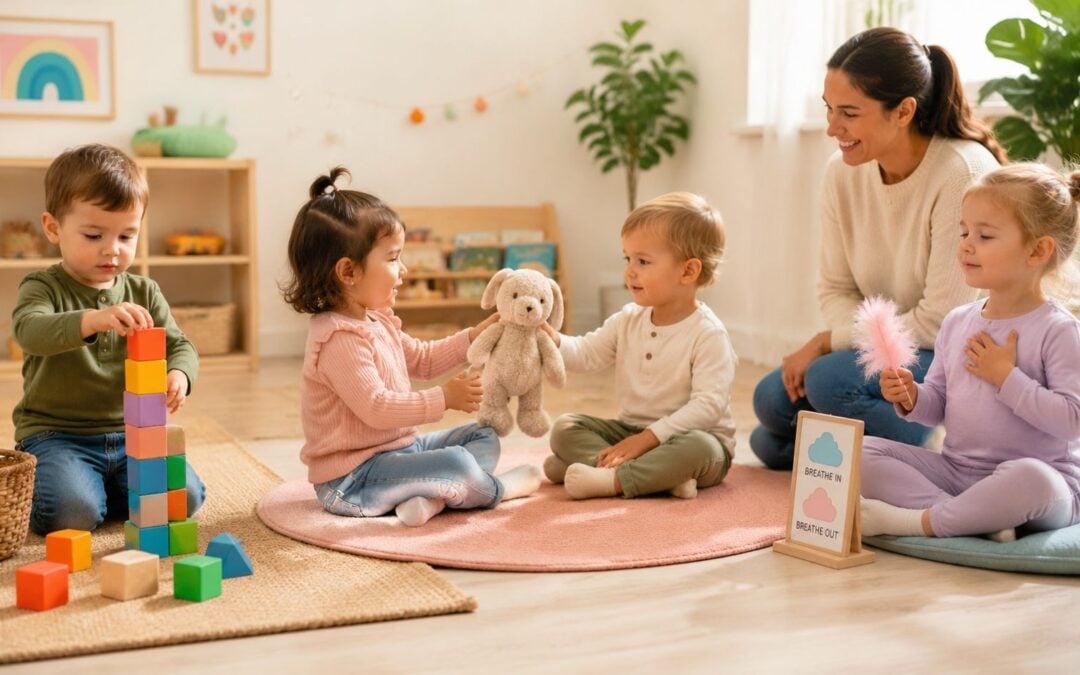
The toddler years can feel like an emotional weather report that changes by the minute. A child is laughing over bubbles, then crying because someone touched the red shovel, then clinging at drop-off, then proudly offering a snack to a friend. That swing isn't a sign that something has gone wrong. It's part of a critical stage for learning feelings, relationships, and self-control.
In early childhood, social and emotional development moved from being treated as simple behavior management to being taught more intentionally through daily routines, songs, play, and feeling-based language. Large early-learning frameworks such as Head Start continue to treat social and emotional learning as a core teaching practice for young children, and NAEYC centers trusting relationships and intentional teaching in that work, as described in Head Start's guidance on social emotional learning. For parents and teachers, that matters. Toddlers aren't just being redirected. They're learning skills.
If you're in the middle of frequent meltdowns, toy battles, or short attention spans, this guide is for you. These social emotional learning activities for toddlers are organized as a practical toolkit, not a random craft list. Each one connects to a core SEL pillar and includes ways to use it at home or in a classroom. If you also care about the wider value of play-based early childhood education, this overview of early learning benefits for Melbourne families complements the same child-centered approach.
1. Emotion Recognition and Naming Activities
Emotion naming is where most toddler SEL work should begin. A child can't use a calming strategy or repair a friendship if they don't yet have words for what's happening inside. Start simple. Happy, sad, mad, and scared are enough at first.
A strong routine is a brief feelings check-in during moments that already repeat. Morning arrival, snack, cleanup, and bedtime work well. In group care, many teachers use a feelings board where each child points to a face card. At home, a parent can do the same with two or three printed pictures on the fridge.
Make feelings visible
Mirror play works because toddlers love looking at faces. Hold up a card with a smiling face, then invite the child to copy it in the mirror. Do the same with sad, angry, and surprised. That helps connect a feeling word to a face and body.
Storybooks help too. Pause during a familiar book and ask, "How does the bunny feel?" If the child can't answer, model it without pressure. For a ready-made visual tool, a simple feelings chart for kids can support the same routine at home or school.
Practical rule: Don't ask toddlers to explain their feelings before they can name them. Label first. Reflect second.
A classroom example looks like this: a toddler grabs a truck, another child cries, and the teacher says, "You look mad. He looks sad. Let's help." A home example is just as direct: "You're angry that the blue cup is in the sink."
What doesn't work is quizzing children when they're already flooded. If a child is screaming, "How do you feel right now?" often raises frustration. Calm first, then label.
- Start with four feelings: Keep the first set small so the child can remember and use the words.
- Use the same words every day: Consistency matters more than creativity.
- Pair words with body cues: "Your fists are tight. That looks angry."
- Keep check-ins brief: One minute is enough for most toddlers.
2. Mindfulness and Breathing Exercises for Young Children
Breathing work with toddlers has to be concrete. If you say, "Take a mindful breath," most children under three will stare at you or keep crying. If you say, "Let's blow a bubble very slowly," they can do it.
Bubble breathing is one of the best social emotional learning activities for toddlers because it gives the breath a job. Blow too hard and the bubble pops. Blow slowly and it floats. That physical feedback makes the lesson real.
Try this during calm moments first. Put one hand on the child's belly and one on your own. Say, "We fill up our belly, then blow the bubble out slow." If you want a simple script for this skill, Soul Shoppe's guide to the belly breathing technique offers child-friendly language.
Use routines, not rescue missions
Breathing helps most when children practice before they need it. A teacher might use three bubble breaths before circle time. A parent might use dragon breaths in the car before childcare drop-off. Repetition is what makes the strategy available later during stress.
The broader idea behind this work lines up with how SEL is defined in the education field: building skills to manage emotions, show empathy, make responsible decisions, and maintain positive relationships. That category is also growing at the systems level. Grand View Research estimated the global SEL market at USD 3.47 billion in 2024, with a projection to USD 27.73 billion by 2033 and a 26.2% CAGR from 2025 to 2033. For schools, that means calming tools and explicit SEL practice are no longer fringe supports. They're part of mainstream planning.
A grounding variation is the five-senses game. Ask, "What do you see? What do you hear? What do you feel on your hands?" Toddlers don't need to complete a long sequence. Just noticing one thing can help them settle.
A short guided demonstration can help adults picture the pacing:
For adults who want a broader overview of why guided calming practices can help, this article on the benefits of guided meditation offers a helpful companion read.
Slow breathing should feel playful, not like a correction.
What doesn't work is introducing breathing as punishment. "Go breathe because you're being bad" turns a regulation tool into a shame cue.
3. Empathy-Building and Kindness Circle Activities
Toddlers are just beginning to notice that other people have separate feelings. That's why empathy activities should stay concrete and immediate. "Maya is crying. What can we do?" is easier than, "How would you feel in her situation?"
One useful structure is a kindness circle. In a classroom, children sit together, pass a soft object, and practice tiny acts of noticing. "I can give Liam a turn." "I can bring a tissue." At home, this can happen at dinner with one prompt: "Who did you help today?"
Use dolls, puppets, and real moments
Puppets lower the emotional stakes. If a puppet falls down and "feels sad," toddlers often respond more openly than they do during a direct peer conflict. A teacher can ask, "What does Bear need?" and offer choices like hug, help, or space.
ZERO TO THREE specifically organizes social-emotional guidance around children ages 24 to 36 months, which is a useful reminder that empathy at this age is still emerging. Their guidance also emphasizes age-appropriate practices such as feelings vocabulary, books about emotions, and activities that don't require sharing every time. That's an important trade-off. Adults often push sharing before toddlers are developmentally ready, then mistake distress for defiance.
When a two-year-old can't share on demand, that doesn't mean they're unkind. It usually means they still need support, time, and simpler expectations.
A practical classroom example is a "helping job" routine. One child carries napkins. Another helps pass out cups. These jobs create low-pressure chances to notice others. At home, a sibling can "help baby find the blanket" or "bring Dad a spoon."
If you want language and examples for teaching this skill more explicitly, Soul Shoppe's article on how to teach empathy gives families and educators a usable starting point.
- Narrate what children can see: "His face looks sad."
- Offer two kind choices: "Do you want to pat her back or get the teacher?"
- Praise the action specifically: "You brought the toy back. That helped him."
- Keep circles short: Toddlers do better with a few quick turns than a long discussion.
4. Play-Based Conflict Resolution and Problem-Solving Games
A lot of adult conflict coaching is too verbal for toddlers. Long explanations, fairness lectures, and forced apologies usually miss the mark. Toddlers need short scripts, adult support, and repeated practice inside ordinary conflicts.
One of the best setups is puppet problem-solving. Use two puppets who both want the same block. Let the puppets act out grabbing, crying, and pausing. Then model a simple repair: "My turn, then your turn." In a classroom, teachers can repeat the same script every day so children begin to anticipate the steps.
Keep the script short
For toddlers, a useful sequence is calm, state, solve. First regulate the body. Then name the problem in one sentence. Then offer one or two solutions. "You both want the shovel. We can take turns, or find another shovel."
This approach fits well with classroom guidance that recommends practicing sharing and turn-taking in everyday routines such as snack, lunch, and group meeting time. The point is repetition. Toddlers learn conflict skills in the same places where conflict keeps happening.
A strong home example is bath time with two cups and one faucet toy. A caregiver can coach, "Sam's turn, then Ana's turn," while using a hand cue or timer. In a classroom block area, a teacher might create a "solution station" with pictures showing wait, trade, ask, and get help.
If you want ready-made ideas in this area, Soul Shoppe's collection of conflict resolution activities for kids can be adapted down to toddler level by shortening the language and increasing adult modeling.
What doesn't work is insisting on "say sorry" before the child is calm. A rushed apology often teaches performance, not repair. For toddlers, returning a toy, helping rebuild a tower, or waiting for a turn is often the more meaningful repair action.
5. Self-Regulation and Coping Strategy Tools
A toddler is screaming because cleanup started two minutes earlier than expected. Another has gone floppy under the table after a loud transition. Those moments call for tools the child can see, touch, and practice often. "Use your coping skills" is too abstract for this age. A glitter jar, a cozy corner, wall pushes, or a visual timer gives the body something concrete to do.
This part of the SEL toolkit supports the self-regulation pillar. In Soul Shoppe's framework, children do better when adults teach skills directly, model them in calm moments, and repeat them during everyday routines. For toddlers, that means building a small set of coping tools into the day instead of waiting for a big upset.
A regulation space does not need special furniture or a large budget. In a classroom, I would rather see one predictable spot used well than a beautiful calm corner no one has taught children to use. A small rug, one sensory bottle, a stuffed animal, and a feelings card are enough. At home, a basket with a soft blanket, a board book, and one calming object in a quiet corner usually works better than filling the area with too many choices.
Match the tool to the child's nervous system, not to what looks cute on social media. Some toddlers settle through movement. Others need to watch something repetitive. Others need an adult nearby and very little sensory input. The trade-off is simple. More choices can help one child feel in control, but they can overwhelm another child who is already flooded.
Try a few tools and keep the routine consistent:
- Visual countdowns: Use fingers, photos, or a short timer before transitions so the child can see what is coming.
- Heavy work: Wall pushes, carrying pillows, or pushing a laundry basket can organize the body before frustration spills over.
- Cozy reset spaces: Keep one familiar place where a child can recover with support, not as a punishment spot.
- Simple coping choices: Offer two options such as, "Do you want to squeeze the pillow or sit with me?"
Practice matters more than the object itself. A glitter jar only helps if the child has used it many times while calm. The same is true for breathing cards, squeeze balls, or movement breaks. During a meltdown, adults are helping the child retrieve a familiar pattern.
Language should stay short. "Your body is fast. Let's push the wall." "You're upset. Sit with me and squeeze." Toddlers usually cannot process long explanations once they are dysregulated.
Story can help here too. Adults often get better results when they use a short, repeatable narrative around the tool, such as "First we stop, then we help the body, then we go back." For ideas on shaping simple, memorable scripts, MEB Books' storytelling guide offers useful principles that can be adapted for child-facing routines.
One caution. Sending a dysregulated toddler away alone rarely teaches self-control. Most children this age need co-regulation first, which means an adult stays close, keeps the environment predictable, and helps the child use one practiced tool until the body settles enough to rejoin the group.
6. Social Stories and Modeling Through Picture Books
Books give toddlers a safe way to study hard moments. A child who can't yet talk about their own jealousy, fear, or frustration may still point to a character and say, "He sad." That's enough to start.
Choose books with clear faces, simple plots, and emotions that show up in daily life. Waiting, losing a turn, missing a parent, feeling left out, being excited, or making a mistake all make strong story topics for this age.
Read slowly enough to notice feelings
The useful part isn't racing to the end. It's pausing on one page and helping children observe. "Her eyebrows look tight." "His body is hiding." "What happened right before that?"
NAEYC's guidance emphasizes intentional teaching, modeling, coaching in the moment, and using children's books and cues to reinforce prosocial behavior. That fits exactly with how picture books work best in toddler SEL. Read, notice, connect, repeat.
A home example is bedtime reading after a rough day. If a toddler struggled with hitting, a caregiver might read a simple feelings book and say, "The child is mad. Mad feelings happen. Hands stay safe." In a classroom, a teacher might revisit the same book all week, then reenact it with dolls during center time.
Follow-up matters. After reading about sadness, invite children to rock a baby doll or offer a tissue to a stuffed animal. After reading about waiting, practice waiting for a stamp or a turn with a drum.
If you want a broader lens on how story structure shapes connection and meaning, MEB Books' storytelling guide offers helpful ideas that educators can translate into read-aloud practice.
What doesn't work is treating books as one-time moral lessons. Toddlers need the same story again and again before the social message sticks.
7. Sensory and Movement-Based Emotional Expression Activities
A toddler melts down during cleanup, throws a block, then drops to the floor. Asking, "How do you feel?" usually goes nowhere in that moment. The body is already doing the talking.
That is why this part of the SEL toolkit focuses on movement, rhythm, touch, and simple art. In the Soul Shoppe approach, children do better when adults teach skills through repeated, concrete practice. For toddlers, sensory and movement activities often work best because they connect emotion to something the child can do right away.
An emotion dance is a strong place to start. Play one song and give one prompt at a time. "Show me sleepy." "Show me frustrated." "Show me excited." Keep it short, and model the movement yourself so children are not asked to invent from scratch. In a classroom, this fits before circle time or after a noisy transition. At home, it helps late-afternoon energy come out in a safer, more organized way.
Let the body show the feeling
Some children express more through their hands than their words. Offer paper with two crayons, a small lump of clay, scarves, or a drum. Then narrate what you see without judging or interpreting too fast. "You are pressing hard." "That sound is loud and fast." "Your hands slowed down."
The true objective is often missed by adults. The goal is not a cute art product or perfect participation. The goal is helping a child notice, release, and shift an emotional state without hurting themselves or others.
Research on structured early childhood SEL programs, including findings discussed earlier in the article, points in the same direction. Planned, repeated experiences support behavioral adjustment better than asking young children to calm down on command. That matters for this pillar of the toolkit. Sensory play is most useful when adults choose it with a purpose.
There is a real trade-off here. Sensory input can regulate one child and overwhelm another. Water play, finger paint, loud music, spinning, and textured bins can help a sensory-seeking toddler settle into their body. The same setup can push a different child into faster breathing, grabbing, or shutdown. Watch the child's cues and change one variable at a time.
A few practical adjustments help.
- Match the activity to the child's arousal level: Jumping, stomping, and drumming help release big energy. Slow stretching, rocking, and scarf waving help bodies come down.
- Keep choices narrow: One material and one feeling prompt works better than a table full of options.
- Adapt for setting: At home, use couch cushions, bath cups, or kitchen music. In a classroom, use clear boundaries, visual cues, and shorter turns.
- Use adult narration sparingly: Name what the body is doing, then pause so the child can stay in the experience.
- Finish with a closing routine: A sip of water, a wall push, a quiet squeeze, or one short book helps the nervous system settle.
Used this way, sensory and movement activities are not random add-ons. They support self-regulation, emotional expression, and co-regulation through the body first, which is often the most developmentally appropriate entry point for toddlers.
8. Family Engagement and Home-School SEL Partnerships
Toddlers learn fastest when adults use the same language across settings. If school says "take a belly breath" and home says "calm your body," that's still workable. If one setting teaches patiently and the other only reacts during crises, progress usually stalls.
Good home-school SEL partnership is simple, not complicated. One short note, one phrase, and one modeled routine go further than a long newsletter full of theory. Teachers can send home a weekly skill such as "gentle hands" or "waiting turn." Parents can reply with what worked or where the child got stuck.
Make adaptation part of the plan
This is especially important for children with developmental delays, speech and language differences, autism, or multilingual homes. Generic toddler SEL lists often stop at "use emotion cards" or "practice breathing." They don't explain how to adapt those tools.
That gap matters because the OECD reports that around 1 in 6 children globally live with a disability. A one-size-fits-all activity list leaves many families without a usable next step. In practice, adaptation may mean using photos instead of drawings, offering one feeling choice instead of four, pairing words with signs or gestures, building a personalized social story, or using a home language first.
A toddler doesn't need a more complicated SEL activity. They usually need the same activity made clearer, shorter, and more visual.
At school, a teacher might send home a picture of the exact calm-down corner routine used in class. At home, a caregiver can recreate only one part of it, such as the same breathing cue or sensory bottle. In multilingual families, adults can label the same feeling in both languages during everyday routines. Consistency matters more than perfect matching.
Soul Shoppe's broader family and school resources can fit naturally into this kind of partnership because the organization focuses on shared language, self-regulation, communication, and conflict resolution across school communities.
Toddlers SEL Activities: 8-Point Comparison
| Item | Implementation complexity | Resource requirements | Expected outcomes | Ideal use cases | Key advantages |
|---|---|---|---|---|---|
| Emotion Recognition and Naming Activities | Low, simple routines, needs repetition | Minimal, emotion cards, mirrors, books | Improved emotional vocabulary and self-awareness; fewer frustration-based behaviors | Morning circle, transitions, home labeling | Easy to implement; supports language and early regulation |
| Mindfulness and Breathing Exercises for Young Children | Low–Medium, adults must model consistently | Minimal, visual cues, music, short scripts | Better attention, reduced anxiety, improved self-regulation | Brain breaks, calm-down moments, pre-transition routines | Accessible anywhere; builds focus and parasympathetic activation |
| Empathy-Building and Kindness Circle Activities | Medium, requires skilled facilitation and safety | Low–Moderate, stories, puppets, structured time | Increased prosocial behavior, reduced peer conflict, stronger belonging | Circle time, community-building, bullying prevention | Builds community and perspective-taking; supports inclusion |
| Play-Based Conflict Resolution and Problem-Solving Games | Medium, modeling and guided practice needed | Low–Moderate, toys, puppets, conflict scripts | Improved problem-solving, reduced adult intervention in minor conflicts | Free play, peer disputes, role-play lessons | Engaging; skills transfer directly to peer interactions |
| Self-Regulation and Coping Strategy Tools | Medium, ongoing coaching and reminders | Moderate, calm-down stations, sensory tools, timers | Greater independence, fewer disruptions, improved impulse control | Transition areas, calm corners, individualized supports | Empowers children; adaptable to individual needs |
| Social Stories and Modeling Through Picture Books | Low–Medium, requires thoughtful selection and facilitation | Low, quality books and discussion prompts | Better emotion understanding, language development, perspective-taking | Storytime, targeted SEL lessons, small groups | Engaging and developmentally appropriate; integrates literacy |
| Sensory and Movement-Based Emotional Expression Activities | Medium, needs space and facilitation | Moderate–High, art supplies, instruments, space | Healthy nonverbal emotional expression; motor skill gains; regulation | Music/movement sessions, art stations, sensory breaks | Highly engaging; effective for children with limited verbal skills |
| Family Engagement and Home-School SEL Partnerships | High, sustained coordination and communication | Moderate, staff time, materials, translation services | Stronger skill transfer, consistent home-school language, family support | Parent workshops, take-home activities, family nights | Amplifies impact across settings; builds lasting continuity |
From Activities to Habits Nurturing an Emotionally Healthy Child
The most useful social emotional learning activities for toddlers don't look flashy. They look repetitive. A feelings check-in at breakfast. A breathing game before cleanup. A puppet script for toy conflicts. A cozy space with one sensory tool. The power comes from how often those moments happen, not from how elaborate they are.
That pattern matches what early-childhood guidance has been moving toward for more than two decades. Social-emotional development is now treated as a core part of school readiness and daily teaching practice, not an optional add-on. For toddlers, that means adults intentionally teach feelings, empathy, turn-taking, and self-regulation through routines, play, and relationships.
If you're a parent, start small. Pick one activity that fits a part of your day that already feels hard. Maybe it's naming feelings at bedtime, or using bubble breaths before leaving the playground. If you're a teacher, look at your conflict hotspots and transition points first. Those are often the best places to add SEL support because the need is already there.
It also helps to be honest about what doesn't work. Long lectures don't work. Forced apologies usually don't work. Expecting toddlers to share everything, every time, often doesn't work. Teaching when a child is fully dysregulated rarely works well either. Toddlers learn best from short, repeated, adult-modeled interactions that happen while they feel safe.
Modeling still carries the most weight. When adults say, "I'm frustrated. I'm going to take a breath," children hear both the feeling and the action. When adults repair after snapping, children learn that relationships can bend and recover. That's a deeper lesson than any poster on the wall.
For schools and families who want more structure, it can help to use a consistent framework so everyone is reinforcing the same skills. Soul Shoppe is one option that offers programs and resources focused on connection, safety, empathy, self-regulation, mindfulness, communication, and conflict resolution. The exact format matters less than the shared language and follow-through.
You do not need to do all eight activities at once. Choose one self-awareness tool, one regulation tool, and one relationship tool. Use them often enough that your toddler starts to predict them. Once that happens, the work begins to shift. The activity stops being a special lesson and becomes part of how the child moves through the day.
That is the actual goal. Not perfect behavior. Not a toddler who never cries, grabs, or melts down. The goal is a child who gradually learns, with help, that feelings can be named, bodies can calm, and relationships can be repaired.
If you're ready to build a stronger shared language around empathy, self-regulation, and conflict resolution at school or at home, explore Soul Shoppe for programs, resources, and practical SEL support.