

Mindfulness activities for students: 8 Quick Practices to Boost Focus
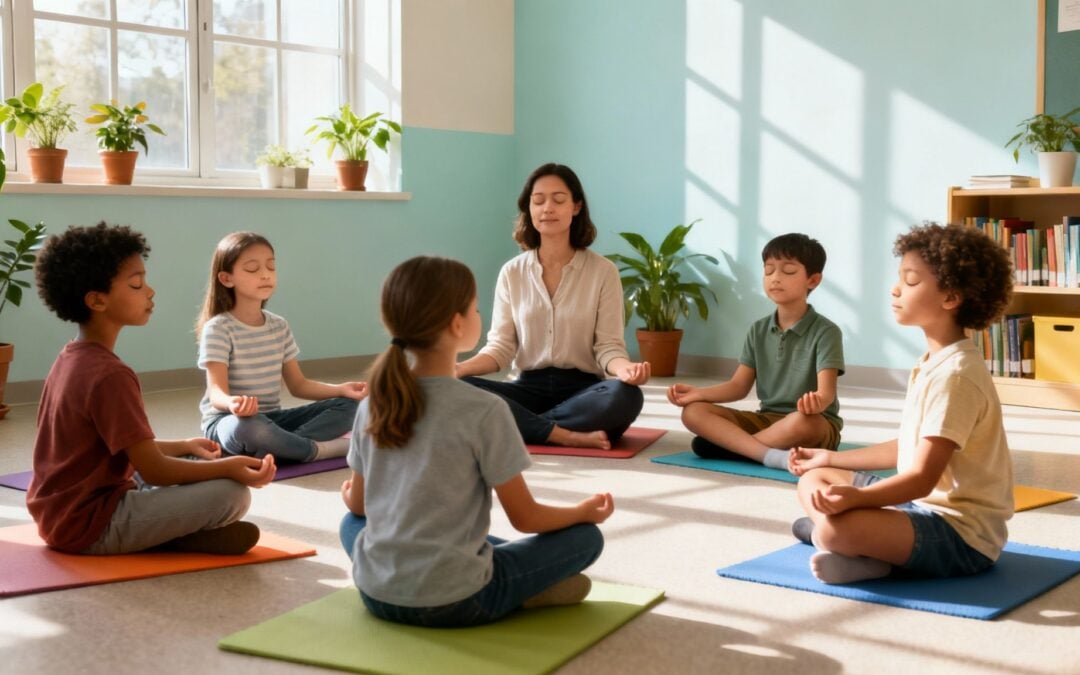
In today’s fast-paced world, students face unprecedented levels of stress and distraction. The ability to pause, self-regulate, and connect with the present moment is no longer a soft skill; it is an essential tool for academic success and lifelong well-being. This article moves beyond theory to provide a practical, actionable roundup of 10 mindfulness activities for students, designed for easy implementation in any K–8 classroom or home. We’ll explore how these simple, research-backed practices can transform a chaotic classroom into a focused, empathetic community.
This resource is crafted for educators, administrators, and parents seeking concrete strategies to foster attention, emotional balance, and kindness. Rather than just discussing concepts, we provide a detailed toolkit. For those new to the core principles, exploring the essence of mindfulness meditation can provide a helpful foundational understanding before you dive into the activities.
Each of the following mindfulness activities for students includes:
- Step-by-step instructions for easy facilitation.
- Age-appropriate adaptations for grades K–8.
- Practical examples for classroom and home settings.
- Key learning goals, such as improving self-regulation and focus.
Get ready to discover how these powerful yet simple exercises can help you cultivate a more peaceful and resilient learning environment.
1. Body Scan Meditation
Body Scan Meditation is a foundational practice where students bring gentle, non-judgmental attention to different parts of their body, one at a time. This guided exercise helps anchor students in the present moment by connecting them with physical sensations like warmth, tingling, or pressure, fostering a stronger mind-body connection. It serves as an excellent introduction to mindfulness for students of all ages.
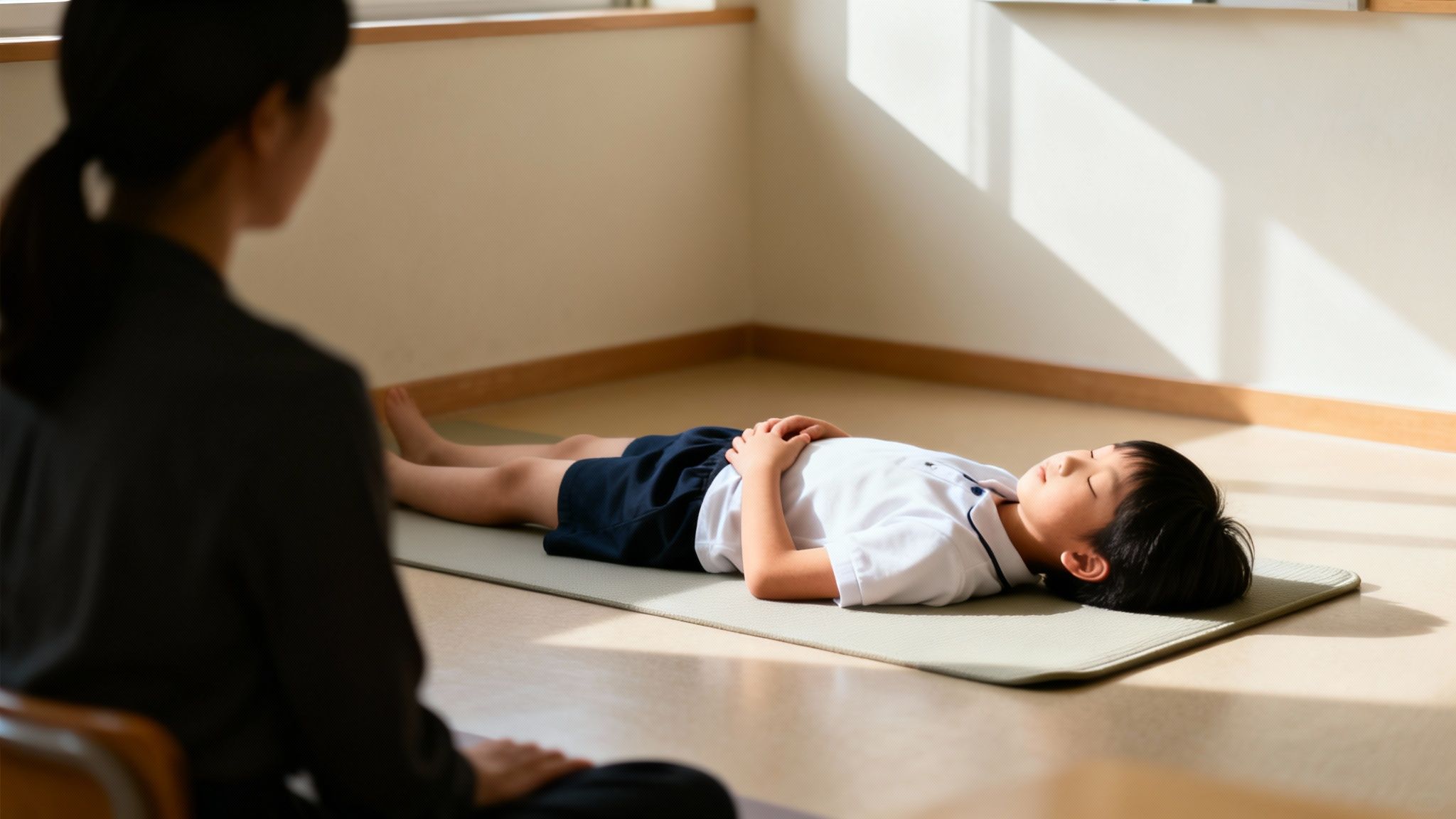
This simple yet powerful tool is used by organizations like Soul Shoppe to teach students how to identify physical cues tied to emotions, which is a key component of self-regulation.
When to Use a Body Scan
This activity is particularly effective for calming the nervous system and resetting focus. It’s a perfect tool to use:
- After recess: To help students transition from high-energy play to quiet classroom work.
- Before tests: To ease anxiety and help students center themselves.
- During morning meetings: To start the day with a calm, focused mindset.
How to Implement Body Scan Meditation
To begin, have students find a comfortable position, either sitting upright or lying down. Guide them with a calm voice, prompting them to notice sensations in their feet, then legs, stomach, arms, and so on, up to their head.
Practical Example Script:
“Let’s get comfortable in our chairs. You can close your eyes if you like. Now, bring all your attention down to your feet. Can you feel your shoes on your feet? Wiggle your toes inside. Now, let’s move up to your legs. Feel your legs resting on the chair. Are they warm? Are they cool? Just notice. Now bring your attention to your tummy, feeling it get a little bigger as you breathe in and a little smaller as you breathe out.”
Implementation Tips:
- Start Small: For younger students (K-2), keep the scan brief, around 3-5 minutes, focusing on major body parts like “your wiggly toes” or “your strong legs.”
- Use Descriptive Language: Use gentle, invitational language such as, “Notice any feelings of warmth in your hands,” or “Can you feel your back resting against the chair?”
- Model First: Practice the body scan yourself so students see it as a normal and valuable activity.
- Trauma-Informed Approach: Emphasize that there is no right or wrong way to feel. If a student feels discomfort, they can gently shift their focus to their breath or a part of the body that feels neutral or pleasant.
2. Mindful Breathing Exercises
Mindful Breathing Exercises are simple, focused techniques that guide students to control their breath, which directly influences their nervous system. Practices like “Belly Breathing” or “Box Breathing” help students anchor their attention, slow their heart rate, and manage the body’s fight-or-flight response. This makes breathing one of the most accessible and effective mindfulness activities for students to use anywhere, anytime.
This foundational tool helps students learn what to do when big emotions take over, transforming breath into a portable self-regulation anchor. It’s a core skill for managing impulses and navigating difficult feelings.
When to Use Mindful Breathing
Breathing exercises are a powerful intervention for both proactive regulation and in-the-moment de-escalation. They are ideal to use:
- During transitions: To reset the energy between different subjects or activities.
- Before public speaking: To calm nerves and focus the mind before a presentation.
- For conflict resolution: To help students pause and cool down before discussing a problem.
How to Implement Mindful Breathing
Introduce various breathing patterns and encourage students to find one that feels right for them. For example, guide them through “Box Breathing”: inhale for 4 counts, hold for 4, exhale for 4, and hold for 4, tracing a square in the air with a finger.
Practical Example: “Belly Breathing”
Have students place one hand on their chest and the other on their belly. Instruct them: “Breathe in slowly through your nose, and feel your belly puff up like a balloon. The hand on your chest should stay still. Now, breathe out slowly through your mouth and feel the balloon deflate.” You can place a small stuffed animal on their belly if they are lying down to make it more visual.
Implementation Tips:
- Make It Visual: Use pinwheels, bubbles, or Hoberman spheres to give students a tangible visual for their breath. Tracing shapes with a finger is also effective.
- Practice When Calm: Introduce and practice these techniques when students are calm and regulated. This builds the skill so it is available during moments of stress.
- Normalize the Practice: Frame breathing breaks as a tool for everyone, not just for students who are upset. Say, “Let’s all take three ‘lion breaths’ to get our wiggles out.”
- Offer Variety: Teach different methods like “Bumblebee Breath” (humming on the exhale) or “Rainbow Breathing” (tracing an arc in the air) so students can choose their favorite.
3. Guided Mindful Movement & Yoga for Children
Guided Mindful Movement combines physical poses, stretching, and breath awareness in a playful format. These practices, often incorporating yoga, help students develop body awareness, physical strength, and emotional regulation by connecting intentional movement with their breath. It’s an active, engaging way to introduce mindfulness activities for students who may struggle with sitting still.
This approach transforms mindfulness into a dynamic experience. In many special education classrooms, for instance, teachers use mindful movement to support sensory regulation and help students channel their physical energy constructively.
When to Use Mindful Movement
This activity is excellent for releasing pent-up energy, improving focus, and fostering a positive classroom climate. It is particularly useful:
- As a brain break: To re-energize students and reset attention during long instructional periods.
- During P.E. class: To introduce a non-competitive physical activity focused on self-awareness.
- To start the day: To help students arrive in their bodies and prepare their minds for learning.
How to Implement Mindful Movement
Guide students through a sequence of simple, child-friendly poses or movements. Frame the activity with a story or theme to keep them engaged, such as pretending to be different animals or moving like elements in nature (a flowing river, a strong mountain).
Practical Example: “Mountain to Star”
“Let’s all stand up tall and strong like a mountain. Feel your feet planted firmly on the ground. Take a deep breath in. Now, as you breathe out, jump your feet apart and stretch your arms out wide like a sparkling star! Breathe in, and jump back to Mountain Pose. Let’s do that three times.”
Implementation Tips:
- Make it Playful: Use animal names for poses like “Downward Dog” or “Cat-Cow.” Create a story around the movements, such as a “journey through the jungle.”
- Offer Choices: Empower students by offering variations. For example, “You can be a tall, still tree or a tree swaying in the breeze.”
- Start Short: Begin with 5-10 minute sessions and gradually increase the duration as students build stamina and interest.
- Normalize All Bodies: Emphasize that every body is a “yoga body.” Model and celebrate effort over perfect form, ensuring all students feel successful and included.
4. Mindful Listening Circles
Mindful Listening Circles are structured group conversations where students practice deep, non-judgmental listening and authentic speaking. This powerful format often uses a “talking piece” to ensure only one person speaks at a time, creating a safe space for every voice to be heard and valued. It’s one of the most effective mindfulness activities for students to build empathy, community, and psychological safety.
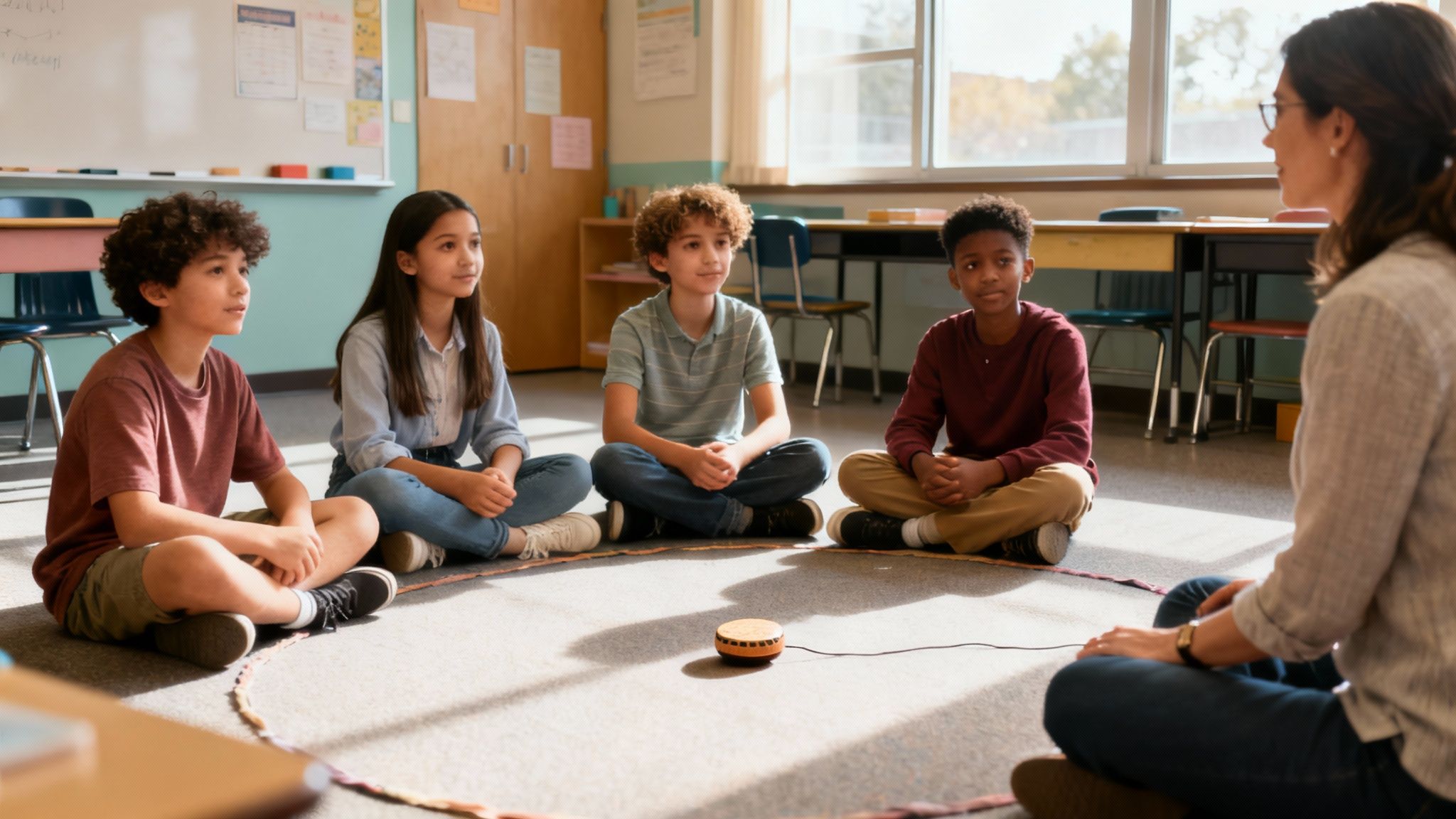
This practice is central to programs like Soul Shoppe, which use circles to foster connection and teach essential social-emotional skills. You can learn more about developing these foundational abilities with listening skills activities for your classroom.
When to Use Mindful Listening Circles
This activity is ideal for building community and addressing social dynamics. It is particularly useful for:
- Morning meetings: To check in with students and set a positive tone for the day.
- Conflict resolution: To repair harm and find solutions after a disagreement.
- Advisory or homeroom periods: To build a strong sense of belonging and team identity.
How to Implement Mindful Listening Circles
Gather students in a circle where everyone can see each other. Introduce a talking piece (a small, special object) and explain that only the person holding it may speak. Pose a prompt and pass the talking piece around the circle.
Practical Example Prompt:
“Our talking piece today is this smooth stone. When you are holding the stone, I invite you to share one ‘rose’—a happy moment from your weekend—and one ‘thorn’—a moment that was a little tricky. Remember, you can always pass if you don’t feel like sharing.”
Implementation Tips:
- Establish Agreements: Co-create clear rules with students, such as “listen with respect,” “speak from the heart,” and “what’s said in the circle stays in the circle.”
- Use a Talking Piece: This simple tool naturally teaches turn-taking and prevents interruptions, ensuring all students get an opportunity to share.
- Honor the Right to Pass: Always give students the option to pass if they are not ready to share. This builds trust and safety.
- Start with Light Prompts: Begin with simple, fun questions like, “What is one thing that made you smile today?” before moving to deeper topics. This helps students feel comfortable with the format.
5. Mindful Eating & Food Awareness
Mindful Eating & Food Awareness is a sensory-focused practice where students use all their senses to experience their food. Instead of eating on autopilot, they are guided to notice the colors, textures, aromas, and tastes, which grounds them in the present moment and helps them develop a healthier, more appreciative relationship with what they consume. This is one of the most accessible mindfulness activities for students as it can be integrated into daily routines like snack or lunch time.
This practice encourages students to slow down, listen to their body’s hunger and fullness cues, and build gratitude for their food. It turns a simple meal into a rich sensory experience and a moment for focused attention.
When to Use Mindful Eating
This activity is perfect for building routine mindfulness and teaching self-regulation around food. It is especially useful:
- During snack time: To create a calm, focused break in the day.
- In health or science class: To connect with lessons on nutrition, agriculture, or the five senses.
- At the beginning of lunch: To set a calm tone in a typically chaotic cafeteria environment.
How to Implement Mindful Eating
Start with a single, simple food item like a raisin, a strawberry, or a small cracker. Guide students through a sensory exploration before they even take a bite.
Practical Example with a Raisin:
“Today we’re going to be food scientists with this one raisin. First, let’s just look at it. Notice its wrinkly lines. Now, feel it between your fingers. Is it squishy or hard? Next, hold it under your nose and take a sniff. What does it smell like? Now, place it in your mouth but don’t chew yet! Just notice how it feels on your tongue. Finally, take one very slow bite and see what flavors you discover.”
Implementation Tips:
- Engage All Senses: Guide students to look at the food’s colors and shapes, feel its texture, smell its aroma, and listen to any sounds it makes before tasting it slowly.
- Start with One Bite: Challenge them to take just one slow, mindful bite, noticing all the flavors and sensations as they chew.
- Cultivate Gratitude: Prompt students to think about where the food came from: the plant, the farmer, the truck driver, and the grocery store.
- Focus on Nutritious Choices: Choosing wholesome snacks makes the experience more impactful. For more inspiration, you can explore fun and healthy snack ideas for students.
- Be Allergy-Aware: Always be mindful of student allergies and dietary restrictions, providing safe and inclusive options for everyone.
6. Loving-Kindness Meditation (Metta Practice)
Loving-Kindness Meditation, also known as Metta Practice, is a heart-centered mindfulness activity where students actively cultivate compassion. They silently repeat phrases of goodwill, first for themselves, then for loved ones, neutral people, and eventually even those with whom they have difficulty. This practice directly strengthens empathy, reduces negative self-talk, and fosters a more connected and caring classroom community.
This powerful practice is a cornerstone for teaching empathy to kids and teenagers, as it helps build the emotional muscle for compassion.
When to Use Loving-Kindness Meditation
This activity is especially useful for building community and addressing social-emotional challenges. It is a powerful tool to use:
- During conflict resolution: To help students shift from anger to a more open-hearted perspective.
- To start the day: As a morning meeting activity to set a positive, empathetic tone for the school day.
- Within anti-bullying initiatives: To help students develop compassion for others and understand the impact of their actions.
How to Implement Loving-Kindness Meditation
Ask students to sit comfortably and close their eyes if they wish. Guide them to silently repeat a few simple phrases, directing the kind wishes inward first, then outward.
Practical Example Script:
“Let’s find a comfy seat. You can put a hand on your heart if you like. First, let’s send some kind wishes to ourselves. Silently in your mind, say: ‘May I be happy. May I be healthy. May I be safe.’ Now, think of someone you care about, like a family member or a friend. Picture them in your mind and send them the same wishes: ‘May you be happy. May you be healthy. May you be safe.'”
Implementation Tips:
- Simplify Phrases: For younger students, use simple phrases like, “May I be happy. May I be safe.” Then, guide them to say, “May you be happy. May you be safe,” while thinking of a friend.
- Start with the Easy: Begin by directing kindness toward oneself and then to people who are easy to love (family, pets, close friends) before moving toward more challenging relationships.
- Acknowledge Difficulty: Model that it’s okay if it feels hard to send kind wishes to certain people. Emphasize that the goal is the intention, not a specific feeling.
- Set Clear Boundaries: Reassure students that wishing someone well does not mean condoning harmful behavior. It is a practice for their own heart, not for excusing others’ actions.
7. Mindful Creative Expression & Journaling
Mindful Creative Expression combines art (coloring, drawing, painting) and reflective journaling into a nonjudgmental practice. These activities support emotional regulation and self-expression, offering an essential outlet for students who may struggle to share their feelings verbally. This approach helps students process emotions and develop metacognition in a safe, creative space.

This method provides a tangible way for students to explore their inner world. It allows them to give form to abstract feelings like joy, frustration, or sadness, making these emotions easier to understand and manage.
When to Use Mindful Creative Expression
This versatile practice is ideal for promoting introspection and emotional processing. It can be used:
- During morning meetings: To set a positive intention for the day through gratitude journaling or drawing.
- For conflict resolution: To help students reflect on a situation by drawing or writing about their perspective.
- As a calm-down corner activity: To provide a self-soothing, constructive outlet for big emotions.
How to Implement Mindful Creative Expression
Establish a quiet, supportive environment where students feel safe to create without judgment. Provide a variety of materials and let students choose their preferred medium, whether it’s crayons, clay, or a simple notebook.
Practical Example: “Drawing Your Feelings”
“Let’s check in with ourselves. What feeling is inside you right now? Is it a sunny yellow feeling? A stormy gray feeling? A calm blue feeling? You don’t have to draw a face or a person. Just choose the colors and shapes that feel like your feeling today and scribble them onto the paper.”
Implementation Tips:
- Emphasize Process Over Product: Remind students, “There is no right or wrong way to create.” The goal is expression, not a perfect art piece.
- Use Sentence Starters: For students who need more structure, provide prompts like, “Today I felt…” or “I feel proud when…”
- Offer Drawing Alternatives: For pre-writers or students who prefer visuals, allow doodling or drawing in response to journal prompts.
- Ensure Privacy and Respect: Never grade or correct journals. Create a culture where this work is seen as a personal reflection tool, not an assignment to be evaluated.
8. Mindful Observation & Sensory Awareness Practices
Mindful Observation invites students to slow down and use their senses to explore an object with focused curiosity. By closely examining a natural item like a leaf or a piece of artwork, students anchor their attention in the present moment, noticing details they might otherwise overlook. This practice cultivates a sense of wonder and appreciation while strengthening concentration skills.
This sensory-based approach is a tangible way to introduce mindfulness. It provides a concrete focal point, making it one of the most accessible mindfulness activities for students who may struggle with more abstract concepts like watching their breath.
When to Use Mindful Observation
This activity is excellent for grounding students and sharpening their focus, especially when transitioning between subjects. It’s an ideal tool to use:
- During science lessons: To enhance nature study and encourage detailed scientific observation.
- As a writing prompt: To inspire descriptive language and creative thinking before a writing task.
- After a disruptive event: To calmly redirect group energy and re-establish a peaceful classroom environment.
How to Implement Mindful Observation
Begin by giving each student a simple object, like a smooth stone, a flower petal, or a seashell. Ask them to become “curiosity detectives” and investigate the object using only their senses.
Practical Example with a Leaf:
“Today, you are a nature detective and this leaf is your clue. First, use your detective eyes. What is the exact color? Do you see tiny lines, like roads on a map? Now, gently use your sense of touch. Is it smooth, waxy, or fuzzy? Be a detective and find one tiny detail you’ve never noticed before on a leaf.”
Implementation Tips:
- Start with Sight: Prompt them with questions like, “What tiny lines or patterns do you see?” or “Notice all the different shades of color on your object.”
- Engage Other Senses: Guide them to explore texture by asking, “How does it feel in your hand-is it smooth, rough, or bumpy?” If appropriate, you can also explore smell.
- Use a Timer: Set a timer for 3-5 minutes to help students sustain their focus without feeling overwhelmed.
- Encourage Sharing: After the observation, invite students to share one new thing they noticed. This fosters a non-judgmental atmosphere and values each student’s unique perspective.
9. Mindful Walking & Movement Meditation
Mindful Walking & Movement Meditation is an active practice that combines gentle physical movement with focused awareness. Students walk slowly and deliberately, paying full attention to the sensation of each step, their breath, and their surroundings. This activity is particularly beneficial for students with high energy needs, as it channels their physical energy into a grounding and calming exercise.
This method transforms everyday movement into an opportunity for mindfulness. By focusing on the physical act of walking, students learn to quiet their minds and connect with their bodies in the present moment, making it a powerful tool for self-regulation.
When to Use Mindful Walking
This is one of the most versatile mindfulness activities for students because it can be integrated into existing routines. Use it to:
- During classroom transitions: Turn hallway walks into a quiet, orderly practice.
- For movement breaks: Offer a structured alternative to free-play that helps reset focus.
- Before challenging activities: Use a slow walk to calm nerves and center attention before a test or presentation.
- During outdoor time: Leverage nature trails or school gardens for a multisensory experience.
How to Implement Mindful Walking
Ask students to walk at a much slower pace than usual, either in a line or following a designated path. Guide their attention to the physical sensations of movement.
Practical Example for Hallway Transitions:
“As we walk to the library, let’s try ‘turtle walking.’ We’re going to walk so slowly and quietly that no one would even know we’re here. Pay attention to your feet. Feel your heel touch the ground, then the middle of your foot, then your toes. See if you can walk the entire way to the library without your mind wandering off.”
Implementation Tips:
- Start Slow and Short: Begin with a brief, 2-3 minute walk at a very slow pace to help students focus on the details of each movement.
- Guide their Attention: Use simple verbal cues like, “Notice how your foot feels as it lifts off the ground,” or “Feel the floor beneath your shoes.”
- Anchor with Phrases: Connect breath to movement with phrases like, “Breathing in, I take a step. Breathing out, I take a step.”
- Create a Path: Use tape on the floor or a clear route outdoors to provide a simple structure for the walk, preventing distraction and keeping the group contained.
- Normalize the Practice: Incorporate mindful walking into regular routines, like the walk to the library or cafeteria, to make it a familiar and expected part of the day.
10. Gratitude & Appreciation Practices
Gratitude practices guide students to mindfully notice and appreciate the positive elements in their lives. This activity shifts focus from what’s wrong to what’s right, encompassing people, experiences, and simple pleasures. Cultivating gratitude helps build resilience, fosters a sense of belonging, and promotes a positive classroom culture.
This powerful practice is more than just saying “thank you”; it’s about internalizing appreciation for the good things, big and small. By making gratitude a regular habit, we teach students to find joy in the everyday, which is a core skill for emotional well-being. To explore this topic further, Soul Shoppe offers valuable insights into what gratitude means for kids.
When to Use Gratitude Practices
This activity is versatile and can be used to set a positive tone, build community, or reframe a challenging day. It is particularly effective:
- During morning meetings: To start the day with a positive and appreciative mindset.
- At the end of the day or week: To reflect on positive moments and end on a high note.
- To build classroom culture: Appreciation circles can strengthen peer relationships and reduce conflict.
How to Implement Gratitude & Appreciation Practices
Begin by introducing the concept of gratitude in simple terms. Ask students to think of one small thing that made them smile that day. This makes the idea accessible and less overwhelming.
Practical Example: “Gratitude Popcorn”
“Let’s end our day with some Gratitude Popcorn. I’ll start by sharing one small thing I’m grateful for today. I’m grateful for the sun shining during recess. As soon as I’m done, anyone who has something they’re grateful for can ‘pop up’ and share it. We won’t all go at once, just one at a time, like popcorn popping in a machine.”
Implementation Tips:
- Start Specific: Guide students with specific prompts, such as, “I’m grateful for the way my friend shared their crayons with me,” or “I appreciate the sunny weather at recess.”
- Model Authentically: Share your own genuine gratitude. Students can spot inauthenticity, so your sincere example is crucial.
- Create a Gratitude Wall: Dedicate a bulletin board where students can post notes or drawings of things they are thankful for, creating a visual reminder of positivity.
- Balance with Reality: Acknowledge that it’s okay to have tough days. Gratitude doesn’t mean ignoring challenges; it means finding good things even when life is hard.
Student Mindfulness Activities: 10-Item Comparison
| Practice | Implementation Complexity | Resource Requirements | Expected Outcomes | Ideal Use Cases | Key Advantages |
|---|---|---|---|---|---|
| Body Scan Meditation | Low–Moderate — simple scripts; introduce trauma-informed options | Minimal — mat/chair optional | Increased interoceptive awareness, relaxation, reduced anxiety | Morning routines, transitions, test prep, calm-downs | Accessible for all ages; easy classroom integration |
| Mindful Breathing Exercises | Low — easy to teach but needs practice | None — visual cues or props optional | Rapid nervous system calming; improved focus and self-regulation | Escalation de-escalation, short breaks, classroom management | Instant, portable tool usable anywhere |
| Guided Mindful Movement & Yoga for Children | Moderate — benefits from trained facilitator | Space, mats, minimal props, trained staff | Reduced restlessness, strength, body confidence, mood boost | PE, high-energy groups, morning movement, sensory regulation | Embodied regulation; engages kinesthetic learners |
| Mindful Listening Circles | High — requires skilled facilitation and agreements | Quiet space, talking piece, trained facilitator | Greater empathy, belonging, communication, peer support | Community-building, conflict resolution, advisory periods | Builds psychological safety and social skills |
| Mindful Eating & Food Awareness | Moderate — logistical planning for food/access | Food items, controlled space; allergy considerations | Slower eating, sensory awareness, healthier food relationships | Health classes, garden-to-table lessons, snack time | Practical life skill; sensory engagement |
| Loving-Kindness Meditation (Metta) | Moderate — guided scaffolding; sensitive for some students | None — scripts or recordings helpful | Increased compassion, self-kindness, reduced aggression | Empathy lessons, anti-bullying work, brief morning practice | Directly cultivates prosocial attitudes and belonging |
| Mindful Creative Expression & Journaling | Moderate — routines, confidentiality norms | Art supplies, journals, quiet workspace | Emotional processing, self-expression, metacognition | Counseling, SEL lessons, reflective time, art integration | Nonverbal outlet; documents growth over time |
| Mindful Observation & Sensory Awareness | Low — simple prompts and objects | Natural/art objects, optional journals or sketching tools | Improved attention, observation skills, grounding | Nature study, art lessons, short calming breaks | Minimal materials; strong curriculum links |
| Mindful Walking & Movement Meditation | Low–Moderate — needs behavior norms and route | Safe walking space, optional markers | Grounding, reduced restlessness, improved proprioception | Transitions, recess, kinesthetic learners, hallway practice | Combines movement with mindfulness; no special equipment |
| Gratitude & Appreciation Practices | Low — simple routines, requires authentic modeling | Journals, display materials (optional) | Increased resilience, positive classroom culture, wellbeing | Morning/closing rituals, routines, appreciation activities | Simple to implement; research-backed benefits |
Putting It All Together: Weaving Mindfulness into Your School’s DNA
Throughout this guide, we’ve explored a rich collection of mindfulness activities for students, from the quiet stillness of the Body Scan Meditation to the shared connection of Mindful Listening Circles. Each practice, whether it’s Mindful Breathing, Mindful Movement, or Gratitude Journaling, offers a unique pathway for young learners to develop crucial life skills. These are not just isolated exercises; they are building blocks for a more self-aware, regulated, and empathetic generation.
The core takeaway is that integrating these practices is less about adding a new subject and more about cultivating a new way of being. The true power of mindfulness unfolds through consistency and authentic modeling. When students see educators and caregivers participating with genuine intention, they learn that these tools are for everyone, not just for moments of crisis but for everyday well-being.
Your Actionable Next Steps
Making these mindfulness activities for students a sustainable part of your environment requires a thoughtful, gradual approach. Don’t feel pressured to implement all ten practices at once. Instead, consider these practical starting points:
- Start Small and Build Momentum: Choose one or two activities that feel most accessible and relevant to your students’ needs. Perhaps you begin each morning with three rounds of “Belly Breathing” or dedicate five minutes after recess to a Mindful Listening Circle. Consistency is more impactful than variety in the beginning.
- Create a Shared Language: Use mindfulness vocabulary consistently. Words like “anchor breath,” “noticing,” and “non-judgmental” can become part of your classroom’s daily lexicon, providing students with the language to articulate their internal experiences.
- Integrate, Don’t Isolate: Weave these practices into your existing routines. A Mindful Observation exercise can be a 3-minute transition before a science lesson. A Mindful Eating practice can transform a routine snack time into a moment of sensory awareness and gratitude. This shows students that mindfulness is a tool for all parts of life.
- Lead with Empathy and Patience: Remember, the goal is not perfect silence or flawless execution. The goal is practice. Celebrate effort over outcome, creating a safe space where students feel comfortable exploring their inner worlds without fear of getting it “wrong.”
The Lasting Impact of a Mindful School Culture
By championing these mindfulness activities for students, you are investing in skills that extend far beyond academic success. You are equipping them with the tools to navigate anxiety, manage conflict, cultivate empathy, and build resilience in the face of life’s inevitable challenges. A classroom grounded in these principles becomes a calmer, more focused, and more connected learning community.
This journey transforms not only the students but the educators as well. As you guide these practices, you are also nurturing your own sense of presence and well-being. This creates a positive feedback loop, where a more centered adult fosters a more centered environment for children to thrive. Ultimately, you are not just teaching mindfulness; you are building a foundation for lifelong emotional intelligence and compassionate action.
Ready to move from individual activities to a fully integrated, school-wide social-emotional learning program? Soul Shoppe provides comprehensive, evidence-based programs that embed mindfulness, empathy, and conflict resolution into the very fabric of your school’s culture. Explore how Soul Shoppe can partner with you to create a safer, more connected learning community for every student and educator.