

Restorative Practices in the Elementary Classroom: A Practical Guide for Educators
When a third grader knocks over a classmate’s project — on purpose — most teachers know the drill: a consequence, maybe a trip to the office, and a hope that it doesn’t happen again. But what if the more powerful response wasn’t about punishment at all? What if it was about repair?
That’s the core idea behind restorative practices in the elementary classroom. For educators who are tired of discipline cycles that don’t change behavior, it offers something genuinely different: a way to address harm while building the relationships and culture that make harm less likely in the first place.
Here’s what you need to know — and how to actually get started.
—
What Are Restorative Practices (and What They’re Not)
Restorative practices originated in criminal justice as an alternative to purely punitive responses. Schools adopted the framework because the underlying question — Who was harmed? How can we repair it? — fits what educators are actually trying to accomplish.
In an elementary classroom, restorative practices are not:
- A replacement for all consequences
- A way to let kids “get away with” harmful behavior
- One more program layered onto an already full plate
They are a philosophy that reframes the purpose of discipline. Instead of asking What rule was broken, and what punishment fits? you ask What happened, who was affected, and what can we do to make it right?
That shift changes everything — especially for young learners still developing the neural pathways for empathy, impulse control, and perspective-taking.
—
Why Restorative Practices Work in Elementary Classrooms
Elementary school is, in many ways, the ideal setting for restorative approaches. Young children are still forming their understanding of relationships, fairness, and community. They’re not yet entrenched in behavioral patterns — which means early investment pays real dividends.
Here’s what the broader research and practitioner experience consistently show:
- Relationship-based discipline is more effective long-term than punitive approaches, particularly for students who’ve experienced adversity or trauma.
- Students who understand the impact of their actions on others are more likely to make different choices — not from fear of punishment, but from developing genuine empathy.
- Classroom community directly affects learning. Kids cannot focus, take risks, or collaborate when they don’t feel safe or connected to the people around them.
Restorative practices address all three of these realities at once. They’re also a natural extension of strong SEL work — grounding social-emotional skills in real situations rather than hypothetical ones.
—
The Two Sides of Restorative Practice: Proactive and Responsive
One of the most important things to understand about restorative practices is that they aren’t only for after something goes wrong. The framework has two distinct parts, and the proactive side is where the real culture-building happens.
Proactive Restorative Practices
Proactive practices build the trust and community that make everything else possible. In elementary classrooms, these look like:
- Community circles: Regular gatherings — often daily or weekly — where students share, listen, and practice being in relationship. Not a problem-solving space. Just a place to connect.
- Classroom agreements: Co-created norms that belong to students, not just rules handed down by the teacher.
- Affective language: Teachers modeling how to name feelings and their impact. “When that happened, I felt disappointed — because I care about how we treat each other here.”
- Check-ins and check-outs: Simple daily rituals that keep you attuned to how each student is actually doing.
These aren’t extras you fit in when you have time. They’re the foundation. The stronger the community, the more effective any responsive practice will be when something does go wrong.

Responsive Restorative Practices
When something does go wrong — a conflict, an act of cruelty, a rupture in trust — responsive practices guide the repair:
- Restorative conversations: A one-on-one check-in using open questions (see below) to help a student reflect on what happened and what needs to change.
- Restorative circles: A facilitated group process that brings those involved together to share their perspectives and work toward a concrete repair.
- Problem-solving circles: Useful when a recurring classroom dynamic needs collective attention, not just individual response.
These are not quick fixes. But they produce outcomes that a detention or a note home simply cannot: a student who understands the harm they caused and has taken a meaningful step toward repairing it.

—
Practical Restorative Practices You Can Use This Week
You don’t need to redesign your entire classroom culture before you begin. Here are four entry points that work immediately:
Start a Community Circle
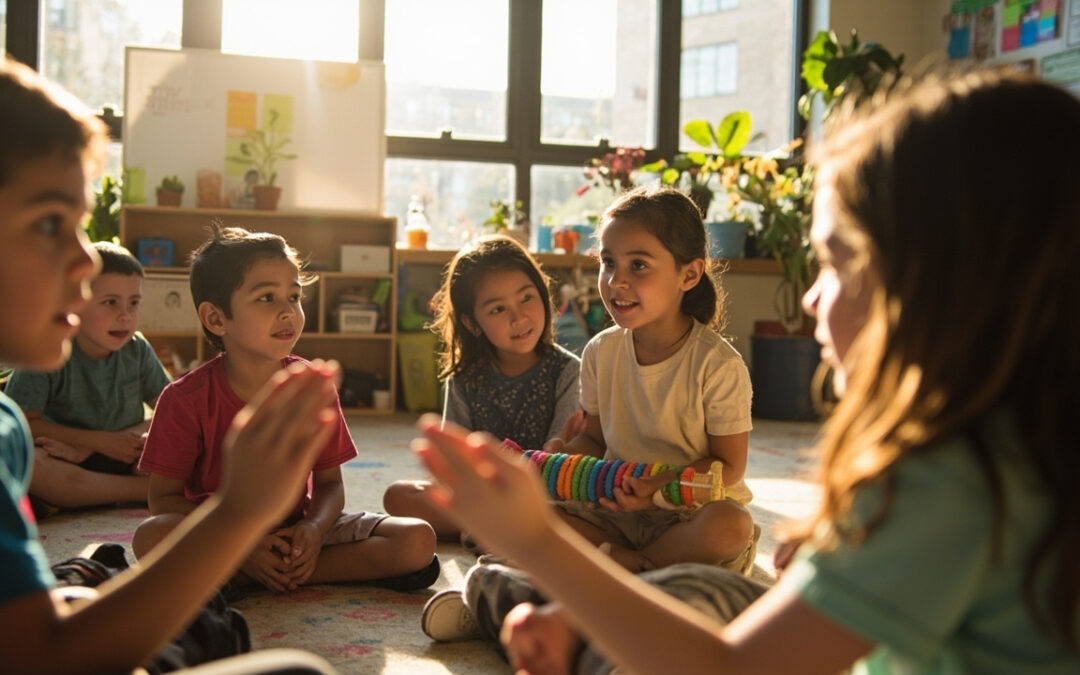
Gather students in a circle — chairs, the floor, whatever your space allows — and use a simple talking piece so only one person speaks at a time. Open with a low-stakes prompt: What’s one thing you’re looking forward to this week? The format itself teaches listening, turn-taking, and belonging. Ten minutes is enough to start.
Use the Four Restorative Questions
When a conflict arises, resist the instinct to jump straight to consequences. Instead, start here:
1. What happened?
2. What were you thinking at the time?
3. Who has been affected by this, and how?
4. What do you think needs to happen to make things right?
These questions aren’t soft. They require genuine reflection and real accountability. They also give students meaningful voice in the repair process — which dramatically increases the likelihood they’ll follow through.
Model Affective Statements
Use “I” language to name the emotional impact of behavior — yours and your students’. “I felt really concerned when I saw that happen, because I know how much you worked on this.” This isn’t about guilt-tripping; it’s about making the human impact of actions visible and real. Young students often respond to this in ways they don’t respond to abstract rules.
Try a Morning Check-In
A 5-minute check-in — On a scale of 1 to 5, how are you feeling today? with a brief share — gives you immediate data about your class and signals to every student that you see them as a whole person. It’s also the gentlest on-ramp to a fuller circle practice.
—
Common Challenges (and How to Work Through Them)
“I don’t have time for circles.” Start with five minutes once a week. Also consider: how much time are you currently spending on repeated behavior issues? Proactive practices often reclaim time over the course of a school year.
“Students don’t take it seriously.” This is almost always a sign that community hasn’t been built up enough yet. Spend more time on proactive circles before moving to responsive ones. Trust isn’t instant — it’s accumulated.
“What about kids who’ve caused real harm?” Restorative practices can absolutely coexist with other consequences. A student can serve a suspension and participate in a restorative process. One doesn’t cancel the other. The restorative piece addresses the relationship and the community; the consequence addresses the behavior.

—
Where Restorative Practices Fit in Your SEL Work
If your school already has an SEL program, restorative practices aren’t a replacement — they’re a complement. SEL builds the vocabulary and skills: empathy, self-awareness, responsible decision-making. Restorative practices give those skills a real-world arena where students have to actually use them — when it’s hard, when there are stakes, when someone got hurt.
Think of it this way: SEL teaches students what empathy looks like. Restorative practices put them in situations where they have to practice it in real time, with real people they have real relationships with.
Together, they don’t just change behavior. They change classroom culture.
—
Building Culture One Circle at a Time
Restorative practices in the elementary classroom aren’t a quick fix. They’re a long game — a daily investment in the kind of community where students feel safe, connected, and accountable to each other.
The good news: you don’t have to implement everything at once. Start with a talking piece and a circle. Ask one restorative question the next time a conflict comes up. Model affective language once this week.
Small, consistent steps build the culture you’re working toward — and your students will show you it’s working.
—
Interested in bringing restorative practices and SEL to life in your school? Explore how Soul Shoppe supports educators with programs, tools, and professional development designed for real elementary classrooms.