

How to Implement Social Emotional Learning in the Classroom
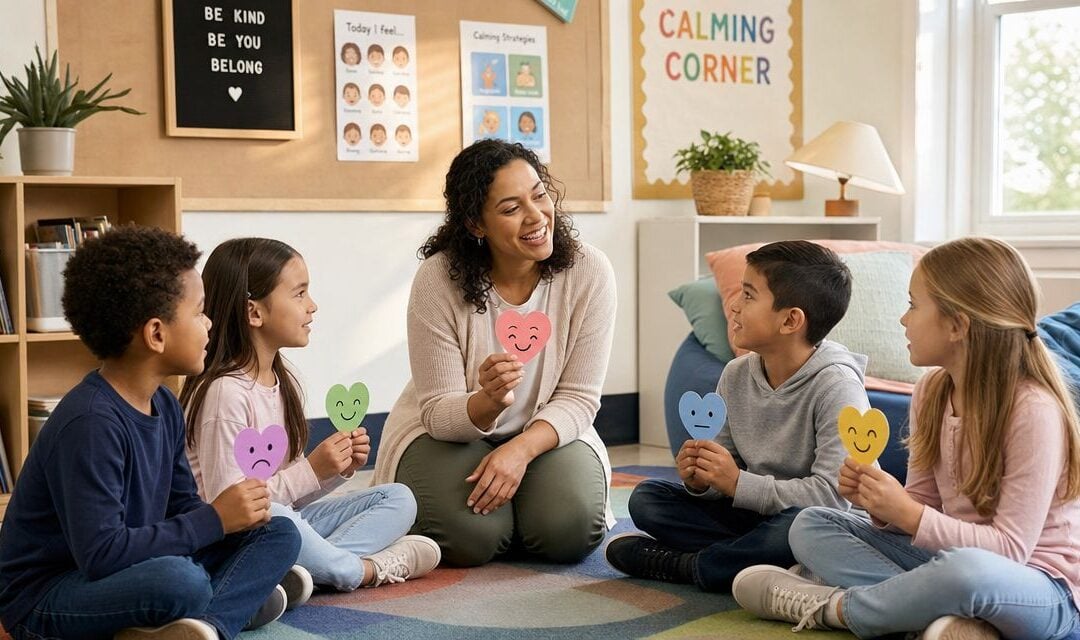
Somewhere between the math block and dismissal, it happens. Two students snap at each other over a pencil. One child puts their head down and won't try the assignment. Another keeps making jokes because that's easier than saying, "I'm overwhelmed."
Most teachers don't need a lecture on why behavior matters. You live it all day. What you need is a way to respond that helps kids settle, reconnect, and keep learning.
That's where social emotional learning fits. It isn't extra fluff, and it isn't a reward for classes that are already calm. It's a practical way to teach students how to notice feelings, manage stress, solve problems, and stay connected to the people around them. If you've been wondering how to implement social emotional learning in the classroom without adding one more impossible task to your plate, start small and think in layers: routines, lessons, relationships, and schoolwide support.
Creating a Classroom Where Every Student Thrives
A third grader rips up her paper after making a mistake. Two classmates start whispering about it, and now the whole table is off track. In another room, a middle school student shrugs and says, "I don't care," even though you can tell he does. These moments look different on the surface, but they often point to the same missing skills: naming emotions, handling frustration, reading social cues, and repairing conflict.
Social emotional learning gives teachers a way to teach those skills directly. Instead of only reacting after problems explode, you build habits that help students pause sooner and recover faster. That changes the feel of the room. Kids get more language for what they're feeling, and teachers get more options than "stop" and "sit down."
A 2018 meta-analysis reviewing 50 years of studies found that SEL programs produced significant gains in reading, mathematics, and science for PreK to 12 students, and the benefits were observed across grade levels and across student groups, as summarized in Northern University's overview of SEL research. That matters because it tells us SEL isn't a side project. It belongs in real classrooms with real academic demands.
What this looks like in an ordinary week
In practice, SEL can be as simple as greeting students by name, running a quick feelings check-in, teaching one sentence stem for conflict, and giving students a calm place to reset. Those moves don't solve everything. They do create enough safety and predictability for learning to happen more often.
For the classroom environment itself, this piece on what makes a peaceful and welcoming classroom pairs well with daily SEL practice.
SEL works best when students experience it as part of the day, not as a special event that disappears when things get busy.
Building the Foundation with Core SEL Routines
The strongest classrooms don't rely on one great lesson. They rely on repeated routines. Students need the same emotional tools practiced again and again when they're calm, so those tools are available when they're upset.
A strong foundation for SEL starts with the five core competencies from CASEL: self-awareness, self-management, social awareness, relationship skills, and responsible decision-making. Research syntheses covering hundreds of studies, summarized by the Learning Policy Institute's report on evidence for social and emotional learning, found that this approach supports stronger social-emotional competencies, better behavior, and gains in academic performance.

Make the five competencies visible and simple
You don't need to introduce the CASEL language like a formal unit. Translate it into classroom language students can use.
- Self-awareness means "I can notice what I'm feeling."
- Self-management means "I can calm my body and make a plan."
- Social awareness means "I can think about how someone else might feel."
- Relationship skills means "I can listen, speak respectfully, and work things out."
- Responsible decision-making means "I can choose a response that helps, not harms."
Post those ideas on the wall in student-friendly words. Refer to them when something real happens. If a student is frustrated during writing, say, "Let's use self-management." If two students interrupt each other, say, "This is relationship skills practice."
Start the day with one predictable check-in
Morning meeting doesn't have to be elaborate. In many classrooms, a five-minute routine is enough. The key is consistency.
A simple structure works well:
- Greeting: "Good morning, Maya. I'm glad you're here."
- Check-in: "Show with fingers, colors, or a one-word answer how you're arriving today."
- Mini skill: one brief breathing, listening, or speaking routine.
- Preview: "Today, we'll practice asking for help respectfully during partner work."
Here are a few check-in prompts you can use tomorrow:
- For K to 2: "Point to the face that matches how you feel."
- For 3 to 5: "What's one word for your energy right now?"
- For 6 to 8: "What's something that might help you focus today?"
If you need help building routines that calm students before instruction starts, this guide on routines for kids and emotional grounding offers practical ideas that transfer well to classrooms.
Practical rule: Keep the routine short enough that you'll actually use it on busy days.
Teach one calming strategy until everyone knows it
Many teachers make the mistake of offering six coping tools at once. Start with one. Practice it when no one is upset. Then coach students to use it during mild frustration.
You can use this script:
"Let's take a turtle breath. Pretend you're a turtle pulling into your shell. Tuck your head down, breathe in slowly through your nose, and as you breathe out, slowly peek your head back out."
That works especially well in K to 3, but older students often respond if you present it plainly and skip babyish tone. For middle grades, you might call it "slow in, slower out" and have students track the breath with a hand on the desk.
Other low-prep regulation routines include:
- Desk reset: Students put both feet down, relax shoulders, and take three quiet breaths.
- Hand trace breathing: Trace one finger up and down the other hand while breathing in and out.
- Count and choose: "Name what you're feeling. Rate it low, medium, or high. Choose one calm strategy."
Create a calm-down space that teaches, not punishes
A Peace Corner isn't time-out with softer decor. It should be a brief reset space students use to regulate and return.
Keep it simple. Add a small visual feelings chart, one breathing prompt, a reflection card, and a clear expectation such as: "Calm body. Quiet reset. Return when ready." A clipboard with sentence starters can help:
- "I am feeling…"
- "What happened was…"
- "What I need next is…"
- "When I go back, I will…"
For younger students, use pictures. For older students, use a short written reflection or a dry-erase board.
Build shared language for conflict
Students need actual words. "Use your words" is too vague. Give them sentence stems they can practice during low-stakes moments.
Try these:
- I-statement: "I feel frustrated when you grab the marker because I wasn't finished."
- Boundary: "Please don't touch my work without asking."
- Repair: "I want to fix this. Can we start over?"
- Request: "Next time, can you ask first?"
Role-play these during class meetings. Keep the scenarios ordinary: line cutting, teasing, interrupting, not sharing materials. Students are much more likely to use language they've rehearsed.
Weaving SEL into Your Academic Lessons
One of the biggest misconceptions about SEL is that it requires a separate block you don't have. In most classrooms, the more sustainable move is to build social and emotional skills into the lessons you're already teaching.
That means you use reading discussions to practice perspective-taking, math problem solving to practice frustration tolerance, and social studies to practice empathy and ethical thinking. SEL becomes part of how students learn, not one more thing stacked on top.
What SEL looks like during instruction
In literacy, ask students to support emotional inferences with evidence. "What clues in the text tell you how she was feeling?" moves the conversation beyond guessing. It teaches careful reading and emotional awareness at the same time.
In math, normalize productive struggle. Before students tackle a challenging problem, you might say, "If you feel stuck, that's the moment to use self-management. Pause, breathe, reread, and try one part." During partner work, coach them to ask, "Can you explain how you started?" instead of "What's the answer?"
In social studies, SEL often shows up through perspective. When students study a community, a migration, a protest, or a historical decision, invite them to ask: "What pressures might this group have faced?" or "How might two people have experienced this event differently?"
For more classroom-ready examples, this collection of social emotional learning strategies can help teachers expand beyond standalone activities.
Sample SEL Integration Activities by Grade Band
| Grade Band | Literacy (Relationship Skills) | Math (Self-Management) | Social Studies (Social Awareness) |
|---|---|---|---|
| K-2 | Read a picture book and ask, "How did the character know their friend was upset?" Then have students practice one kind response. | Before independent work, teach a "try, breathe, ask" routine. Students try one strategy, take one slow breath, then ask for help. | When learning about helpers in the community, ask, "What does this person do to care for others?" |
| 3-5 | During character analysis, ask students to compare two characters' communication choices and discuss what made one more respectful. | After a hard problem, students reflect: "What did I do when I got stuck?" Share useful coping moves with a partner. | When studying communities or regions, ask students to consider how people with different roles may see the same issue differently. |
| 6-8 | Use discussion stems such as "I hear your point, and I see it differently because…" during text-based conversation. | Teach students to notice stress signals during multi-step tasks and choose a reset move before giving up. | During historical inquiry, have students examine whose voices are centered, whose are missing, and how perspective shapes understanding. |
Questions that pull double duty
A good integration question strengthens both the subject and the SEL skill. Here are a few that work across grade levels:
- In reading: "What does this character need but isn't saying out loud?"
- In writing: "How can you disagree respectfully in your response?"
- In math: "What do you tell yourself when the first strategy doesn't work?"
- In science: "How does your group decide whose idea to test first?"
- In social studies: "What might seem fair to one group and unfair to another?"
Ask SEL questions during content lessons when students are already engaged. That's when the skill feels useful instead of abstract.
Fostering a Culture of Empathy and Connection
Some classrooms feel settled the moment students walk in. Not silent. Not rigid. Just steady. Students know how to join a group, how to disagree without escalating, and how to recover after a rough moment.
That kind of room is built through repeated human choices. The teacher notices tone. Students learn how to repair harm. Everyone shares some responsibility for belonging.

Use restorative conversations after conflict
When a conflict happens, many students expect one thing: blame. A restorative approach still holds students accountable, but it also teaches them how to understand impact and repair relationships.
A simple four-question script works well:
- What happened?
- What were you feeling at the time?
- Who was affected, and how?
- What needs to happen to make things right?
This can happen in a quiet corner, at a back table, or after class. Keep your voice steady. Don't rush to solve it for them. Let students do the thinking.
Here is what that might sound like with upper elementary students:
- Student A: "He kept interrupting me."
- Student B: "I thought you were ignoring me."
- Teacher: "Who was affected?"
- Student A: "Both of us. We stopped working."
- Teacher: "What's one repair step?"
- Student B: "I'll let you finish, then ask."
Give students jobs that build community
Not every class job has to involve papers or pencils. Some of the best jobs strengthen the social life of the room.
Consider roles like these:
- Inclusion Ambassador: notices when someone is left out during partner or group work.
- Peacemaker: reminds classmates to use agreed-upon sentence stems during small conflicts.
- Welcome Greeter: helps new or absent students rejoin routines.
- Calm Corner Manager: checks that reflection tools are put back and ready.
These roles matter because they tell students that empathy and responsibility aren't private virtues. They are part of how the classroom runs.
Let students see you practice SEL too
Years ago, I snapped at a class after a loud transition. I wasn't cruel, but my tone was sharper than I wanted. A minute later, I stopped, took a breath, and said, "That came out harsher than I meant. I was feeling frustrated, and I didn't handle it the way I want us to handle frustration here. I'm sorry. Let me try that again."
The room softened immediately. Not because I was perfect, but because I showed them what repair looks like.
A short video can help teachers picture this kind of relational work in action.