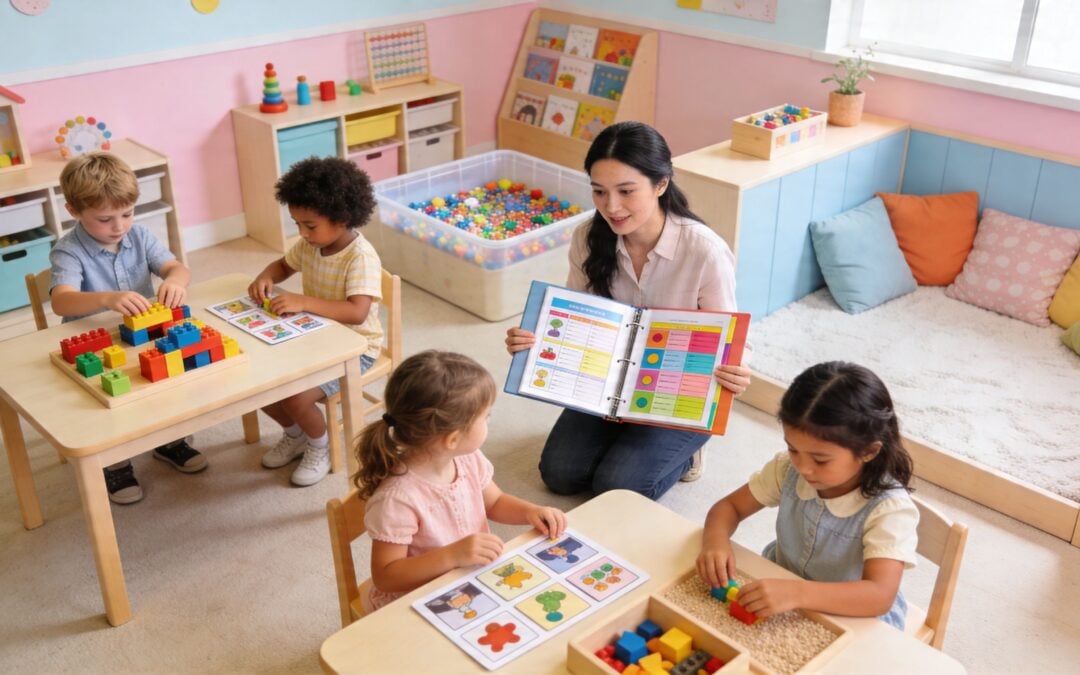
Beyond ABCs, the strongest preschool lesson plan ideas build a classroom where children learn how to be with themselves and with other people. You can see the difference quickly. One child is disappointed that the blue marker is gone, but instead of melting down, she says, “I’m frustrated.” Two children both want the same truck, and with support, they try turns instead of grabbing. A quiet child starts to join circle because the routines feel safe and predictable.

That kind of room doesn’t happen because a teacher added a poster about feelings. It happens because social-emotional learning is built into the day, not saved for a special lesson once a week. Preschoolers need repeated practice with naming emotions, calming their bodies, listening, solving problems, and feeling that they belong. Those skills are just as teachable as counting, sorting, or letter recognition.

That’s also why the best preschool lesson plan ideas aren’t only about themes like apples, weather, or community helpers. They connect academic learning with concrete social practice. Early math standards already point in this direction. Kindergarten students in the Common Core are expected to organize, represent, and interpret data in categories, including comparing how many are in each group, according to CCSS-aligned guidance summarized here. In preschool, that can look like graphing favorite feelings, tallying classroom choices, or sorting how classmates like to greet each other.

Busy teachers and parents don’t need more cute activities without a plan. They need lessons that work in real classrooms, with wiggles, conflicts, uneven language development, and a wide range of needs. The ideas below are built for that reality. Each one includes a clear activity, practical examples, differentiation moves, simple assessment, and a home extension so the lesson doesn’t stop at pickup.

1. Emotion Recognition and Naming Circle

Start with the simplest skill, giving feelings names children can use. Sit in a circle with a mirror, a few emotion cards, and one short picture book. Pick just three or four feelings at first, such as happy, sad, frustrated, and excited. More choices sound richer, but too many labels at once usually create guessing instead of understanding.

A teacher holds a mirror for a child while other children hold emotion-labeled cards in a circle.

Ask children to look at a card, copy the face, then check themselves in the mirror. That mirror matters. Preschoolers often understand feelings better when they can connect the word to a face and body, not just hear an adult define it.

How to run it

Read a familiar story and pause on one page. Ask, “How does the character feel?” Then follow with, “What do you see that makes you think that?” That second question keeps the conversation grounded in observable clues like eyebrows, tears, posture, or voice.

At transition times, repeat a quick ritual. Children can point to a feeling card as they come to circle, lunch, or rest. If you want to deepen the work, Soul Shoppe’s guidance on naming feelings and helping kids find the words they need fits naturally with this kind of daily practice.

Practical rule: Don’t correct a child too quickly if they misread a feeling. Ask what they noticed first. The explanation often tells you more than the answer.

For differentiation, offer visual choices instead of open-ended questions for children with limited expressive language. For sensory-sensitive children, skip exaggerated group mimicking if it feels like too much and let them point or match instead.

  • Assessment: Note whether a child can match a facial expression to a feeling word, identify a character’s emotion, or name their own feeling with support.
  • Home extension: Send home two or three feeling words with simple prompts like “When did you feel excited today?”
  • What works: Repetition, mirrors, and familiar books.
  • What doesn’t: Abstract discussions about emotions without visual support.

2. Mindfulness and Breathing Activity Stations

Some children need movement to calm. Some need touch. Some need a script. A single whole-group breathing lesson rarely reaches everyone, which is why stations work well.

Set up three calm choices around the room. One can be bubble breathing. One can be a stuffed animal “belly buddy” station where children watch the toy rise and fall on their stomach. One can be a sensory station with a glitter bottle or soft fabric squares for slow touch and observation.

A young boy blowing bubbles at a table next to a girl holding a plush toy.

Keep the language concrete. “Smell the flower, blow out the candle” works better than “regulate your nervous system.” Practice when children are calm, not only after a conflict. If you wait until a child is already overwhelmed, the strategy feels like a demand instead of a tool.

Best station choices for preschool

A short rotation is enough. Preschool attention is brief, and calm practice should feel accessible, not heavy.

  • Bubble breathing: Children inhale, then blow slowly enough to make one large bubble instead of many fast ones.
  • Belly buddy breathing: Children lie down and watch a plush toy move as they breathe.
  • Slow-move path: Tape simple footprints on the floor and invite heel-to-toe walking.

Soul Shoppe’s explanation of the belly breathing technique gives families and staff a shared routine, which helps children use the same language across settings.

Teachers often ask whether mindfulness belongs in preschool. It does, if it stays physical, brief, and optional in delivery. Children don’t need long silent meditations. They need usable calming habits.

Some children will giggle through the first few rounds. That’s normal. Stay steady and keep going.

For differentiation, let children choose between seated, standing, or lying-down options. For children who resist stillness, begin with movement and end with one breath.

  • Assessment: Watch whether children can copy the breath pattern, choose a calming station, or return to group with less support over time.
  • Home extension: Send one breathing phrase home and encourage families to use it before bedtime or transitions.
  • What works: Consistent routines and visual prompts.
  • What doesn’t: Treating calming tools as consequences.

3. Kindness and Empathy Circle Stories

Books are one of the easiest ways to teach empathy because they let children practice noticing another person’s inner world. Choose stories with clear social moments. A character is left out. Someone makes a mistake. A friend helps. Keep the plot simple enough that children can track both action and feeling.

Read slowly and stop often. Ask, “What might help right now?” That question moves children from emotion recognition into response. You’re not only naming sadness. You’re teaching what caring can look like.

Turning story time into social practice

After reading, act out one moment with puppets or stuffed animals. If the story shows a child dropping blocks and feeling upset, one puppet can offer help, one can laugh, and children can compare the outcomes. This keeps empathy concrete.

Soul Shoppe’s approach to teaching empathy pairs well with this kind of discussion because preschoolers learn best when caring language is practiced, not merely praised.

Use a class kindness chart, but keep it descriptive. Write or draw what happened: “Mila got a tissue for Ben” or “Jordan moved over so Ava had space.” Avoid turning kindness into a competition for stickers.

  • Assessment: Listen for whether children can identify how a character feels and suggest one helpful response.
  • Differentiation: Offer picture choices for children who struggle with open discussion. For children with social communication differences, rehearse one response line such as “Do you want help?”
  • Home extension: Send home one book title and one dinner-table question, such as “When did someone help you today?”

One strong example is a classroom “kindness replay.” After lunch, the teacher briefly retells one helpful moment from the morning and asks children to show the feeling on their faces. That simple replay ties story language to real classroom life.

4. Conflict Resolution and Problem-Solving Role-Play

This lesson belongs in every preschool room because conflicts will happen anyway. The question isn’t whether children will argue over materials, space, or turns. The question is whether they’ll have any script beyond grabbing, crying, or shutting down.

Use a very simple scenario first. Two children want the same shovel. One child says, “I had it.” The other says, “I want it now.” Freeze the action and ask the group what the children could say or do next.

Lead in with a visual support, then show the role-play clip below during teacher planning or for family workshops.

A simple problem-solving path

Children need a short sequence they can remember under stress. Long scripts fall apart in real moments.

  • Say the problem: “We both want the truck.”
  • Listen: Use a talking object so each child gets a turn.
  • Pick a solution: Trade, take turns, use a timer, or find another similar item.
  • Check back: “Did that work?”

Soul Shoppe shares helpful examples in these conflict resolution activities for kids, and the key is the same in preschool as in older grades. Children need repeated rehearsal before a real disagreement.

What doesn’t work is forcing apologies on demand. A child can say “sorry” and still have no idea what to do next time. What works is helping children name the problem, hear another person, and try a concrete next step.

“Use your words” is too vague for most preschoolers. Give them the actual words.

For inclusive practice, use picture cards showing options like wait, trade, ask, or help. For children who struggle with transitions, keep the same conflict routine every day and post it at child height.

  • Assessment: Notice whether a child can state the problem, wait for a turn to speak, or choose from two possible solutions.
  • Home extension: Share the same classroom script with families so children hear the same language at home.

5. Belonging and Classroom Community Building

If children don’t feel they belong, every other lesson gets harder. They’re less willing to speak, take risks, ask for help, or recover from mistakes. Community building isn’t extra. It’s part of classroom management, family engagement, and learning readiness all at once.

A strong belonging lesson can be as simple as a daily greeting choice board. Children choose a wave, fist bump, dance move, or verbal hello. Then they see their photo moved from “home” to “school” on an attendance board. That small ritual tells a child, “You’re seen. You matter here.”

A friendly teacher assists preschool students in a classroom with educational name cards and colorful handprint artwork.

Routines that help children feel included

The strongest routines are predictable and visible. They don’t depend on which adult is leading that day.

  • Name practice: Use every child’s name often and learn the correct pronunciation from family members.
  • Shared jobs: Give every child a real classroom role, not just the most confident children.
  • Cooperative play: Choose activities where children build or create together instead of competing.
  • Family presence: Display family photos at eye level and refer to them naturally during the day.

For a simple movement option, cooperative games for team building can be adapted for preschool with shorter turns and clear visual expectations.

One useful classroom project is a “We Belong Here” mural. Each child adds a handprint, photo, or drawing of something important to them. During circle, children introduce one piece of their section. That works better than generic “all about me” pages that end up on a wall without shared discussion.

  • Assessment: Watch who enters easily, who hangs back, who knows classmates’ names, and who joins group tasks with support.
  • Differentiation: Offer nonverbal greeting choices, visual job cards, and a quiet participation option for children who warm up slowly.
  • Home extension: Ask families to send a photo, favorite song, or short note about what helps their child feel safe.

6. Social Stories and Friendship Skills Curriculum

Some social skills have to be taught directly. “Be nice” doesn’t tell a child how to join a game, ask for a turn, or respond when someone says no. Social stories help because they break a social moment into clear, repeatable steps.

Pick one friendship skill and stay with it for several days. Joining play is a good starting point. Read a short homemade social story with photos of your classroom: “I see children playing. I can watch first. I can say, ‘Can I play?’ I can join gently.” Using real photos from your room makes the story easier to transfer into daily play.

One skill at a time works best

Children learn social routines through repetition and consistency. When adults switch language constantly, children don’t know what to hold onto.

Try a mini-cycle like this over one week:

  • Day one: Read the social story and model the skill.
  • Day two: Practice with puppets.
  • Day three: Rehearse in centers with adult support.
  • Day four: Notice and narrate real examples.
  • Day five: Review with photos of children using the skill.

This is especially helpful for neurodiverse learners and children who need more predictability around social expectations. Existing preschool planning resources often leave that adaptation gap wide open, even though inclusive classrooms need concrete modifications for sensory needs, transitions, and social communication support, as discussed in this overview of inclusive preschool education gaps.

What works is using the same short language across adults. “Watch, ask, join gently” is easier than a long lecture in the block area.

  • Assessment: Track whether a child can use one step independently, such as watching first or asking to join.
  • Differentiation: Use picture cue cards, peer models, and shorter practice bursts in low-stress settings.
  • Home extension: Send the social story home so families can rehearse the same script before playdates or sibling play.

7. Self-Awareness and Personal Strengths Discovery

Preschoolers benefit from hearing what they’re good at, but broad praise isn’t enough. “Good job” fades quickly. Specific reflection helps children build a more stable sense of self.

Create a weekly “strength spotlight” for one child. Use photos, a quote, and one or two teacher observations. “You kept trying to fit the puzzle piece even when it was tricky.” “You noticed Maya was sad and brought her a tissue.” That kind of feedback teaches children to connect actions with identity.

Make strengths visible and specific

This lesson works best when strengths include both academic and social qualities. Otherwise, children start to think only fast finishers or strong talkers have value.

Use a small display or binder page with prompts like:

  • I enjoy
  • I’m learning
  • My friends know me for
  • One thing I’m proud of

Children can dictate responses while you write. Revisit those statements later so they don’t become a one-time poster and disappear into wall décor.

A nice extension is a “teacher noticing board” near sign-in. Families can read one sentence about what their child did well that day. Keep it concrete and effort-based.

Children believe the stories adults repeat about them. Make those stories accurate, generous, and specific.

For differentiation, let children respond through pointing, drawing, choosing photos, or moving objects instead of speaking. For children who struggle with self-expression, start with preference language: “I like,” “I don’t like,” “I want,” and “I need.”

  • Assessment: Listen for whether children can name a preference, a strength, or a task they’re still learning.
  • Home extension: Invite families to share one strength they see at home so school and home language align.
  • What works: Documentation, photos, and child dictation.
  • What doesn’t: Empty praise that gives no usable information.

8. Listening and Respectful Communication Lessons

Listening has to be taught as a physical and social skill. Preschoolers don’t automatically know how to wait, track a speaker, or respond respectfully, especially in a busy room with noise, movement, and competing interests.

Begin with a game, not a lecture. Sound scavenger hunts work well. Ask children to close their eyes for a few seconds and identify what they hear: a bell, footsteps, a zipper, water running. Then connect that same body posture to listening to a friend.

Teach what listening looks like

A visual checklist helps because “listen” is invisible unless you make it concrete. Draw simple icons for eyes watching, body still, mouth quiet, and ears listening.

The progression can look like this:

  • Model: Teacher and assistant show good and poor listening in a playful way.
  • Practice: Children use a talking object during partner share.
  • Reflect: Ask, “What did listening help us do?”

For early childhood classrooms, this kind of communication practice belongs alongside academics. Preschoolers naturally gather and organize information through hand-raising counts, tallying, and classroom voting, and teachers can help them see those moments as real data work, according to Stanford’s DREME guidance on data in the preschool classroom. A simple example is voting on which song to sing, then listening while classmates explain their choice.

What doesn’t work is expecting long carpet discussions without scaffolds. What works is short turns, visible supports, and specific praise such as, “You waited until Ana finished.”

  • Assessment: Watch whether a child can wait for a turn, repeat back one idea, or face the speaker during a short exchange.
  • Differentiation: Use visual timers, partner talk before whole group, and movement breaks between speaking turns.
  • Home extension: Encourage families to use one listening game during car rides or meals.

9. Celebrating Diversity and Inclusive Community Practices

Children notice differences early. They notice skin tones, languages, family structures, mobility devices, hairstyles, food, and names. If the classroom stays silent, children still form ideas. Inclusive teaching means guiding those observations with respect instead of pretending everyone is the same.

Start by looking at the room itself. Do the books, dolls, puzzles, dramatic play items, and posters reflect the children you teach and the wider world? If not, the lesson begins with changing the environment.

Small classroom choices send big messages

Use books and materials that include many kinds of families, cultures, and abilities in everyday situations, not only in holiday units. Normalize difference through routine conversation. “Ayaan says hello to grandma in Arabic.” “Lena has two homes.” “Mateo uses headphones when the room feels loud.”

This area is often underdeveloped in common preschool planning resources. Much of the available content still centers academic themes while offering limited guidance for directly embedding social-emotional learning into daily instruction, including empathy, emotional regulation, and peer connection, as noted in this discussion of a social-emotional integration gap in preschool planning.

One practical activity is a family story share. Invite each family to contribute a photo, object, song, greeting, or favorite food tradition. Keep it simple so participation is realistic. A family doesn’t need to come in person to be included.

When bias shows up, respond calmly and clearly. Children need correction without shame and guidance without silence.

For differentiation, preview new cultural materials for children who need routine, and provide sensory alternatives during music, food, or celebration activities. Inclusion isn’t only representation. It’s also access.

  • Assessment: Notice whether children show curiosity respectfully, use classmates’ names correctly, and include peers whose backgrounds differ from their own.
  • Home extension: Ask families to share one word, ritual, or tradition they’d like honored in the classroom.

10. Teaching Resilience and Growth Mindset Through Challenge Activities

A good challenge activity is hard enough to require effort and manageable enough that children can still succeed with support. That balance matters. If the task is too easy, children don’t practice persistence. If it’s too hard, you get shutdown, avoidance, or frantic behavior.

Try a building challenge with recycled materials, blocks, tape, and clothespins. Ask children to make a bridge for a toy animal or a house that won’t fall when the table is gently tapped. Then pause halfway through and ask, “What are you trying now?” That question shifts attention from outcome to strategy.

How to teach persistence without pressure

Use growth-minded language all through the lesson. “You’re still figuring it out.” “That didn’t work yet.” “What else could you try?” Keep your tone matter-of-fact. If adults become overly excited or evaluative, children start performing for approval instead of staying with the task.

Children also benefit from early exposure to data and investigation through play. Researchers and teacher supports connected to early childhood data science describe a need for practical tools that help teachers bridge abstract ideas through concrete experiences like sorting, observing, and representing information in play-based ways, as explained in Adding Data Science to Preschool Math. In a resilience lesson, children can compare which building designs stood longer or sort strategies that helped.

A reflection circle after the challenge is where much of the learning lands. Ask, “What was tricky?” “What did you do when it got frustrating?” “Who changed their plan?”

  • Assessment: Notice whether a child stays with a task, asks for help, tries a second strategy, or recovers after a mistake.
  • Differentiation: Offer graduated materials, visual step cards, and a break option for children who become overwhelmed.
  • Home extension: Send home one challenge prompt using common household materials and encourage families to praise effort and strategy, not speed or perfection.

Side-by-Side Comparison: 10 Preschool Lesson Plans

Activity Implementation Complexity Resource Requirements Expected Outcomes Ideal Use Cases Key Advantages
Emotion Recognition and Naming Circle Low–Moderate (routine facilitation) Low (charts, mirrors, stories) Better emotion vocabulary and recognition Daily check-ins, morning circle Engaging, adaptable, builds teacher-child trust
Mindfulness and Breathing Activity Stations Moderate (setup and modeling) Moderate (sensory tools, quiet space) Immediate calming skills and self-regulation Calm corners, transitions, sensory supports Multi-sensory, practical coping tools
Kindness and Empathy Circle Stories Low–Moderate (story facilitation + follow-up) Low (books, puppets) Improved perspective-taking and empathy Read-alouds, community-building lessons Emotionally engaging, memorable learning
Conflict Resolution and Problem-Solving Role-Play Moderate–High (teacher skill, repetition) Low–Moderate (scripts, puppets, posters) Stronger problem-solving and communication Small groups, conflict coaching, role-play time Safe practice space, builds agency
Belonging and Classroom Community Building Moderate (ongoing rituals, planning) Low–Moderate (displays, collaborative materials) Increased belonging, reduced anxiety, better engagement Start of year, routines, family events Foundational for all SEL, visible culture gains
Social Stories and Friendship Skills Curriculum Moderate (systematic instruction) Moderate (visual stories, materials) Improved specific social behaviors and sharing Targeted skill instruction, small groups Direct skill teaching, supports diverse learners
Self-Awareness and Personal Strengths Discovery Moderate–High (individual attention) Moderate (portfolios, documentation tools) Greater self-confidence, identity, resilience Individual conferences, portfolios, interest centers Strength-based, fosters agency and voice
Listening and Respectful Communication Lessons Moderate (modeling and routines) Low (timers, talking objects, posters) Better attention, turn-taking, calmer class Circle time, morning meetings, transitions Foundational for academics and relationships
Celebrating Diversity and Inclusive Community Practices Moderate–High (ongoing adult learning) Moderate–High (diverse materials, family partnerships) Increased inclusion, cultural awareness, equity Curriculum planning, family engagement, events Authentic inclusion, supports belonging for all
Teaching Resilience and Growth Mindset Through Challenge Activities Moderate (scaffolding, adult framing) Low–Moderate (challenge materials, reflection tools) Increased persistence, adaptive coping, growth orientation STEM tasks, project work, reflective lessons Normalizes struggle, builds long-term resilience

Putting SEL at the Heart of Your Classroom

These preschool lesson plan ideas work because they treat social-emotional learning as daily instruction, not an add-on. Children don’t build empathy from one kindness poster. They build it by hearing feelings named, watching adults model repair, practicing scripts in real moments, and revisiting the same skills across the year. That repetition is what turns a lesson into a habit.

If you’re trying to improve your planning, start smaller than you think you should. Pick one routine and make it consistent. An emotion check-in at arrival. A breathing station after recess. A friendship script in the block area. A class kindness replay before dismissal. Most classrooms improve through steady practice, not through a giant reset.

That matters in modern early childhood settings because the academic side of preschool has gotten more complex. Preschool enrollment reached 58% of 3 to 5-year-olds in the United States by 2023, according to the measurement lesson plans overview citing NCES data. At the same time, teachers are being asked to support early math, language, behavior, inclusion, and family partnership. The most workable response isn’t to carve the day into disconnected programs. It’s to teach whole-child skills through what you’re already doing.

For example, graphing can become a feelings lesson when children sort how they feel at morning meeting. That connects naturally to early standards for organizing and interpreting category data. A collaborative art project can become a belonging lesson when each child contributes something personal and the class practices noticing one another’s ideas. Story time can become empathy practice when children pause to read facial expressions and suggest caring responses. The strongest preschool lesson plan ideas do double duty.

Teachers also need permission to notice trade-offs. Whole-group discussions build shared language, but some children will participate better with puppets, picture cards, or partner talk first. Open-ended activities encourage voice and creativity, but many children need clear visuals and repeated scripts before they can succeed in them. Calm corners help when they’re taught proactively. They don’t help much when they’re introduced only after a child is already dysregulated and feels sent away.

Inclusion has to stay at the center of this work. If a lesson depends on long verbal responses, children with language delays or social communication differences may get left out. If it depends on noisy sensory materials, some children will spend the lesson coping rather than learning. If it assumes all families can attend daytime events or send supplies, belonging becomes uneven. Good planning anticipates those barriers and offers more than one path into participation.

Keep assessment simple and useful. In preschool, the best assessment often looks like a clipboard note, a photo, or one sentence recorded after an interaction. Can the child name a feeling with support? Ask to join play? Recover after frustration? Wait for a turn? Use a calming strategy? Those observations tell you more than a polished final product.

There’s also real value in shared language across school and home. Children do better when teachers, counselors, administrators, and caregivers use the same short phrases for breathing, listening, problem-solving, and repair. That’s one reason many schools look for SEL partners that support adults as well as children. Soul Shoppe’s work is built around connection, safety, empathy, and practical tools that school communities can use, including research-based experiential programs delivered over more than 20 years.

The goal isn’t a perfect classroom with no conflict, no tears, and no noise. Preschool shouldn’t look like that. The goal is a room where children learn what to do with big feelings, mistakes, and differences. When SEL sits at the heart of your planning, the classroom becomes calmer, clearer, and more humane. Children don’t just learn letters, numbers, and routines. They learn how to live and learn alongside other people.


If you want support turning these ideas into shared schoolwide practice, Soul Shoppe offers practical SEL programs, workshops, and tools that help children and adults build empathy, communication, conflict resolution, and belonging in everyday classroom life.