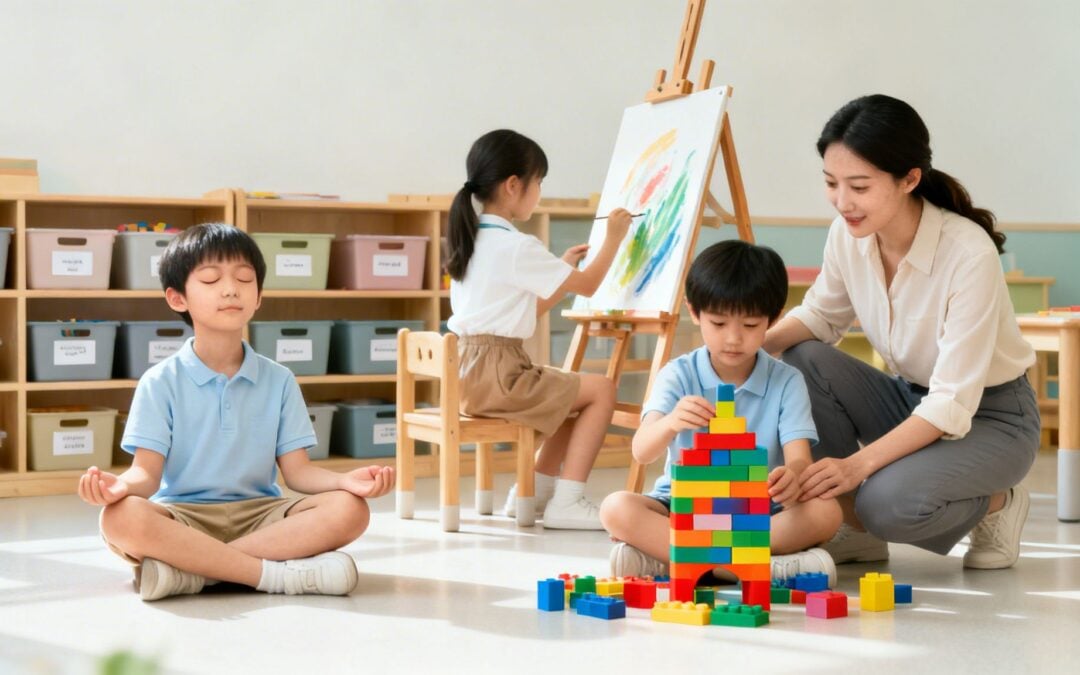
Anxiety in children can feel overwhelming for everyone involved-the child, their parents, and their teachers. It often manifests not just as worry, but as stomachaches, irritability, avoidance, or difficulty concentrating in the classroom. The core challenge lies in finding practical, in-the-moment tools that empower kids to navigate these big feelings without feeling defined by them. This guide moves beyond generic advice to offer a curated roundup of 10 evidence-based anxiety activities for kids, designed for easy implementation in both school and home settings.
This is not a theoretical discussion; it is a hands-on toolkit. Each activity is broken down into actionable steps, providing the specific language and structure needed to help children from kindergarten through 8th grade build resilience, self-awareness, and a sense of control. For example, instead of just suggesting "deep breathing," we provide scripts for guided exercises like "Box Breathing" or "Bumblebee Breath," complete with age-appropriate adaptations.
As experts in social-emotional learning, we have seen these strategies transform school communities by creating a shared language of support and emotional regulation. This article will equip educators, administrators, and parents with the same practical tools. You will learn how to implement structured grounding techniques, creative expression prompts, and cognitive reframing exercises that foster a sense of safety and connection. Ultimately, our goal is to help you turn moments of anxiety into powerful opportunities for emotional growth and learning.
1. Mindfulness and Deep Breathing Exercises
Mindfulness and deep breathing are foundational anxiety activities for kids because they directly engage the body's nervous system. These practices teach children to activate their parasympathetic nervous system, which signals the body to rest and calm down, counteracting the "fight or flight" response of anxiety. By focusing on the physical sensation of the breath, children learn to anchor themselves in the present moment rather than getting carried away by worried thoughts.
This technique is effective because it’s a portable tool a child can use anytime, anywhere, without needing special equipment. It provides an immediate, tangible action they can take when they feel overwhelmed, empowering them with a sense of control over their emotional state.
How to Implement It
- Goal: To teach children a simple, reliable self-regulation technique to manage anxious feelings as they arise.
- Best For: In-the-moment calming, daily routine for emotional regulation, and transitions between activities.
- Time: 1-5 minutes.
Step-by-Step Guide:
- Introduce the Concept: Explain breathing in simple terms. For younger kids, you can say, "Let's pretend we're smelling a beautiful flower. Breathe in deep through your nose. Now, let's pretend we're blowing out birthday candles. Breathe out slowly through your mouth." For older students, explain how slow, deep breaths tell their brain it's safe to relax.
- Model the Technique: Practice with them. A common method is Box Breathing:
- Breathe in slowly for a count of four.
- Hold the breath for a count of four.
- Breathe out slowly for a count of four.
- Hold the breath out for a count of four.
- Practice Consistently: Integrate "Mindful Minutes" into daily routines. For example, a teacher might say, "Before we start our math test, let's all do three 'box breaths' together to clear our minds." Consistent practice during calm times helps children remember the skill when they actually feel anxious.
Practical Tips and Variations
- For Younger Children (K-2): Use "Bubble Breathing" (pretending to blow bubbles) or "Belly Buddies" (lying down with a small stuffed animal on their belly and watching it rise and fall with each breath).
- For Older Children (3-8): Introduce guided mindfulness apps or scripts. Encourage them to notice where they feel the breath in their body (nostrils, chest, stomach) to deepen their focus.
- At Home: Create a designated "calm-down corner" where breathing exercises are practiced. Parents can model the behavior by taking deep breaths themselves during stressful moments.
- In the Classroom: Establish a non-verbal signal for when a student needs a breathing break. Organizations like Soul Shoppe often integrate whole-class breathing exercises into their assemblies to create a shared school-wide language for self-regulation.
Key Insight: The power of this practice lies in its simplicity and accessibility. By teaching children to focus on their breath, you give them a lifelong tool for managing stress that requires nothing more than their own body and attention.
For more ideas on how to incorporate these practices, you can explore additional mindfulness activities for kids to expand your toolkit.
2. Progressive Muscle Relaxation (PMR)
Progressive Muscle Relaxation (PMR) is a powerful kinesthetic activity where children intentionally tense and then release different muscle groups. This process helps them become aware of the physical sensations of stress and relaxation, providing a tangible way to release the tension that often accompanies anxiety. It teaches a direct mind-body connection essential for self-regulation.
This technique is particularly effective for children who internalize anxiety physically, such as clenching their jaw, tensing their shoulders, or having stomachaches. By practicing PMR, they learn to recognize these signs of tension and gain a concrete method for letting that physical stress go, which in turn calms their minds.
How to Implement It
- Goal: To teach children how to recognize and release physical tension, giving them a hands-on tool to reduce anxiety.
- Best For: Bedtime routines to ease anxiety before sleep, calming down after an emotionally charged event, and for kids who hold stress in their bodies.
- Time: 5-10 minutes.
Step-by-Step Guide:
- Introduce the Concept: Explain that when we feel worried, our bodies can get tight and stiff. This activity helps us learn how to make our bodies feel loose and relaxed, like a floppy noodle.
- Guide the Sequence: Lead the child through a script that involves tensing and then relaxing muscle groups one by one. Use descriptive, kid-friendly language:
- Hands: "Squeeze your hands into tight fists, like you're squeezing a lemon. Hold it… now let the juice drip out and relax your hands."
- Arms: "Pretend you are a strongman and make a muscle. Tighter! Now let your arms go limp."
- Face: "Scrunch up your whole face like you just smelled something sour. Wrinkle your nose and squeeze your eyes shut. Now, relax and smooth it all out."
- End with Stillness: After moving through all the muscle groups (including shoulders, stomach, legs, and feet), have the child lie still for a minute and notice how calm and heavy their body feels.
Practical Tips and Variations
- For Younger Children (K-2): Use a "Tense and Melt" script. Have them pretend to be a snowman standing tall and stiff (tense), then imagine the sun comes out and they melt into a puddle (relax).
- For Older Children (3-8): Pair PMR with calming music or nature sounds. Encourage them to rate their tension level on a scale of 1 to 10 before and after the exercise to see the difference.
- At Home: Incorporate PMR into the bedtime routine to help a child with anxiety settle down for sleep. A parent can guide them through the steps while they are tucked in bed, whispering, "Now let's squeeze our toes tight, like we're digging them into the sand… and relax."
- In the Classroom: After a high-energy activity like recess, a physical education teacher can lead a 5-minute PMR cool-down. School counselors often use this in small groups as part of anxiety intervention programs.
Key Insight: PMR gives children a physical vocabulary for relaxation. It moves the abstract idea of "calming down" into a concrete set of actions they can perform and feel, empowering them to actively manage their body’s response to stress.
3. Guided Imagery and Visualization
Guided imagery and visualization are powerful anxiety activities for kids that tap into their natural capacity for imagination. This technique involves leading a child through a detailed, multi-sensory mental journey to a calm, safe, or happy place. By focusing on these positive, imagined scenarios, children can mentally step away from anxious thoughts and feelings, effectively activating their parasympathetic nervous system to induce a state of relaxation.
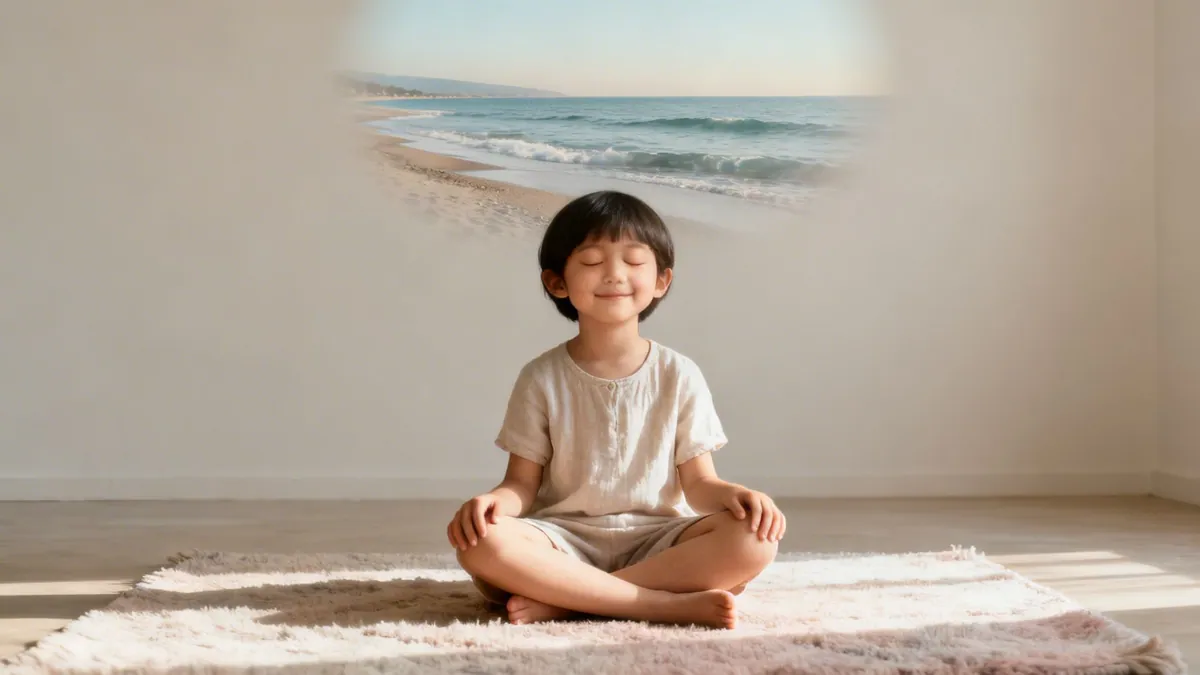
This method is effective because it creates a mental escape route from stress. It empowers children by teaching them that they can change their emotional state simply by using their minds. Repeated practice helps build positive neural pathways, reinforcing the brain's ability to access calmness and making it a more automatic response to stress over time.
How to Implement It
- Goal: To help children build a mental "safe space" they can access anytime to reduce anxiety and promote relaxation.
- Best For: Bedtime routines, transitions, pre-test calming, and building emotional resilience.
- Time: 3-10 minutes.
Step-by-Step Guide:
- Find a Quiet Space: Have the child sit or lie down comfortably in a place with minimal distractions. Ask them to close their eyes if they feel comfortable doing so.
- Use a Calming Script: Begin by guiding them through a few deep breaths. Then, using a slow, soothing voice, describe a peaceful scene. Use rich, sensory details: "Imagine you are walking on a warm, sandy beach. Feel the soft sand between your toes. Hear the gentle waves washing ashore. See the bright blue sky above you."
- Encourage Personalization: Ask them to add their own details to their special place. What else do they see, hear, or feel? This makes the experience more vivid and personal.
- Gently Return: After a few minutes, slowly guide them back to the present moment. Ask them to wiggle their fingers and toes before slowly opening their eyes.
Practical Tips and Variations
- For Younger Children (K-2): Keep visualizations short and simple. Focus on concrete, comforting ideas. For example, "Imagine you are a sleepy kitten curled up in a soft, warm sunbeam. Feel how warm and cozy you are. Now, imagine someone you love is gently stroking your back."
- For Older Children (3-8): Introduce more complex scenarios, like visualizing success before a sports game or presentation. Encourage them to create and write down their own "safe place" script that you can read to them.
- At Home: Use guided visualization stories at bedtime to ease nighttime anxiety. Apps like Calm or Headspace offer a wide variety of kid-friendly guided imagery sessions.
- In the Classroom: A teacher can lead a brief, whole-class visualization before a test to calm nerves. A school counselor might work with an anxious student to create a personalized "safe place" recording they can listen to with headphones when feeling overwhelmed.
Key Insight: Visualization leverages a child's imagination as a therapeutic tool. It teaches them that they possess an internal resource for creating calm and safety, no matter what is happening externally.
4. Grounding Techniques (5-4-3-2-1 Sensory Method)
Grounding techniques are powerful anxiety activities for kids designed to pull their focus away from distressing internal thoughts and back to the physical world. The 5-4-3-2-1 Sensory Method is a structured, evidence-based exercise that interrupts an anxiety spiral by systematically engaging all five senses. It forces the brain to redirect its attention from abstract worries to the concrete, tangible environment.
This method is highly effective because it provides a simple, memorable script for children to follow during moments of panic or overwhelming anxiety. By concentrating on external sensory information, a child’s nervous system receives the message that they are safe in the present moment, which helps to de-escalate the "fight or flight" response and restore a sense of calm and control.
How to Implement It
- Goal: To equip children with a rapid mental tool that anchors them in the present moment when they feel overwhelmed by anxious thoughts or panic.
- Best For: Acute anxiety, panic attacks, dissociative moments, and helping dysregulated students regain focus.
- Time: 2-5 minutes.
Step-by-Step Guide:
- Introduce the Concept: Explain that when our minds are full of worries, we can use our five senses as anchors to bring us back to the "here and now." Frame it as a detective game where they have to find clues in their environment.
- Guide Them Through the Steps: Calmly and slowly, prompt them to identify:
- 5 things you can SEE: Ask them to look around and name five objects. A practical example would be: "Okay, let's play. I see the green plant, the blue pen on the desk, the white clock, your red shoes, and the yellow sticky note."
- 4 things you can FEEL: Guide them to notice physical sensations, such as the chair beneath them, their feet on the floor, or the texture of their clothing.
- 3 things you can HEAR: Prompt them to listen for sounds nearby, like a ticking clock, distant traffic, or the hum of a computer.
- 2 things you can SMELL: Encourage them to identify any scents in the air, like a pencil, a book, or hand sanitizer.
- 1 thing you can TASTE: Ask them to notice the taste inside their mouth or have them take a sip of water.
- Practice During Calm Times: Like breathing exercises, grounding is most effective when learned and practiced when a child is not in distress. Use posters or cue cards to help them remember the sequence.
Practical Tips and Variations
- For Younger Children (K-2): Simplify the prompts and make it a game. "Can you find five blue things in the room?" or "Let's touch four different textures and describe them."
- For Older Children (3-8): Encourage them to silently practice the 5-4-3-2-1 method on their own. They can also write down what they notice in a journal to deepen the grounding effect.
- At Home: A parent can gently guide a child through the steps during a moment of panic. Having a "grounding object," like a smooth stone or a piece of textured fabric, can enhance the sense of touch.
- In the Classroom: Teachers can establish a non-verbal signal for a student to request a grounding break. The entire class can also practice this as a "sensory reset" after a high-energy activity to help everyone settle.
Key Insight: Grounding interrupts the feedback loop of anxiety. By forcing the brain to process real-time sensory data, you stop anxious thoughts from spiraling and re-establish a connection to the safety of the present moment.
5. Creative Expression Activities (Art, Music, Movement)
Creative expression activities like art, music, and movement are powerful anxiety activities for kids because they offer a non-verbal outlet for complex emotions. When children feel anxious, they often struggle to find the right words to describe their internal state. These activities bypass the brain's verbal processing centers, allowing kids to externalize their feelings directly and symbolically through color, sound, or physical motion.
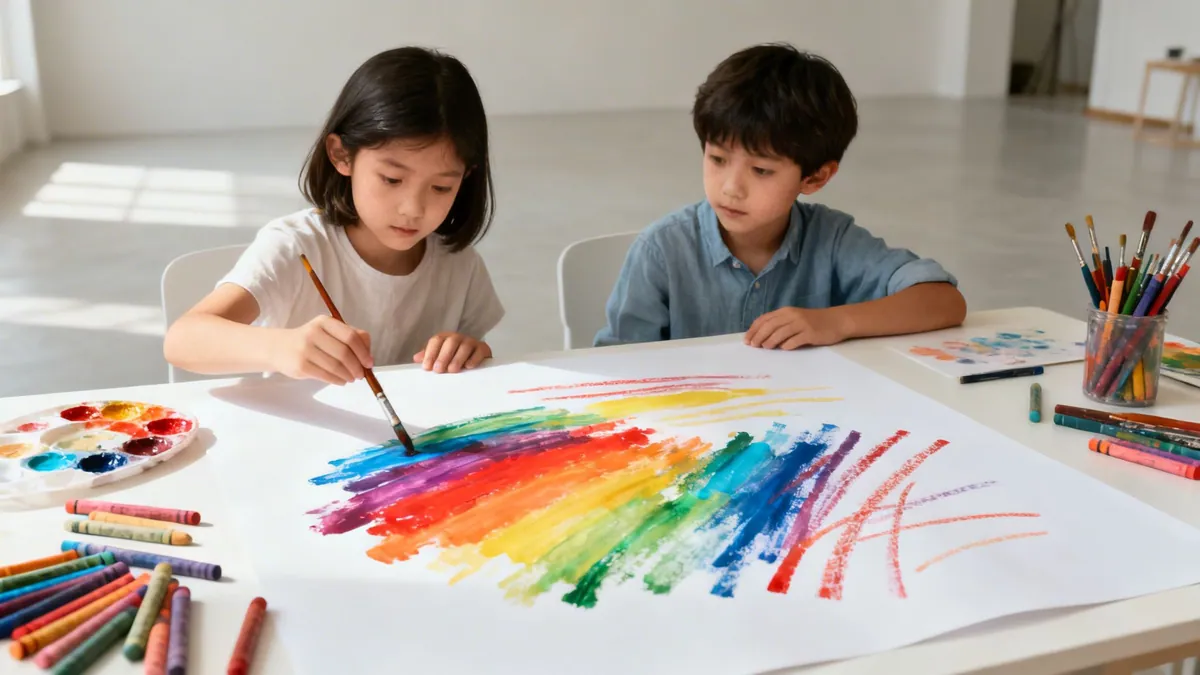
This process is effective because it shifts the focus from the abstract nature of a feeling to a tangible, creative act. It provides a safe container for difficult emotions and helps children gain a sense of mastery over them. Engaging in art, dance, or music can also be inherently calming, promoting a state of flow that reduces anxious thoughts and fosters self-expression.
How to Implement It
- Goal: To provide a non-verbal, constructive outlet for children to process and express anxious feelings safely.
- Best For: Children who have difficulty verbalizing emotions, proactive anxiety prevention, and emotional processing after a stressful event.
- Time: 10-30 minutes.
Step-by-Step Guide:
- Introduce the Concept: Frame the activity as a way to show feelings, not create a perfect masterpiece. You might say, "Let's draw what your worry looks like," or "Let's move our bodies to a song that feels happy and strong."
- Offer Choices: Provide a variety of open-ended materials like clay, paint, markers, or instruments. Let the child choose the medium that feels right for them, which honors their preference and gives them a sense of control.
- Encourage Expression: Prompt them with feeling-based questions: "What color is your anger?" or "If your sadness was a sound, what would it be?" Avoid judgment about the final product; the value is in the process. A practical example is giving a child a lump of clay and saying, "Show me what the knot in your stomach feels like. You don't have to make it look like anything, just show me the feeling."
- Reflect and Connect (Optional): After the creative process, invite the child to talk about their creation. Ask, "Can you tell me about your drawing?" This step helps connect the non-verbal expression with verbal language, building emotional vocabulary.
Practical Tips and Variations
- For Younger Children (K-2): Use large-scale movement like "animal walks" to express different feelings (e.g., a stomping bear for anger). Finger painting is another great way to engage their senses and express emotions physically.
- For Older Children (3-8): Encourage journaling with drawings or creating a "mood playlist." Drama-based games like charades with emotions can help them explore expression in a fun, low-pressure way. For children who enjoy detailed activities, the wonderfully calming and creative world of cross stitch offers a focused way to manage feelings.
- At Home: Create a "feelings art box" with various supplies that is always accessible. Play music and have spontaneous "dance parties" to release pent-up energy and stress.
- In the Classroom: Integrate "feelings art projects" into SEL time. Organizations like Soul Shoppe often use experiential and creative workshops to help students process emotions and build empathy in a group setting.
Key Insight: The power of creative expression lies in its ability to make the invisible visible. By turning an internal feeling into an external creation, children can understand, manage, and communicate their anxiety in a way that words alone often cannot.
6. Physical and Mindful Movement (yoga, stretching, body scan, active play)
Physical and mindful movement provides a powerful outlet for anxious energy, connecting the mind and body to promote calm. When children feel anxious, their bodies often store that tension, leading to restlessness and discomfort. Activities like yoga, stretching, and even active play help release this physical stress and burn off excess cortisol, the body’s stress hormone.
This integrated approach is effective because it teaches interoceptive awareness, or the ability to notice internal body sensations. By combining movement with mindfulness, such as in a body scan, children learn to identify where they hold tension (like tight shoulders or a clenched jaw) and consciously release it. This builds a child's capacity to recognize the early physical signs of anxiety and proactively manage them before they escalate.
How to Implement It
- Goal: To channel anxious energy into a productive physical outlet and build a child's awareness of their own body's stress signals.
- Best For: Releasing pent-up energy, daily stress management, and helping kids who struggle to sit still during traditional calming exercises.
- Time: 5-15 minutes.
Step-by-Step Guide:
- Introduce the Mind-Body Connection: Explain to children that our feelings live in our bodies. Say something like, "Sometimes when you feel worried, your tummy might feel tight or your shoulders might feel heavy. Moving our bodies can help those feelings move through and out."
- Guide a Simple Movement: Choose an activity appropriate for the space and energy level. For energy release, a teacher could say, "Okay class, let's have a 60-second 'shake it out' break. Stand up and shake your arms, shake your legs, and shake all those wiggles out!" For calming, try guided yoga poses.
- Incorporate a Body Scan: After the movement, ask children to stand or sit quietly and notice how their body feels. Prompt them with questions: "Notice your feet on the floor. Are they warm or cool? Can you feel your heartbeat? Is it fast or slow?"
Practical Tips and Variations
- For Younger Children (K-2): Use imaginative movement. Pretend to be different animals: stretch tall like a giraffe, crouch low like a frog, or stand strong like a tree (tree pose).
- For Older Children (3-8): Introduce structured yoga flows or tai chi movements. Use guided body scan meditations from apps or scripts that encourage them to mindfully scan from head to toe.
- At Home: Schedule "movement breaks" during homework time. A 5-minute dance party or a series of simple stretches can reset focus and reduce frustration.
- In the Classroom: Integrate short, 2-3 minute movement breaks between subjects. Use resources like GoNoodle for guided dances or lead simple chair yoga stretches. Soul Shoppe workshops often show teachers how to weave these body-awareness strategies into the daily classroom routine.
Key Insight: Movement gives anxiety a place to go. By teaching children to listen to their bodies and respond with mindful motion, you equip them with a somatic tool for emotional regulation that addresses the physical root of their anxious feelings.
To explore this further, you can discover more about embodiment practices for kids in school and at home.
7. Journaling and Writing Reflection
Journaling and writing reflection are powerful anxiety activities for kids that help them externalize and process their emotions. This cognitive-emotional technique involves documenting thoughts, feelings, and worries, which helps children develop emotional literacy, identify patterns in their anxiety, and challenge unhelpful thought cycles. By putting their feelings on paper, kids create distance from overwhelming emotions, allowing for clearer thinking and problem-solving.
This method is effective because it transforms abstract worries into concrete words that can be examined and understood. It provides a private, non-judgmental space for children to express themselves honestly, creating a tangible record of their emotional journey and coping strategies. This process reinforces their ability to manage anxiety by turning reflection into a proactive skill.
How to Implement It
- Goal: To help children process complex emotions, identify anxiety triggers, and develop self-awareness by externalizing their thoughts and feelings through writing.
- Best For: Daily emotional check-ins, processing specific worrying events, building emotional vocabulary, and cognitive restructuring.
- Time: 5-15 minutes.
Step-by-Step Guide:
- Introduce the Journal: Frame the journal as a safe and private space. For younger kids, call it a "Worry Book" or "Feelings Diary." For older kids, explain it as a tool for "clearing their head" and organizing thoughts.
- Provide a Starting Point: Begin with guided prompts to ease them into the practice. For example, a teacher could put a prompt on the board: "Write or draw about one thing you're excited for and one thing you're nervous about today." Or a parent could ask, "What is one thing that felt tricky today? Let's write it down."
- Establish a Routine: Make journaling a consistent practice, such as during morning arrival in a classroom or before bed at home. Repetition makes it a reliable coping mechanism that children will turn to independently over time.
Practical Tips and Variations
- For Younger Children (K-2): Since writing skills are still developing, use a "draw and dictate" method. Let them draw their feeling or worry, and then an adult can write down their spoken words to describe it.
- For Older Children (3-8): Introduce more complex journaling formats like a "Thought Record" from Cognitive Behavioral Therapy (CBT). They can list a situation, the automatic thought, the feeling, and then a more balanced, alternative thought.
- At Home: Create a "Worry Box" where children can write down a worry on a slip of paper and "post" it into the box to be discussed with a parent later. This physically contains the anxiety.
- In the Classroom: Use daily journal prompts for morning work to serve as an emotional check-in. Establish clear rules about privacy, ensuring students know their journal is their personal space unless they choose to share.
Key Insight: Journaling teaches children that they are separate from their anxious thoughts. By writing them down, they learn they can observe their worries without letting those worries define them, a foundational skill for lifelong emotional regulation.
8. Social Connection and Peer Support
Social connection is one of the most powerful anxiety activities for kids because it directly counters the isolation where worried thoughts often grow. This relational approach helps children build a sense of belonging and psychological safety, reminding them they are not alone. Secure relationships with peers and trusted adults act as a buffer against stress and provide a network for co-regulation.
This method is effective because it shifts the focus from an internal struggle to a shared, supportive experience. When children feel seen, heard, and valued within a community, their nervous systems can more easily shift from a state of threat to one of safety. Organizations like Soul Shoppe have long emphasized that building school-wide connection is fundamental to reducing anxiety and fostering resilience.
How to Implement It
- Goal: To reduce feelings of isolation and build a supportive community where children feel safe to share their experiences and seek help.
- Best For: Children who withdraw when anxious, building a positive classroom or school climate, and developing long-term resilience.
- Time: Varies; can be brief daily check-ins or ongoing structured programs.
Step-by-Step Guide:
- Create Structured Opportunities: Don't leave connection to chance. A practical example is implementing a "Lunch Buddy" system where a teacher pairs an anxious child with a friendly, trained peer for a low-pressure social meal once a week.
- Teach Key Social Skills: Explicitly teach skills like active listening, empathy, and conflict resolution. Role-playing scenarios where students practice offering support or asking for help can build confidence and competence.
- Establish Peer Support Systems: Formalize peer-to-peer help. This could be a peer mentoring program where older students support younger ones, or a student-led support group for specific concerns like anxiety or family changes, facilitated by a school counselor.
- Promote Whole-School Community: Use assemblies and classroom meetings to build a shared identity and collective responsibility for one another's well-being. This creates a culture where seeking and offering support is normalized and celebrated.
Practical Tips and Variations
- For Younger Children (K-2): Use "Partner-Up" activities where students are paired for a task. Implement a "Kindness Catcher" jar where students write down acts of kindness they witness, reinforcing a supportive classroom environment.
- For Older Children (3-8): Launch student support groups or a peer mentoring program. Provide training for peer mentors on anxiety awareness, active listening, and knowing when to get an adult involved.
- At Home: Encourage participation in group activities or clubs based on your child’s interests. Arrange one-on-one playdates with a trusted friend to practice social skills in a comfortable setting.
- In the Classroom: Start the day with a "Connection Circle" where each student shares a brief update. Proactively address any signs of exclusion or bullying to maintain a foundation of safety for all students.
Key Insight: Anxiety shrinks when connection grows. By intentionally building a web of supportive relationships, you give children a powerful, living resource that fosters resilience far more effectively than isolated coping skills alone.
To build the foundational skills for this approach, you can find more ideas in these kids' social skills activities.
9. Cognitive Reframing and Thought Challenging
Cognitive reframing is a powerful anxiety activity for kids that teaches them to identify, question, and change the negative thought patterns that fuel anxiety. This technique is rooted in Cognitive-Behavioral Therapy (CBT) and empowers children by showing them that thoughts are not always facts. By learning to challenge their anxious thoughts, they develop the critical skill of separating feelings from reality, which is fundamental for building long-term resilience.
This approach is highly effective because it gives children a concrete strategy for managing their internal world. Instead of being swept away by worry, they learn to become "thought detectives," actively investigating their thoughts for evidence. This process interrupts the cycle of anxious rumination and catastrophizing, helping them develop more balanced and realistic perspectives.
How to Implement It
- Goal: To help children recognize anxious thought patterns and replace them with more helpful, evidence-based ones.
- Best For: Repetitive worries, catastrophic thinking (e.g., "I'm going to fail my test"), and building long-term emotional regulation skills.
- Time: 5-10 minutes.
Step-by-Step Guide:
- Introduce the Concept: Explain that our brains sometimes send us "worry thoughts" that aren't 100% true. Use a simple analogy like a thought being a "guess" about what might happen, not a fact.
- Identify the Thought: Help the child pinpoint the specific anxious thought. For example: "Everyone will laugh at me during my presentation." Write it down so it feels more manageable.
- Gather Evidence (Be a Detective): Guide them to challenge the thought. A practical script could be: "Okay, let's be detectives. What evidence do you have that everyone will laugh? Has that happened before? What's a more likely thing to happen? What would you tell a friend who had this same worry?"
- Create a New Thought: Help them formulate a more balanced, realistic thought. Instead of "Everyone will laugh," it could be, "I'm prepared for my presentation, and even if I'm nervous, my friends will support me."
Practical Tips and Variations
- For Younger Children (K-2): Use "Thought Bubbles." Draw the worry thought in one bubble and then draw a more helpful "brave thought" in another. Personify the worry thought as a "Worry Monster" whose tricks they can learn to spot.
- For Older Children (3-8): Introduce a "Thought Record" worksheet with columns for the situation, the anxious thought, the evidence against it, and a new balanced thought. This structured approach helps them internalize the process.
- At Home: When a child expresses a major worry, compassionately validate their feeling ("It sounds like you're really scared") before gently moving into detective work ("Let's look at the evidence for that thought").
- In the Classroom: During morning meetings, discuss the idea of "thinking traps" like jumping to conclusions. A school counselor can run small groups on "thought challenging" for students with high anxiety.
Key Insight: This technique teaches children that they have agency over their thoughts. By systematically questioning their worries, they learn that anxiety is a manageable emotion, not an uncontrollable force.
You can find more ways to build this skill with additional positive thinking exercises for children.
10. Nature Connection and Outdoor Time
Connecting with nature is a powerful anxiety activity for kids because it taps into our innate biological affinity for the natural world. Structured and unstructured time outdoors engages multiple senses, encourages physical activity, and provides a broader perspective that can make worries feel smaller. This approach leverages the inherent calming properties of natural environments to reduce stress, lower cortisol levels, and improve overall mood.

This method is effective because it simultaneously addresses cognitive, physical, and sensory aspects of anxiety. Research increasingly demonstrates that spending time outdoors can significantly reduce stress and improve mood, highlighting the healing power of green spaces for mental well-being. By immersing a child in a natural setting, you provide an environment that naturally calms the nervous system and encourages mindful observation.
How to Implement It
- Goal: To use the calming and restorative effects of nature to reduce anxiety, promote physical activity, and build emotional resilience.
- Best For: Proactive emotional regulation, sensory breaks for overwhelmed children, and building a long-term coping strategy.
- Time: 15-30 minutes.
Step-by-Step Guide:
- Schedule Predictable Nature Time: Integrate outdoor time into the daily or weekly routine. This could be a 20-minute walk after school, a designated "outdoor classroom" period, or a weekend family hike. Predictability makes it a reliable coping tool.
- Engage the Senses: Guide the child to actively notice their surroundings. For example, a teacher could take the class outside and say, "For the next three minutes, let's do a 'listening walk.' I want you to walk silently and notice all the different sounds you can hear. We'll share what we heard when we get back."
- Encourage Gentle Movement: Activities like walking, gardening, or simply exploring a park combine the benefits of physical activity with nature exposure. This helps release anxious energy and boosts mood-enhancing endorphins.
Practical Tips and Variations
- For Younger Children (K-2): Go on a "nature scavenger hunt" to find specific items (a smooth rock, a yellow leaf). Plant a small windowsill garden to care for, connecting them to the life cycle of plants.
- For Older Children (3-8): Introduce nature journaling, where they can draw or write about what they observe. Involve them in larger projects like a school or community garden, giving them a sense of purpose and accomplishment.
- At Home: Establish a family ritual like a post-dinner walk or a weekly visit to a local park. Even having lunch in the backyard can be an effective way to break up the day and get fresh air.
- In the Classroom: If access to large green spaces is limited, bring nature indoors with classroom plants. Use a "nature window" to observe weather patterns or bird feeders. A short walk around the school grounds can serve as an effective anxiety break.
Key Insight: Nature provides a free, accessible, and highly effective therapeutic environment. By making outdoor time a regular part of a child's routine, you equip them with a powerful tool for self-regulation that addresses anxiety on both a psychological and physiological level.
10 Anxiety-Reducing Activities for Kids: Side-by-Side Comparison
| Technique | Implementation complexity | Resource requirements | Expected outcomes | Ideal use cases | Key advantages |
|---|---|---|---|---|---|
| Mindfulness and Deep Breathing Exercises | Low — simple to teach; needs repeated practice | Minimal — no equipment | Immediate calming; improved interoception and self-regulation over time | Acute anxiety, classroom transitions, anywhere | Portable, evidence-based, builds agency |
| Progressive Muscle Relaxation (PMR) | Moderate — guided sequence and time needed | Low — script/audio and space to lie/sit | Reduced somatic tension; improved sleep and body awareness | Somatic anxiety, bedtime routines, small-group work | Concrete physical feedback; kinesthetic engagement |
| Guided Imagery and Visualization | Moderate — needs scripts/recordings and facilitation | Low–Medium — audio/quiet space for immersion | Calm, “safe place” creation; builds positive neural associations | Pre-test/performance anxiety, bedtime, visualization practice | Highly customizable; engages imagination |
| Grounding Techniques (5-4-3-2-1) | Low — quick structured steps | Minimal — none required | Rapid interruption of anxiety spirals; returns attention to present | Acute panic/overwhelm; discreet classroom or hallway use | Fast, discreet, easy to teach and apply |
| Creative Expression (Art, Music, Movement) | Moderate–High — planning and facilitation required | Variable — materials, space, facilitator expertise | Emotional externalization; improved expression and confidence | Ongoing SEL, therapeutic groups, expressive interventions | Multimodal, nonverbal processing; builds connection |
| Physical & Mindful Movement (yoga, stretching) | Moderate — instructor/guidance helpful | Low–Medium — space, optional mats/props | Lowers stress hormones; improves mood, interoception, energy regulation | Movement breaks, energy release, daily routines | Combines exercise + mindfulness; metabolizes anxious energy |
| Journaling & Writing Reflection | Low–Moderate — prompts and structure helpful | Minimal — paper/pencil or digital device | Externalizes worries; builds emotional vocabulary and insight | Reflection time, pattern tracking, homework/practice | Low-cost, portable, creates record of progress |
| Social Connection & Peer Support | High — culture-building and ongoing facilitation | Medium — staff time, program structures, supervision | Reduced isolation; increased belonging and sustained support | Schoolwide interventions, mentoring, support groups | Addresses root social causes; sustainable peer-led support |
| Cognitive Reframing & Thought Challenging | Moderate — requires teaching CBT skills | Low — training materials and facilitator | Reduced rumination; improved realistic thinking and resilience | Age 8+, persistent anxious thinking, classroom lessons | Evidence-based; empowers cognitive agency |
| Nature Connection & Outdoor Time | Low–Moderate — scheduling and access planning | Variable — outdoor space, supervision | Lowers cortisol; improves mood, attention, sensory regulation | Nature breaks, outdoor classrooms, gardening programs | Low-cost, multi-mechanism benefits; sensory regulation |
Building a Culture of Support: Integrating Anxiety Tools into Daily Routines
Navigating the landscape of childhood anxiety can feel overwhelming, but as we've explored, a robust toolkit of practical strategies can make all the difference. This collection of ten distinct anxiety activities for kids offers more than just temporary relief; it provides the foundational building blocks for lifelong emotional resilience. From the immediate calm of Deep Breathing Exercises to the creative release of Art Therapy and the grounding power of Nature Connection, each activity equips children with the ability to understand, manage, and ultimately befriend their anxious feelings.
The true power of these tools is unlocked not through occasional use, but through consistent integration into the rhythm of daily life. The goal is to transform these interventions from reactive measures into proactive habits, creating an environment where emotional well-being is as prioritized as academic learning or physical health.
Weaving Wellness into Daily Life
Consistency is the cornerstone of building emotional muscle memory. When a child practices Progressive Muscle Relaxation during a calm story time, they are banking that skill for a moment of future stress. When a classroom begins the day with a collective 'Peace Breath' or uses the 5-4-3-2-1 Grounding technique as a standard transition between subjects, it normalizes self-regulation and makes it a shared, accessible practice for everyone.
Think of it this way: a teacher might model Cognitive Reframing out loud when a lesson plan goes awry. "My first plan for our science experiment didn't work, and that's frustrating. Instead of thinking 'I failed,' I'm going to think, 'This is a great chance to be a scientist and try a different hypothesis.' Who has an idea?" This small act demonstrates that it's okay for things to go wrong and provides a concrete script for managing disappointment.
Creating a Culture of Psychological Safety
The most effective anxiety activities for kids flourish in an atmosphere of psychological safety. This means creating spaces at home and in school where children feel secure enough to express vulnerability without fear of judgment. It’s about shifting the narrative from "What's wrong with you?" to "What's happening, and how can we help?"
When a student is encouraged to take a five-minute break for Mindful Movement or to use a journaling corner to process their feelings, the message is clear: your emotional health matters here. This culture is reinforced through activities focused on Social Connection and Peer Support, where empathy and active listening are taught as essential skills. By fostering this supportive ecosystem, we empower children not only to use these tools for themselves but also to become compassionate allies for their peers.
From Activities to Empowerment
The journey from learning these activities to mastering them is a gradual process that requires patience, practice, and adult co-regulation. The ultimate objective is not to eradicate anxiety, which is a normal human emotion, but to demystify it. We aim to replace feelings of helplessness with a sense of competence and confidence.
By consistently offering and modeling these diverse strategies, you give children a rich vocabulary to manage their inner world. You empower them with the profound understanding that while they cannot always control the waves of anxiety, they can learn to surf. They learn that a racing heart can be slowed with breath, scattered thoughts can be grounded in the senses, and overwhelming feelings can be channeled into a beautiful piece of art. This is the heart of emotional intelligence, a gift that will serve them far beyond the classroom and throughout their entire lives.
Ready to take the next step in building a positive and supportive school climate? Soul Shoppe provides dynamic, evidence-based programs and assemblies that teach students essential social-emotional skills, empowering them to resolve conflicts, practice empathy, and navigate complex feelings like anxiety. Explore our offerings to bring these transformative tools to your entire school community at Soul Shoppe.