

10 Practical Communication Skills Activities for K-8 Students in 2026
Effective communication is a cornerstone of social-emotional learning (SEL), academic achievement, and lifelong success. While the phrase “use your words” is a common refrain in classrooms and homes, teaching children how to use their words constructively requires more than just a simple reminder. It demands intentional practice through engaging, hands-on communication skills activities that build a sophisticated toolkit for expressing thoughts, understanding others, and navigating complex social situations.
This comprehensive guide moves beyond basic instruction to provide a curated collection of practical, grade-tiered activities designed for K-8 students. Educators, administrators, and parents will find detailed, step-by-step instructions for implementing powerful exercises that foster essential competencies. We will cover a broad spectrum of skills, from active listening and interpreting nonverbal cues to resolving conflicts and practicing empathy.
Instead of abstract theories, you will find actionable strategies you can implement immediately. Each activity is structured to be both educational and engaging, helping students develop the confidence and ability to communicate clearly and respectfully. These exercises are not just about preventing misunderstandings; they are about building stronger relationships, fostering a positive school climate, and equipping students with the tools they need to thrive in all aspects of their lives. Whether you’re a teacher looking for a new lesson plan or a parent hoping to support your child’s social growth, this resource provides the concrete activities needed to turn communication theory into a practiced, everyday skill.
1. Active Listening Circles
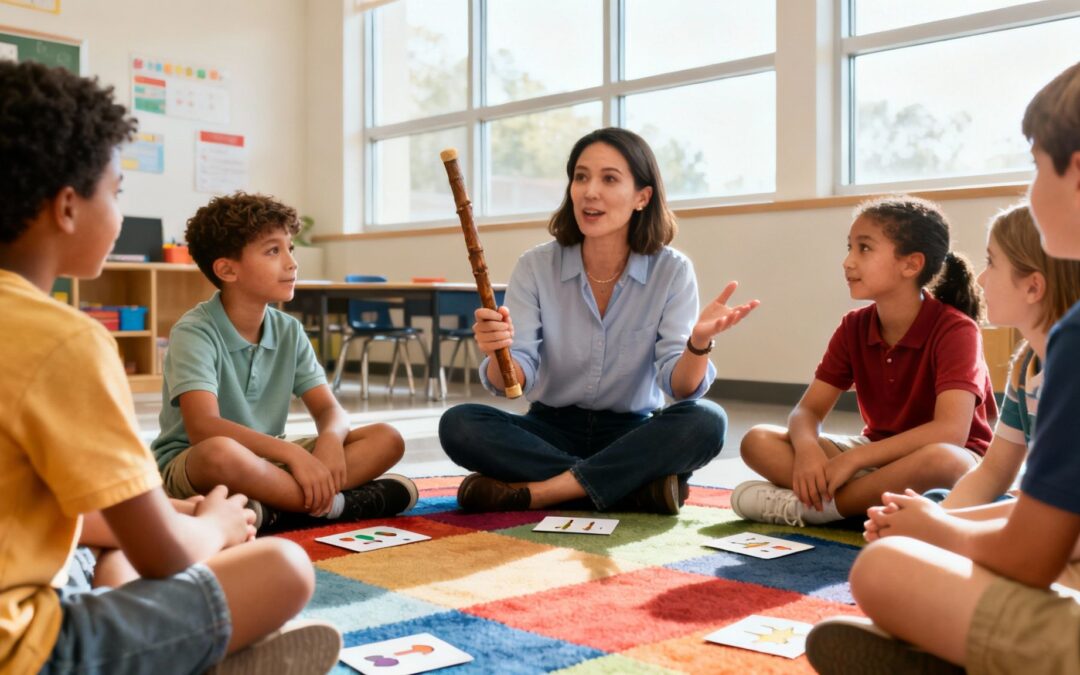
Active Listening Circles are structured conversations designed to teach students how to listen with the intent to understand, not just to reply. In this activity, students sit in a circle and take turns speaking on a specific prompt while the others practice focused, respectful listening. This simple yet powerful exercise builds empathy and creates a safe space for sharing.
This practice is fundamental among communication skills activities because it directly addresses the often-overlooked listening component of dialogue. It helps students learn to honor others’ perspectives, reduce interruptions, and appreciate the value of each person’s voice.
How It Works
Purpose: To develop active listening skills, promote empathy, and build a sense of community and psychological safety.
Time: 15–20 minutes
Materials: A talking piece (e.g., a small ball, decorated stone, or stuffed animal) and a discussion prompt.
Step-by-Step Directions:
- Arrange the Circle: Have students sit in a circle where everyone can see each other.
- Introduce the Prompt: Present a simple, open-ended prompt.
- Practical Example (K-2): “Share your favorite part of the day so far.”
- Practical Example (3-5): “Talk about a skill you’d like to learn.”
- Practical Example (6-8): “Describe a time you showed kindness to someone.”
- Explain the Rules: The person holding the talking piece is the only one who can speak. Everyone else’s job is to listen quietly and attentively, without planning their response.
- Begin the Circle: Hand the talking piece to a starting student. After they share, they pass it to the next person.
- Closing: Once everyone who wishes to share has spoken, briefly thank the group for their respectful listening.
Tips for Implementation
- For Younger Students (K-3): Keep prompts concrete and focused on recent experiences. Use a visually engaging talking piece. Model active listening by nodding and making eye contact with the speaker.
- For Older Students (4-8): Introduce more complex prompts related to feelings, challenges, or goals. After the circle, you can lead a brief reflection on what it felt like to be truly listened to.
- Differentiation: Offer students the “right to pass” if they don’t feel comfortable sharing. This ensures the circle remains a low-pressure, safe environment.
This structured approach is a cornerstone of building a positive classroom culture. To see how these principles are integrated into a broader curriculum, you can explore the tools and strategies in Soul Shoppe’s comprehensive Peace Path® conflict resolution program.
2. Role-Playing and Perspective-Taking Scenarios
Role-Playing Scenarios are interactive exercises where students act out realistic social situations to practice communication strategies and understand different viewpoints. By stepping into another person’s shoes, students can safely explore complex emotions, practice conflict resolution, and build empathy. This hands-on method bridges the gap between knowing what to do and actually doing it in a real-life situation.
This technique is a core component of effective communication skills activities because it moves beyond theoretical discussion into practical application. It helps students develop emotional intelligence and flexible thinking, preparing them to navigate friendship challenges, peer pressure, and other social hurdles with confidence and compassion.
How It Works
Purpose: To build empathy, practice problem-solving, develop conflict resolution skills, and learn to communicate effectively in challenging situations.
Time: 20–30 minutes (including debrief)
Materials: Scenario cards (pre-written situations), optional props to set the scene.
Step-by-Step Directions:
- Introduce the Scenario: Present a relatable conflict or situation.
- Practical Example (K-3): “Two friends both want to be the line leader.”
- Practical Example (4-8): “A student overhears their friends making fun of another classmate’s new haircut.”
- Assign Roles: Assign students roles within the scenario (e.g., the friends, a bystander). It is often powerful to have students play roles that are different from their typical experience.
- Act It Out: Give students a few minutes to act out the scene. Encourage them to use “I” statements and express the feelings of their character.
- Pause and Discuss: Stop the role-play at a key moment and ask observers: “What did you notice about their body language?” or “What is another way this could be handled?”
- Debrief: After the role-play, have students step out of their roles. Discuss how it felt to be each character and what they learned about the situation and themselves.
Tips for Implementation
- For Younger Students (K-3): Use simple, concrete scenarios like sharing a toy or asking to join a game. Use puppets or props to help them feel more comfortable acting.
- For Older Students (4-8): Introduce more complex social dynamics, such as navigating gossip, handling peer pressure online, or disagreeing respectfully with a friend’s opinion.
- Differentiation: Provide sentence starters like “I feel ___ when you ___” or “I need ___” to support students who struggle with expressing themselves. Allow students to participate as active observers if they are not ready to act.
Role-playing is a dynamic tool for building a proactive and empathetic school culture. To learn how to integrate these scenarios into a structured conflict resolution framework, explore Soul Shoppe’s acclaimed student leadership and peer mediation programs.
3. Nonverbal Communication and Body Language Activities
Nonverbal Communication and Body Language Activities teach students to recognize and interpret the powerful messages sent through facial expressions, gestures, posture, and personal space. These exercises help participants understand that a significant portion of communication is conveyed without words, making body awareness essential for effective social interaction.
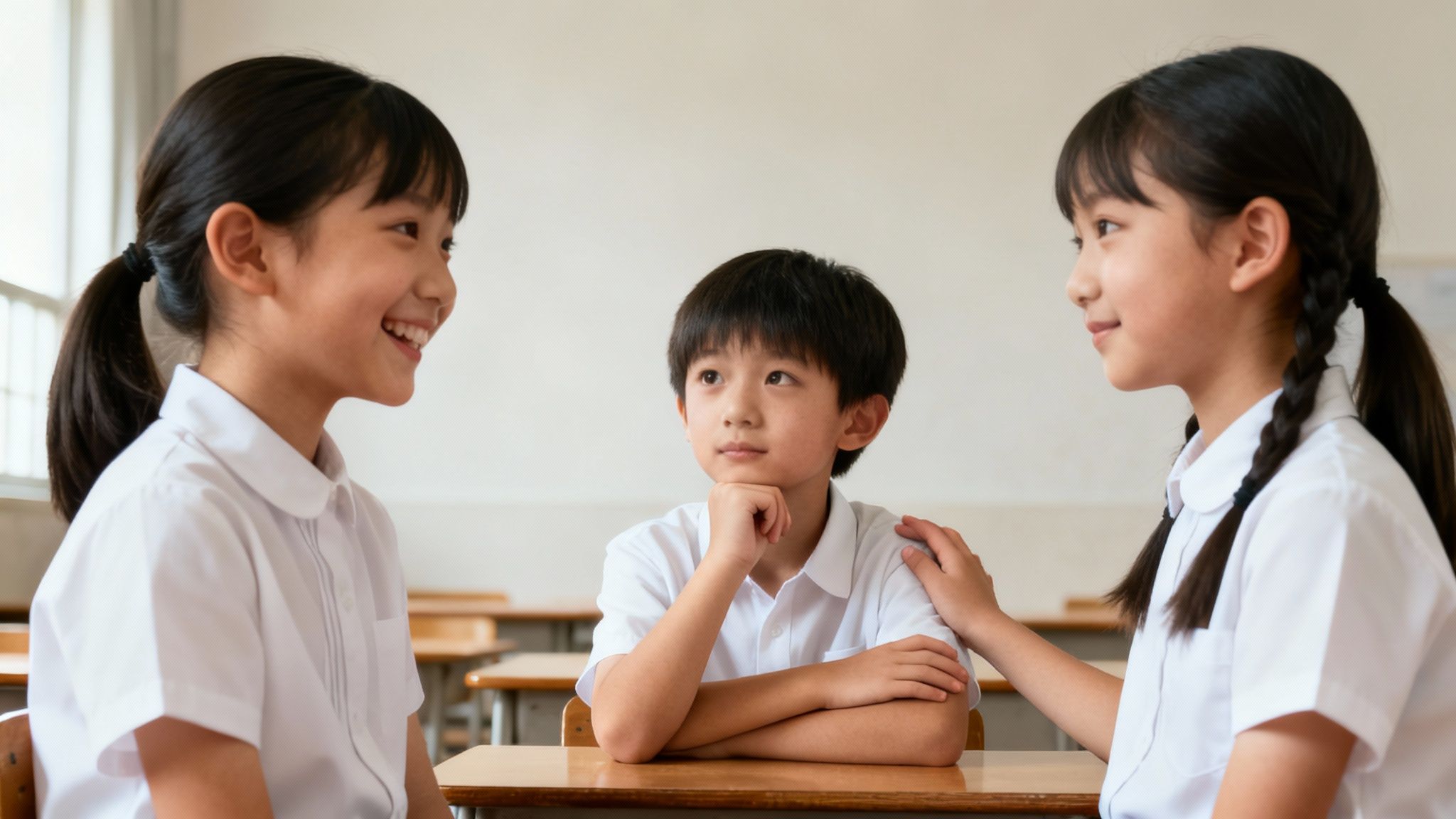
These practices are vital among communication skills activities because they equip students with the ability to “read the room” and align their own nonverbal cues with their intended message. This focus on conscious communication builds self-awareness and empathy, which are core components of Soul Shoppe’s approach to creating respectful school environments.
How It Works
Purpose: To build awareness of nonverbal cues, improve the ability to interpret body language, and practice expressing emotions and intentions without words.
Time: 15–25 minutes
Materials: Varies by activity; may include emotion flashcards, masking tape for personal space bubbles, or a video recording device.
Step-by-Step Directions:
- Introduce the Concept: Explain that we communicate with our bodies, not just our words. Use a simple example: “What does it look like when someone is excited versus when they are sad?”
- Choose an Activity: Select an age-appropriate exercise. A great starting point is Emotion Charades.
- Explain the Rules: For Emotion Charades, a student draws a card with an emotion (e.g., happy, frustrated, surprised) and must act it out using only their face and body. The other students guess the emotion. Practical Example: A student acting out “frustrated” might cross their arms, furrow their brow, and sigh loudly without making any noise.
- Facilitate and Model: Demonstrate an emotion yourself to start. Encourage students to be bold in their expressions and observant in their guessing.
- Debrief: After the game, discuss what specific cues helped students guess the emotion. Ask, “What did their shoulders do? What about their eyebrows or mouth?”
Tips for Implementation
- For Younger Students (K-3): Use Mirroring, where partners face each other and one student mirrors the movements of the other. This builds focus and connection. Use simple, primary emotions for charades.
- For Older Students (4-8): Try Personal Space Bubbles. Use tape to mark a circle around a student and have others slowly approach, with the student saying “stop” when they feel uncomfortable. This makes the concept of boundaries tangible.
- Differentiation: All activities should be “opt-in,” allowing students who are uncomfortable with physical expression to observe or participate in a different role, such as timekeeper or guesser.
By engaging in these hands-on communication skills activities, students gain a deeper understanding of social dynamics. For more ideas on how to build these skills, you can explore strategies for teaching children about reading social cues.
4. Fishbowl Discussions
Fishbowl Discussions are a structured conversation format where a small inner circle of students discusses a topic while a larger outer circle observes. The roles then switch, giving everyone a chance to both speak and listen critically. This dynamic setup sharpens public speaking, active listening, and analytical skills in a controlled environment.
This is one of the most effective communication skills activities for teaching students how to engage in and analyze a conversation simultaneously. It helps participants understand the mechanics of a healthy dialogue, from building on others’ ideas to using evidence, while the observers learn to identify effective communication strategies.
How It Works
Purpose: To develop speaking and active listening skills, encourage critical thinking, and allow students to analyze group dynamics.
Time: 25–40 minutes
Materials: Chairs arranged in two concentric circles (an inner “fishbowl” and an outer circle), discussion prompts or a text to analyze.
Step-by-Step Directions:
- Set Up the Circles: Arrange a small circle of 4–6 chairs in the center (the fishbowl) and a larger circle of chairs around it for the observers.
- Assign Roles: A small group of students begins in the fishbowl, while the rest of the class sits in the outer circle as observers.
- Provide the Prompt: Give the inner circle a specific, thought-provoking question or topic.
- Practical Example (2-4): “What are three rules that make our classroom a better place?”
- Practical Example (5-8): After reading a chapter about a character facing a dilemma, ask, “What were the character’s choices, and what would you have done differently?”
- Begin the Discussion: The inner circle discusses the prompt for a set amount of time (e.g., 8–10 minutes). The outer circle listens silently and takes notes on a specific task, such as tracking how often participants build on each other’s points.
- Switch and Debrief: After the time is up, the inner and outer circles switch roles. A new group enters the fishbowl with a new or related prompt. A final whole-group debrief can discuss both the content and the communication process.
Tips for Implementation
- For Younger Students (2-4): Use simpler topics like, “What makes a good friend?” Give observers a clear, simple task, like using a thumbs-up when they hear a kind word.
- For Older Students (5-8): Tackle more complex topics, like analyzing a character’s motivations in a novel or debating a school policy. Provide observers with a rubric to evaluate the discussion’s quality.
- Differentiation: Use sentence frames to support students in the fishbowl (e.g., “I agree with ___ because…” or “To add to what ___ said…”). Allow observers to write or draw their observations instead of only taking notes.
This activity not only builds individual communication skills but also enhances the entire class’s awareness of what makes a discussion productive. To further support students in navigating challenging conversations, explore the peer mediation strategies within Soul Shoppe’s violence prevention and bullying prevention programs.
5. I-Messages and Nonviolent Communication Practice
I-Messages and Nonviolent Communication (NVC) are structured frameworks that teach students to express their feelings and needs clearly without blaming or criticizing others. Instead of accusatory “you” statements, students learn to use an “I feel…” format, which reduces defensiveness and opens the door for genuine understanding and problem-solving.
This practice is one of the most transformative communication skills activities because it shifts the focus from fault to feeling. It empowers students with a concrete tool to navigate conflict constructively, making it a cornerstone of effective social-emotional learning and a core component of Soul Shoppe’s approach to conflict resolution.
How It Works
Purpose: To teach students how to express personal feelings and needs responsibly, reduce blame in conflicts, and foster empathetic responses.
Time: 20–25 minutes for initial instruction and practice.
Materials: Whiteboard or chart paper, markers, and scenario cards (optional).
Step-by-Step Directions:
- Introduce the Formula: Write the I-Message formula on the board: “I feel [emotion] when [specific situation/behavior] because [my need or what is important to me].”
- Model with Examples: Provide clear, relatable examples.
- “You” statement: “You’re so annoying for making that noise!”
- “I-Message”: “I feel distracted when I hear tapping because I need quiet to focus on my work.”
- Brainstorm Feelings and Needs: Create lists of “feeling words” (sad, worried, confused) and “need words” (respect, safety, friendship) to give students a vocabulary to draw from.
- Practice with Scenarios: Have students practice turning “you” statements into I-Messages.
- Practical Example: Turn “You never pick my idea for the game!” into “I feel left out when my ideas aren’t chosen because I want to be part of the team.”
- Role-Play: Pair students up to practice using I-Messages in brief role-playing situations, such as a disagreement over a game or a misunderstanding in the hallway.
Tips for Implementation
- For Younger Students (K-3): Simplify the formula to “I feel ___ when you ___.” Use picture-based feeling charts. Focus heavily on identifying and naming emotions before moving to the full sentence structure.
- For Older Students (4-8): Introduce the “because” part of the statement to help them connect their feelings to underlying needs. Discuss how I-Messages can be used to solve bigger problems with friends and family.
- Differentiation: Provide sentence stems (“I feel ___ when ___ because ___.”) for students who need more support. Acknowledge that using this format can feel awkward at first and praise any effort.
I-Messages are a powerful tool for building a more respectful and empathetic classroom. To dive deeper into their application, explore our guide on The Magic of ‘I Feel’ Statements for Kids: Transforming Disagagreements.
6. Peer Mediation and Conflict Resolution Role Practice
Peer Mediation and Conflict Resolution Role Practice trains student leaders to facilitate constructive conversations between peers experiencing conflict. This activity uses structured steps to help disputants understand each other and find mutually acceptable solutions, transforming conflict into a learning opportunity. It empowers students with advanced communication skills, empathy, and leadership.
This practice is one of the most impactful communication skills activities because it moves beyond theory into real-world application. It builds a culture of student-led problem-solving, reduces office referrals, and equips children with the tools to navigate disagreements respectfully and independently, a skill they will use for the rest of their lives.
How It Works
Purpose: To develop advanced communication, problem-solving, and leadership skills by training students to mediate peer conflicts effectively.
Time: 20–30 minutes for role-playing; ongoing for a formal program.
Materials: Role-play scenarios, a designated quiet space, and visual aids of the mediation steps.
Step-by-Step Directions:
- Train Mediators: Select and train a group of students in the principles of mediation: neutrality, confidentiality, and active listening. This often requires dedicated training sessions.
- Introduce a Scenario: Present a common conflict scenario for practice.
- Practical Example (K-3): “Two students are arguing over who gets to use the red crayon first.”
- Practical Example (4-8): “One student feels their friend shared a secret they told them in confidence.”
- Assign Roles: Assign students to be the disputants and the mediators.
- Role-Play the Mediation: Guide the student mediators as they lead the disputants through the conflict resolution process: setting ground rules, allowing each person to share their story, identifying feelings and needs, brainstorming solutions, and agreeing on a plan.
- Debrief: After the role-play, lead a discussion about what worked well and what was challenging. Focus on the communication strategies used by the mediators.
Tips for Implementation
- For Younger Students (K-3): Use simplified steps, often called “Peace Talks.” Focus on “I-statements” and expressing feelings. A “conflict corner” with visual cues can provide a structured space for practice.
- For Older Students (4-8): Establish a formal peer mediation program where trained students are available to help resolve conflicts during recess or lunch. Ensure mediators understand the importance of confidentiality and when to involve an adult.
- Differentiation: Start with heavily scaffolded role-plays where the teacher guides the mediators through each step. As students gain confidence, allow them to lead the process more independently. For further guidance on fostering these crucial abilities, particularly in a collaborative setting, consider reading about how to develop problem-solving skills in your child.
This approach not only resolves immediate conflicts but also builds a proactive, positive school climate. To explore more about building these skills, you can find effective conflict resolution strategies for kids that complement peer mediation.
7. Digital Communication and Online Etiquette Simulations
Digital Communication and Online Etiquette Simulations are activities that teach students how to interact respectfully and effectively in digital spaces. Through role-playing, case studies, and guided practice, students learn to navigate the complexities of online tone, digital empathy, and conflict resolution. These exercises are crucial for preparing students to be responsible and kind digital citizens.
This practice is one of the most relevant communication skills activities today, as it directly addresses the modern landscape where students build and maintain relationships. It equips them with the tools to prevent cyberbullying, understand the permanence of their digital footprint, and communicate with clarity and consideration online.
How It Works
Purpose: To develop digital literacy, teach online etiquette (netiquette), and build empathy for others in digital interactions.
Time: 20–30 minutes
Materials: Device with internet access (optional), printed scenarios or worksheets, whiteboard or chart paper.
Step-by-Step Directions:
- Introduce a Scenario: Present a relatable digital scenario.
- Practical Example: “A friend keeps sending you memes during a virtual class, and the teacher is starting to notice. You are worried about getting in trouble.”
- Analyze the Situation: As a class, discuss the scenario. Ask questions like, “How might the person who received the comment feel?” and “What could be the a a’s motivation?”
- Brainstorm Responses: Have students work in small groups to brainstorm potential responses. These could include ignoring the comment, reporting it, defending the person, or messaging the commenter privately.
- Simulate and Role-Play: Select a few potential responses and have students role-play them. For example, they could write out a supportive public comment or a private message to the person who was targeted.
- Debrief and Create Agreements: Discuss the outcomes of each simulated response. Use this discussion to collaboratively create classroom agreements for positive online communication.
Tips for Implementation
- For Younger Students (K-3): Use simplified, text-only scenarios. Focus on basic rules like “Only say things online you would say in person” and “Ask a grown-up for help if something feels wrong.”
- For Older Students (4-8): Explore more complex topics like the impact of tone in text messages, the ethics of screenshots, and how to disagree respectfully in an online forum. Use real (but anonymized) examples they can relate to.
- Differentiation: For students who are hesitant to share, use anonymous polling tools to gauge their responses to different scenarios. Provide sentence starters for practicing supportive or assertive online comments.
By directly teaching and simulating these situations, we help students apply pro-social skills to the digital world. You can find more strategies for creating a safe and respectful school climate in Soul Shoppe’s resources on building a Bully-Free School Culture.
8. Empathy Mapping and Perspective-Taking Exercises
Empathy mapping is a collaborative, visual tool that helps students step into someone else’s shoes. Participants create a chart to explore what another person is thinking, feeling, seeing, and hearing in a specific situation. This exercise moves beyond simple sympathy and builds the cognitive and emotional skills needed for true empathy and perspective-taking.
This practice is one of the most powerful communication skills activities because it makes the abstract concept of empathy tangible and actionable. By systematically analyzing another’s experience, students learn to suspend judgment, recognize different viewpoints, and communicate with greater understanding and compassion.
How It Works
Purpose: To develop deep empathy, enhance perspective-taking abilities, and improve conflict resolution skills by understanding others’ motivations.
Time: 25–40 minutes
Materials: Chart paper or whiteboards, markers, and an empathy map template (with sections for “Says,” “Thinks,” “Does,” and “Feels”).
Step-by-Step Directions:
- Introduce the Subject: Choose a person or character for the empathy map.
- Practical Example: Use the antagonist from a story the class just read, such as the wolf from “The Three Little Pigs,” to understand their motivations beyond just being “bad.”
- Display the Template: Draw the four quadrants (Says, Thinks, Does, Feels) on the board or provide handouts.
- Brainstorm in Quadrants: Guide students to brainstorm what the person might experience in each category. Use prompting questions: “What might they be worried about?” (Thinks), “What actions would we see them take?” (Does), “What phrases might we overhear?” (Says), and “What emotions are they likely feeling inside?” (Feels).
- Fill the Map: As a class or in small groups, students fill in the map with their ideas, using sticky notes or writing directly on the template.
- Debrief and Reflect: Discuss the completed map. Ask questions like, “What surprised you?” or “How does this change how you see this person’s situation?”
Tips for Implementation
- For Younger Students (K-3): Use a simplified map with just “Feels” and “Thinks.” Map a familiar character from a picture book after a read-aloud to explore their motivations.
- For Older Students (4-8): Map complex figures, such as a stakeholder in a current event or even a bully, to understand the root causes of behavior. After mapping, have students write a short narrative from that person’s point of view. For activities focused on practicing modern digital interactions, incorporating tools like a whatsapp widget for tutoring can provide a relevant and practical simulation experience.
- Differentiation: For students who struggle with abstract thought, provide a specific scenario (e.g., “Map what a student feels on their first day at a new school”). Allow drawing or using emojis in addition to words.
9. Collaborative Problem-Solving Challenges and Group Communication Tasks
Collaborative Problem-Solving Challenges are tasks where students must work together to achieve a common goal that is impossible to complete alone. These activities require students to negotiate roles, share ideas, and combine different perspectives to find a solution. Through these shared experiences, students learn the power of teamwork, critical thinking, and effective interpersonal communication.
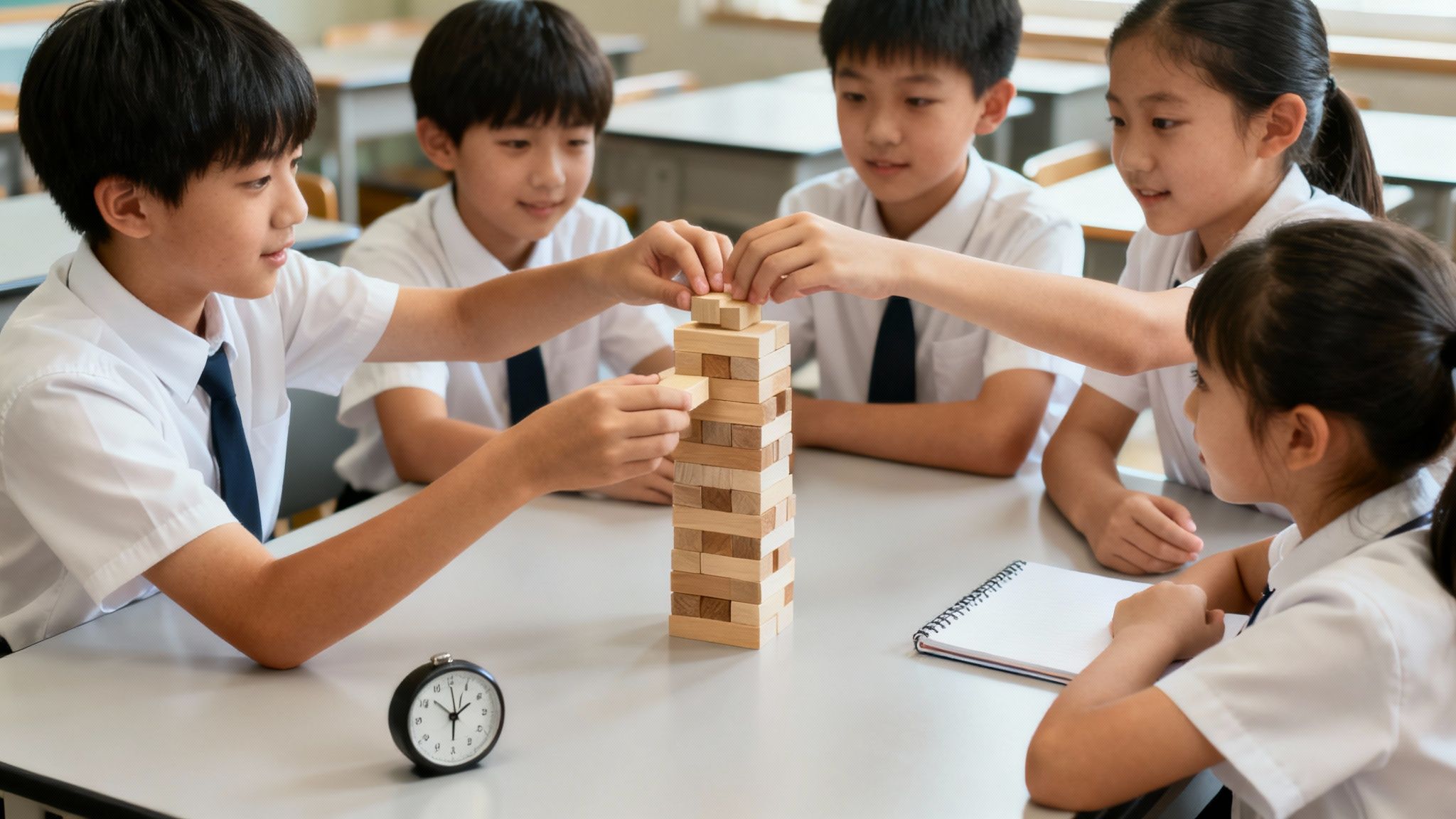
These group communication tasks are vital among communication skills activities because they simulate real-world scenarios where collaboration is key. They teach students to value diverse viewpoints, manage disagreements constructively, and build consensus, reinforcing that collective effort often leads to the most innovative solutions.
How It Works
Purpose: To develop teamwork, problem-solving, negotiation skills, and an appreciation for diverse perspectives.
Time: 20–30 minutes
Materials: Varies by activity (e.g., LEGOs, spaghetti and marshmallows, cups, puzzle pieces, rope).
Step-by-Step Directions:
- Form Groups: Divide students into small, mixed-ability groups of 3-5.
- Present the Challenge: Introduce the task and its constraints.
- Practical Example: The “Human Knot” challenge, where students stand in a circle, grab hands with two different people across from them, and then work together to untangle the “knot” of arms without letting go.
- Explain Communication Rules: Set clear expectations for communication. Emphasize that all ideas should be heard and respected.
- Facilitate the Activity: Give students a set time to plan and execute their solution. Observe their communication patterns and how they handle disagreements.
- Debrief and Reflect: After the time is up, lead a group discussion. Ask questions like, “What communication strategies worked well?” and “What would you do differently next time?”
Tips for Implementation
- For Younger Students (K-3): Use simple, tangible tasks like building the tallest possible tower with a set number of blocks or a “Cup Stack Relay.” Focus on taking turns and using kind words. The goal is successful participation over a perfect outcome.
- For Older Students (4-8): Introduce more complex challenges, such as escape room-style puzzles or a “Blind Construction” activity where one student describes a structure for another to build without seeing it. Assign specific roles like facilitator or timekeeper to ensure accountability.
- Differentiation: Ensure tasks are challenging but achievable for all groups. For students who struggle with group work, provide sentence starters or a script to help them contribute their ideas positively.
These activities provide a dynamic, hands-on way to teach communication skills. For more tools that foster peer-to-peer connection and cooperation, explore Soul Shoppe’s engaging student programs.
10. Gratitude and Appreciation Communication Rituals
Gratitude and Appreciation Communication Rituals are structured activities that give students regular opportunities to express thanks and recognition. By creating dedicated time for students to appreciate peers, teachers, and their community, these rituals help build positive relationships, reinforce pro-social behaviors, and shift the classroom focus from deficits to strengths.
This practice is essential among communication skills activities because it teaches students how to articulate positive feelings constructively. It fosters a culture of kindness and belonging, showing students that their positive contributions are seen and valued, which is central to creating a safe and connected learning environment.
How It Works
Purpose: To develop skills in expressing and receiving appreciation, strengthen peer relationships, and build a positive, supportive classroom culture.
Time: 5–15 minutes, depending on the format.
Materials: Varies by activity (e.g., paper, sticky notes, a jar, a shared journal).
Step-by-Step Directions:
- Introduce the Concept: Explain what appreciation means. Model a specific and meaningful appreciation.
- Practical Example: Instead of saying “Thanks, Maya,” try “I want to appreciate Maya for helping me pick up my crayons when I dropped them. It made me feel supported.”
- Choose a Ritual: Select a format that fits your classroom. A simple start is an “Appreciation Circle” during a morning meeting.
- Set the Rules: Establish guidelines for giving and receiving appreciation. The giver should be specific, and the receiver should learn to simply say, “Thank you.”
- Facilitate the Activity: For an Appreciation Circle, pass a talking piece and have each student share one thing they appreciate about another person. For an “Appreciation Mailbox,” have students write anonymous notes and read them aloud at the end of the week.
- Make it a Habit: Integrate the ritual into your regular classroom routine (daily or weekly) to build momentum and make it a cultural norm.
Tips for Implementation
- For Younger Students (K-3): Use a “Thankfulness Tree.” Students can write or draw what they are thankful for on paper leaves and add them to a large tree cutout on the wall.
- For Older Students (4-8): Start a Gratitude Journal where students write detailed entries about people or experiences they appreciate. This encourages deeper reflection and improves written communication skills.
- Differentiation: Offer multiple formats for expressing gratitude, including verbal sharing, writing, or drawing. Provide a private option, like an appreciation box, for students who are uncomfortable with public recognition.
Creating these consistent rituals is a powerful way to embed social-emotional learning into your daily schedule. To learn more about fostering a culture of belonging, explore the principles in Soul Shoppe’s SEL-focused student assemblies.
10 Communication Activities Comparison
| Technique | Implementation complexity | Resource requirements | Expected outcomes | Ideal use cases | Key advantages |
|---|---|---|---|---|---|
| Active Listening Circles | Medium — needs facilitation and ground rules | Low–Moderate — time, facilitator, talking piece | Increased empathy, psychological safety, belonging | Emotional check-ins, restorative circles, classroom meetings (K-3 with modifications) | Builds deep listening, validates voices, fosters inclusion |
| Role-Playing & Perspective-Taking Scenarios | Medium–High — scenario design and skilled facilitation | Moderate — time, scripts/prompts, facilitator | Improved empathy, conflict-resolution skills, confidence | Practicing hard conversations, bullying response, social skills (K-8) | Experiential practice with immediate feedback; memorable learning |
| Nonverbal Communication & Body Language Activities | Low–Medium — simple activities with clear boundaries | Low — space, short activities, optional recording | Better emotion recognition and self-awareness | SEL lessons, language-barrier support, theater-integrated lessons | Inclusive, engaging, strengthens nonverbal awareness |
| Fishbowl Discussions | Medium — requires clear roles and protocols | Moderate — time, seating/space, observation guides | Enhanced critical thinking, observation, peer learning | Literature analysis, debate prep, large-group discussions | Models strong discussion practices; engages observers |
| I‑Messages & Nonviolent Communication Practice | Low–Medium — teaching formula and modeling | Low — visuals, practice time, adult modeling | Reduced defensiveness, clearer emotional expression | Conflict de-escalation, classroom norms, peer mediation prep | Simple shared language; transferable across settings |
| Peer Mediation & Conflict Resolution Practice | High — extensive training and policy supports | High — 20–40+ hrs training, adult oversight, referral system | Peer-led resolutions, leadership development, fewer referrals | Schools building restorative systems, leadership programs (mediators typically older students) | Develops student leadership and sustainable peer support |
| Digital Communication & Online Etiquette Simulations | Medium–High — up-to-date scenarios and facilitation | High — devices, tech expertise, current examples | Improved digital empathy, safer online behavior, cyberbullying reduction | Digital citizenship lessons, remote learning contexts (age-appropriate) | Directly addresses real-world online challenges; practical skills |
| Empathy Mapping & Perspective-Taking Exercises | Low–Medium — template-driven with guided prompts | Low–Moderate — templates, time for research/interviews | Deeper perspective-taking, analytical and research skills | Literature, social studies, pre-conflict understanding | Visual, systematic method to make empathy concrete |
| Collaborative Problem-Solving & Group Tasks | Medium — careful task design and facilitation | Moderate–High — materials, space, extended time | Stronger teamwork, communication, critical thinking | STEM challenges, team-building, cooperative learning | Engaging, shows value of diverse perspectives in practice |
| Gratitude & Appreciation Communication Rituals | Low — easy to implement consistently | Low — brief time, simple materials | Increased belonging, positive culture, improved well-being | Daily/weekly classroom routines, closing circles (K-8) | Low-cost, high-impact; reinforces strengths and community |
Putting Communication into Action: Your Next Steps
We’ve explored a comprehensive toolkit of ten dynamic communication skills activities designed to empower students from kindergarten through eighth grade. Moving beyond passive learning, these hands-on exercises transform abstract concepts like active listening, empathy, and conflict resolution into tangible, memorable experiences. From the focused intention of Active Listening Circles to the complex social navigation of Digital Communication Simulations, each activity provides a unique pathway to building a more connected, respectful, and collaborative classroom or home environment.
The common thread weaving through these diverse activities is the principle of practice. Communication is not a static subject to be memorized; it is a fluid skill that must be rehearsed, refined, and reflected upon. A single session on “I-Messages” is a great start, but true mastery comes from consistently creating opportunities for students to use these tools in low-stakes, supportive settings.
Key Takeaways for Lasting Impact
As you integrate these exercises, remember these core principles to maximize their effectiveness:
- Scaffolding is Crucial: Start with foundational skills before moving to more complex ones. For example, ensure students are comfortable with Nonverbal Communication cues before asking them to engage in a nuanced Peer Mediation role-play. A solid base prevents frustration and builds confidence.
- Contextualize the Learning: Always connect the activity back to real-world situations. After a Fishbowl Discussion on a hypothetical playground conflict, ask students, “When might you see a situation like this during recess? How could using an ‘I-Message’ change the outcome?” This bridge makes the skills relevant and applicable to their daily lives.
- Model, Model, Model: Children and young adolescents learn as much from observation as they do from instruction. Demonstrate active listening when a student speaks to you. Use “I-Messages” when expressing your own feelings. Your consistent modeling validates the importance of these skills and provides a constant, living example.
- Consistency Over Intensity: A 15-minute Gratitude and Appreciation Ritual once a week can have a more profound, lasting impact than a single, two-hour workshop on communication. Weaving these communication skills activities into the regular rhythm of your classroom or family routine normalizes them, making them a natural part of your shared culture.
Your Actionable Next Steps
Feeling inspired? The journey from reading about these activities to implementing them is the most important step. Here is a simple, actionable plan to get you started:
- Choose One Activity: Don’t try to do everything at once. Review the list and select one activity that best addresses a current need in your group. Is listening a challenge? Start with Active Listening Circles. Are minor conflicts derailing lessons? Try I-Messages and Nonviolent Communication Practice.
- Schedule It: Commit to a specific day and time. Put it on your calendar or in your lesson plan. For example, decide to run a 20-minute Collaborative Problem-Solving Challenge every Friday afternoon for the next month.
- Prepare and Adapt: Gather your materials and think through any necessary differentiations. If you’re working with younger students on Empathy Mapping, you might use simple emojis for feelings instead of written words. For older students, you could use a complex character from a novel they are reading.
- Reflect and Iterate: After the activity, create space for reflection. Ask students: “What was challenging about that? What felt easy? What did you learn about how you communicate?” Use their feedback, and your own observations, to adjust your approach for the next time.
By intentionally and consistently cultivating these skills, you are doing more than just teaching students how to talk and listen. You are equipping them with the fundamental tools they need to build healthy relationships, navigate complex social landscapes, and advocate for themselves with confidence and compassion. You are laying the groundwork for a future where they can connect, collaborate, and contribute meaningfully to the world around them.
Ready to take your school’s social-emotional learning to the next level? The activities in this guide are a powerful start, and Soul Shoppe provides comprehensive programs that build a culture of empathy and respect throughout your entire school community. Explore our evidence-based programs and bring expert-led, transformative SEL experiences to your students by visiting Soul Shoppe.