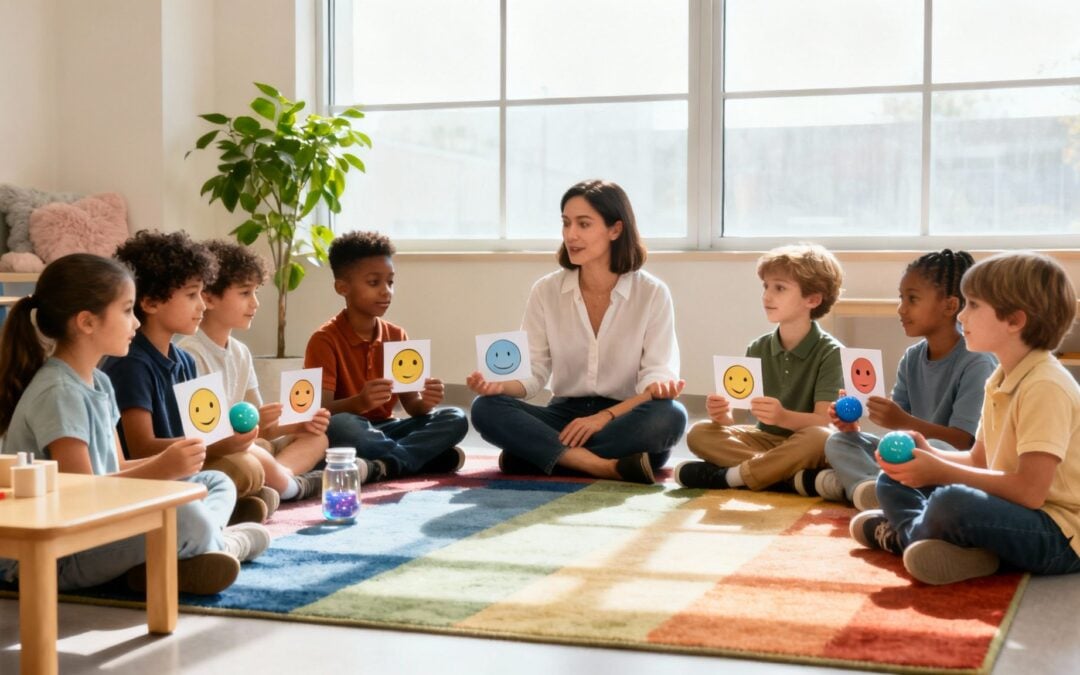
Beyond academics, a child's ability to understand emotions, build healthy relationships, and make responsible choices is crucial for success in school and life. This is the core of social emotional learning (SEL). For elementary students, these skills are not just ‘nice-to-haves’; they are the building blocks of a safe, connected, and productive learning environment where every child can thrive.

Integrating SEL doesn't require a complete curriculum overhaul. Many effective strategies can be woven into daily routines, complementing existing educational frameworks. For instance, philosophies like the Montessori method of teaching naturally emphasize student autonomy and self-management, which are key pillars of social emotional development. By intentionally incorporating SEL, educators and caregivers can cultivate classrooms where students feel seen, heard, and equipped to navigate social complexities.

This article provides a comprehensive roundup of 10 practical and research-backed social emotional learning activities for elementary students. Each activity is designed for immediate use by busy teachers, counselors, and parents, offering a clear structure to guide implementation. You will find:

  • Step-by-step instructions and clear goals for each activity.
  • SEL competency alignment (e.g., self-awareness, relationship skills).
  • Practical adaptations for different grade levels, remote settings, and large classes.

From fostering self-awareness with simple mindfulness exercises to building community through cooperative games, these strategies will equip you to nurture emotionally intelligent and resilient learners. The goal is to provide actionable tools that turn abstract SEL concepts into tangible classroom experiences, strengthening the foundation for academic achievement and lifelong well-being.

1. Mindfulness and Breathing Exercises

Mindfulness practices are foundational social emotional learning activities for elementary students, teaching them to pause, focus on the present moment, and observe their thoughts and feelings without judgment. By guiding children through simple breathing techniques, body scans, or sensory awareness exercises, you help them build a crucial gap between a triggering event and their reaction. This mental space is where self-regulation begins, allowing students to manage big emotions like anxiety, frustration, and over-excitement.

These exercises directly support the core SEL competencies of self-awareness (noticing internal states) and self-management (using a tool to regulate those states). The goal is not to eliminate difficult feelings but to equip children with the skills to navigate them constructively.
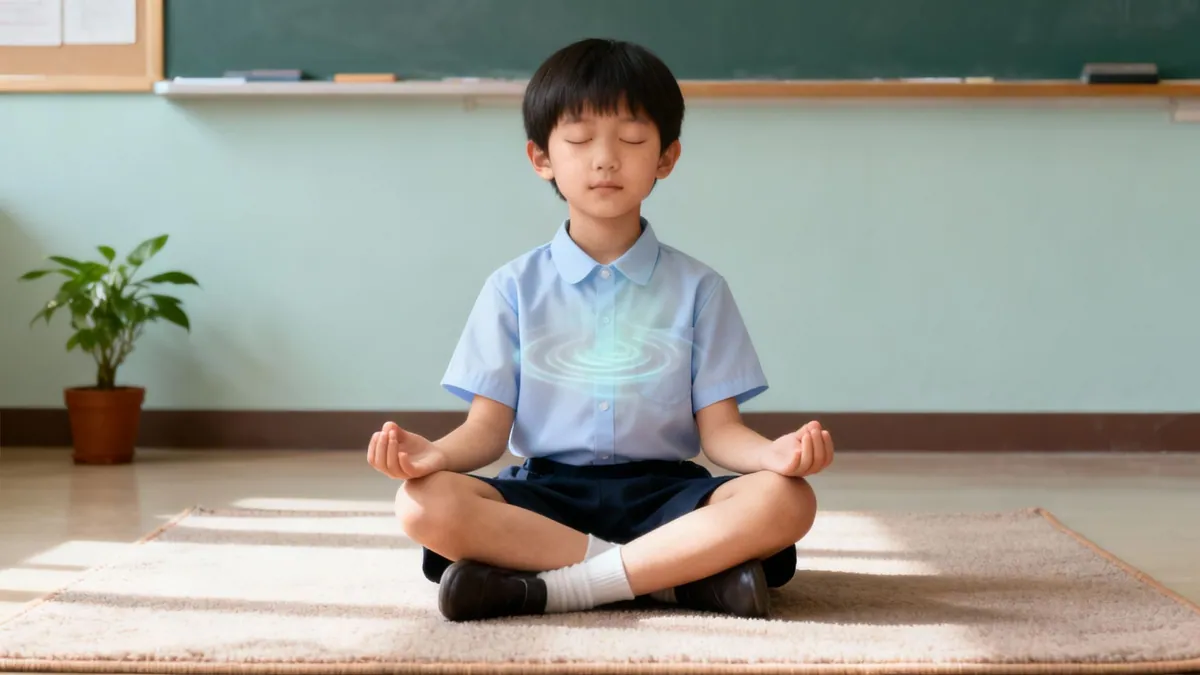
A young Asian boy in a school uniform meditates in a classroom, showing focus and inner calm.

How to Implement Mindfulness and Breathing

Start by integrating short, simple practices into daily routines. For example, a "Mindful Morning" can begin with two minutes of "belly breathing," where students place a hand on their stomach to feel it rise and fall. This tangible sensation helps younger learners stay focused. Before a challenging task like a math test, guide them through a "square breathing" exercise: inhale for four counts, hold for four, exhale for four, and pause for four, tracing a square in the air or on their desk.

Practical Example:
A second-grade teacher notices her class is overly energetic and unfocused after recess. She signals for a "Mindful Minute" by ringing a small chime. She guides them: "Place your feet flat on the floor and rest your hands on your desk. Let's do 'Volcano Breaths.' Reach your arms up high as you breathe in deeply, then push the air out with a 'whoosh' sound as your arms come down." She repeats this three times, and the class settles, ready for the next lesson.

Tips for Success

  • Model First: Always demonstrate the breathing exercise yourself so students see and hear what is expected.
  • Start Small: Begin with practices as short as 30 seconds to one minute, gradually increasing the duration as students build their focus "muscles."
  • Offer Choices: Allow students to sit at their desks, stand, or lie on a rug. Giving them agency over their body position increases comfort and participation.
  • Use Consistent Cues: A specific chime, a hand signal, or a phrase like "Let's find our calm" can signal the start of a mindfulness practice, making transitions smoother.

By consistently weaving these moments into the school day, you provide students with a powerful, portable tool for managing their emotional well-being. For more ideas on creating a peaceful classroom, you can find a variety of mindfulness strategies for a relaxed learning environment on soulshoppe.org.

2. Feelings Check-In and Emotion Identification

Feelings check-ins are structured daily activities where students learn to recognize, name, and express their emotions using specific vocabulary and visual aids. These simple routines build emotional literacy from the ground up, giving children the words to articulate their internal states. This practice is one of the most essential social emotional learning activities for elementary students because it normalizes conversations about feelings and creates a classroom culture of empathy and support.

This activity directly supports the core SEL competencies of self-awareness (identifying one's own emotions) and social awareness (recognizing and understanding the emotions of others). By making emotional identification a regular part of the day, you teach students that all feelings are valid and manageable.
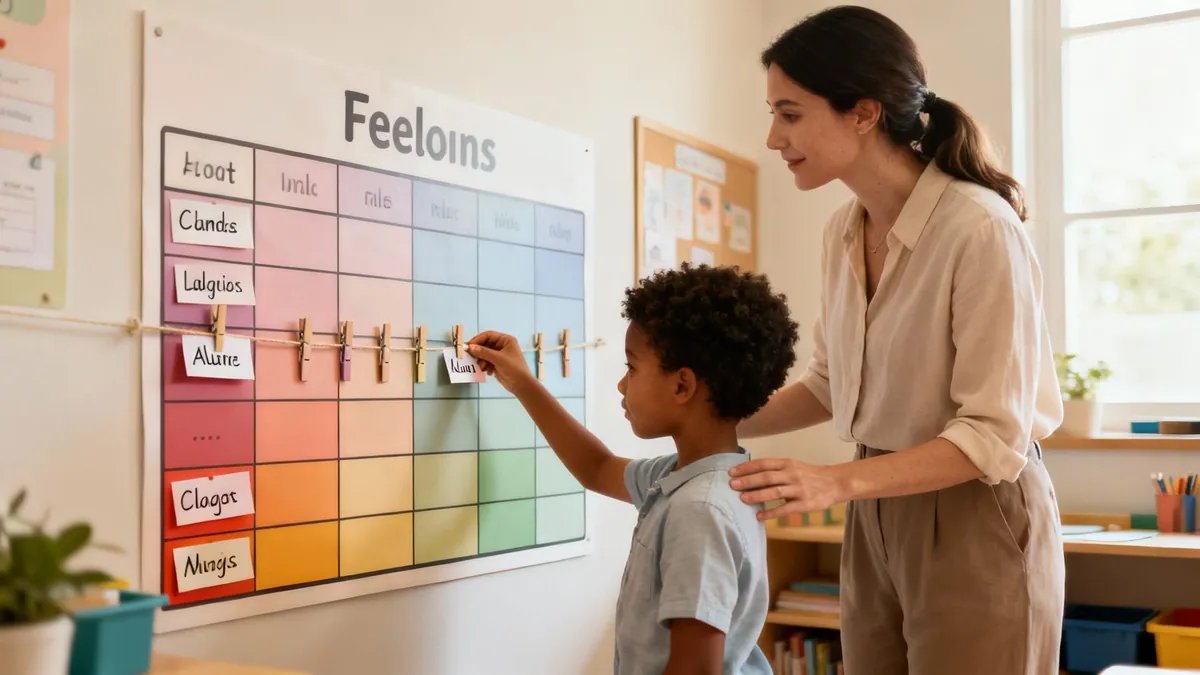
A kind teacher assists a young boy in hanging a word card on a colorful "Feelings" chart in a classroom.

How to Implement Feelings Check-Ins

Integrate check-ins into predictable routines, like morning meetings or the transition after lunch. Use visual tools like a "Feelings Thermometer" or an "Emotion Wheel" where students can point to or place their name next to the feeling that best describes their current state. This non-verbal option is excellent for younger students or those who are hesitant to share aloud. As students become more comfortable, you can invite them to briefly share why they feel a certain way.

Practical Example:
A third-grade teacher starts each morning by having students move their personal clothespin to a section of a large color-coded chart. Red represents intense feelings like anger or excitement, yellow for mild feelings like worry or silliness, and blue for low-energy feelings like sadness or tiredness. She then asks, "I see a few friends in the yellow zone today. Would anyone like to share what's on their mind?" This simple act validates their emotions and gives her valuable insight into her students' readiness to learn.

Tips for Success

  • Validate All Emotions: Respond with empathy and without judgment. Phrases like, "It's okay to feel disappointed," or "I understand why you might feel nervous," create emotional safety.
  • Expand Emotional Vocabulary: Move beyond "happy, sad, mad." Introduce more nuanced words like "frustrated," "proud," "anxious," and "content" to help students identify their feelings with greater precision.
  • Offer Private Options: For students who are not comfortable sharing with the group, provide a journal or a private check-in slip they can hand to you.
  • Connect Feelings to Needs: Ask follow-up questions like, "What do you need right now to help with that feeling?" This empowers students to practice self-advocacy and problem-solving.

Consistently using these check-ins helps students develop a deeper understanding of themselves and their peers. You can explore a variety of methods for these important routines and find more about using mood meters and other reflection tools on soulshoppe.org.

3. Cooperative Games and Team-Building Activities

Cooperative games shift the focus from individual competition to collective success, making them powerful social emotional learning activities for elementary students. Instead of a "win-lose" dynamic, these activities create a "we all win or we all learn together" environment. By engaging in challenges that require communication, shared strategy, and mutual support, children learn to value collaboration and appreciate the unique strengths of their peers.

These activities are essential for developing relationship skills (communication, cooperation, conflict resolution) and social awareness (perspective-taking, empathy). They build a strong sense of classroom community and belonging, teaching students that relying on others and being reliable are equally important. The goal is to solve a problem together, strengthening interpersonal bonds in the process.
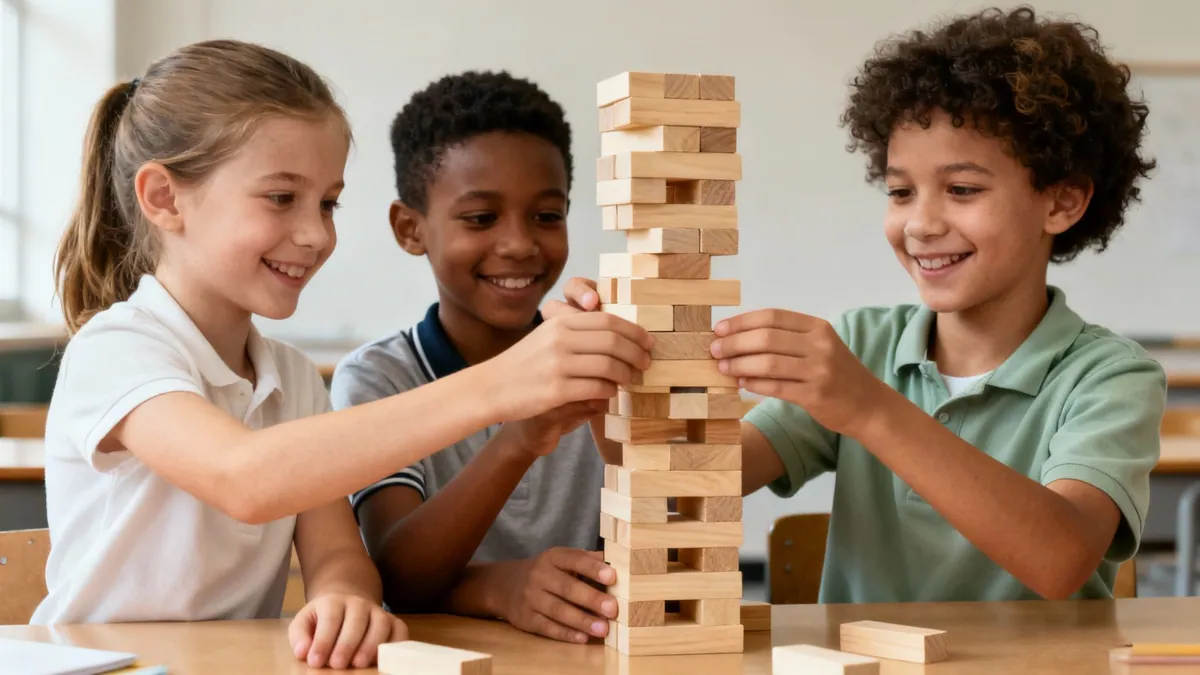
Three happy diverse elementary school children playing Jenga, carefully building a tall wooden block tower.

How to Implement Cooperative Games

Integrate team-building exercises during morning meetings, brain breaks, or dedicated community-building time. Start with low-stakes activities that have simple rules. For example, the "Human Knot" challenges a small group to untangle themselves from a jumble of interconnected arms without letting go. Another classic is "Build a Tower," where teams use limited materials like spaghetti and marshmallows to construct the tallest possible freestanding structure.

Practical Example:
A fourth-grade teacher wants to improve how her students work in small groups. She introduces a challenge: "Cross the River." She lays out a few small mats ("rafts") on the floor and explains that the entire group must get from one side of the room to the other without touching the "water" (the floor). The team must pass the rafts to one another to move forward, requiring planning and clear communication. The activity generates laughter, a few failed attempts, and ultimately, a shared sense of accomplishment.

Tips for Success

  • Focus on Process, Not Outcome: Emphasize how the group worked together, not whether they "won" the challenge. Use prompts like, "What was one helpful thing a teammate said?"
  • Facilitate a Debrief: After the activity, guide a brief discussion. Ask students what went well, what was challenging, and what they might do differently next time.
  • Offer Opt-in Participation: Create a psychologically safe environment where students feel comfortable participating. For activities involving touch, like the Human Knot, allow students to choose their level of involvement.
  • Mix Up the Groups: Intentionally create different groupings for various activities. This helps break down social cliques and builds relationships across the entire classroom.

By incorporating cooperative games, you actively teach students the skills needed to navigate group dynamics, resolve conflicts, and build positive relationships, setting a foundation for successful collaboration inside and outside the classroom.

4. Conflict Resolution and Peer Mediation

Conflict resolution and peer mediation programs are powerful social emotional learning activities for elementary students that teach them to navigate disagreements constructively. Instead of relying on adult intervention for every problem, these structured processes empower children with the skills to listen, understand different perspectives, and find mutually agreeable solutions. This approach transforms conflict from a negative event into a valuable learning opportunity.

These activities directly build the core SEL competencies of social awareness (perspective-taking), relationship skills (communication and conflict resolution), and responsible decision-making (evaluating consequences and solving problems ethically). The ultimate goal is to create a safer, more respectful school climate where students feel capable of solving their own problems.

How to Implement Conflict Resolution

Begin by establishing a dedicated "Peace Corner" or "Conflict Resolution Zone" in the classroom. This area can be equipped with visual aids outlining the steps for resolving a problem, such as using "I-Feel" statements, listening without interrupting, and brainstorming solutions. Introduce these steps through role-playing common classroom scenarios, like arguments over toys or disagreements during a group project. For a more structured approach, older students can be trained as peer mediators to help younger students resolve conflicts during recess.

Practical Example:
Two third-grade students are arguing over a single red marker they both want for an art project. Instead of solving it for them, their teacher directs them to the classroom's Peace Corner. Following the posted steps, the first student says, "I feel frustrated because I need the red marker for my drawing." The second student listens and responds, "I hear you're frustrated. I feel upset because I need it for my drawing, too." They agree to take turns, using the marker for five minutes each, resolving the conflict independently and respectfully.

Tips for Success

  • Start Simple: Teach foundational skills like "I-Feel" statements to students in grades K-2 before introducing more complex mediation steps.
  • Use Real Scenarios: Role-play conflicts that genuinely occur in your classroom or on the playground to make the practice relevant and meaningful.
  • Practice Consistently: Regular practice helps students internalize the steps so they can recall them automatically during a real, emotionally charged conflict.
  • Establish Clear Boundaries: Define which problems students can solve themselves and which require adult help, ensuring safety and appropriate support.

By teaching these essential life skills, you equip students to build healthier relationships and contribute to a more positive community. For a deeper look into the language of resolving disputes, you can explore the use of "I-Feel" statements for kids and how they transform disagreements.

5. Gratitude and Appreciation Practices

Gratitude practices are powerful social emotional learning activities for elementary students that shift their focus toward appreciating the positive aspects of their lives. By regularly identifying and expressing thankfulness, children develop a more optimistic outlook, build resilience against setbacks, and strengthen their connections with others. This intentional focus on appreciation helps counter negativity and fosters a sense of contentment and well-being.

These activities directly support the SEL competencies of social awareness (recognizing the contributions of others) and relationship skills (communicating appreciation to build positive connections). The goal is to cultivate a habit of noticing the good, which can profoundly impact a child's mental health and social interactions.

How to Implement Gratitude and Appreciation

Integrate gratitude into existing routines to make it a natural part of the day. A "Gratitude Circle" during a morning meeting allows students to share one small thing they are thankful for, setting a positive tone for learning. Another effective tool is a "Gratitude Journal," where students can write or draw something they appreciate each day, creating a personal log of positivity to look back on.

Practical Example:
A third-grade teacher starts an "Appreciation Mail" system. Each Friday, students have a few minutes to write a short, specific note of appreciation to a classmate, teacher, or staff member and "mail" it in a decorated classroom mailbox. The teacher reads a few aloud (with permission), and then delivers the notes. This activity not only highlights kindness but also gives every student a chance to feel seen and valued by their peers.

Tips for Success

  • Model Authenticity: Share your own specific gratitudes with the class. For example, say, "I'm grateful for how quietly everyone came in this morning; it helped us get started right away."
  • Encourage Specificity: Guide students beyond generic answers like "my family." Prompt them with questions like, "What is something specific your brother did that you are grateful for?"
  • Offer Multiple Formats: Allow students to express gratitude by writing, drawing, speaking, or even creating a short video. This accommodates different learning styles and comfort levels.
  • Connect to Community: Create a whole-class "Thankfulness Tree" or an "Appreciation Board" where notes can be posted publicly, fostering a school-wide culture of recognition.

By consistently making space for gratitude, you help students develop a lasting habit of recognizing and appreciating the people and moments that make life meaningful. For more ways to foster a positive classroom climate, explore resources like those available on the Greater Good Science Center's education page.

6. Social Stories and Perspective-Taking Activities

Social stories and perspective-taking activities are powerful social emotional learning activities for elementary students that use structured narratives to build empathy and social understanding. By stepping into someone else’s shoes through stories, role-playing, or discussions, children learn to recognize different viewpoints, motivations, and emotional experiences. This process helps them understand how their words and actions impact others, laying the groundwork for more compassionate and inclusive interactions.

These activities are essential for developing the core SEL competencies of social awareness (understanding the perspectives of others and empathizing with them) and relationship skills (communicating effectively and building positive connections). The goal is to move students beyond their own immediate experience and cultivate a genuine curiosity and respect for the diverse world around them.

How to Implement Social Stories and Perspective-Taking

Integrate perspective-taking into your existing literacy or morning meeting routines. Start by reading a book with a clear emotional conflict, like The Hundred Dresses by Eleanor Estes, and pause to ask questions that encourage students to consider different characters' feelings. For example, "How do you think Wanda felt when Peggy teased her? What might Maddie have been thinking when she stood by and said nothing?"

From there, you can move into role-playing scenarios. Use situations that are common in a school setting, like a disagreement over a game at recess or someone feeling left out at the lunch table. Assign roles and have students act out the scenario, then discuss how each character felt and what could have been done differently.

Practical Example:
During a class meeting, a fourth-grade teacher addresses a recurring issue of students saving seats in the cafeteria. She divides the class into small groups and gives them a scenario: "A new student wants to sit at a table, but the other kids say, 'You can't sit here, we're saving these spots for our friends.' How does the new student feel? How do the other kids feel?" The groups discuss and then share their ideas, leading to a class-wide conversation about creating a more welcoming lunchroom.

Tips for Success

  • Use Diverse Literature: Select books and stories that feature characters from a wide range of backgrounds, cultures, and abilities to broaden students' understanding.
  • Ask Probing Questions: Go beyond simple comprehension. Ask "why" questions like, "Why do you think the character made that choice?" or "What might have happened before this story started to make them feel that way?"
  • Connect to Real Life: Help students see the connection between the characters' experiences and their own lives. Ask if they have ever felt a similar way or witnessed a similar situation.
  • Model Empathy: When discussing characters, model empathetic language yourself. Say things like, "It sounds like that must have been really hard for him," to guide students' responses.

By regularly engaging in these activities, you help students build the critical muscle of empathy, transforming your classroom into a more understanding and supportive community.

7. Self-Regulation and Coping Strategy Toolkits

Creating self-regulation and coping strategy toolkits is one of the most powerful social emotional learning activities for elementary students. It moves beyond simply identifying feelings to actively building a personalized plan for managing them. By teaching students to recognize their emotional triggers and the physiological signs of dysregulation, you empower them to proactively choose a strategy that helps them return to a calm, focused state.

This approach directly targets the core SEL competencies of self-awareness (recognizing internal signals) and self-management (deploying a specific coping tool). The goal is to equip every child with a menu of effective, accessible strategies they can use independently when emotions feel overwhelming, fostering resilience and a sense of agency over their well-being.

How to Implement Coping Strategy Toolkits

Begin by explicitly teaching a variety of strategies, explaining which emotions they might help with. Create a visual "Coping Menu" or use a framework like the Zones of Regulation to connect feelings to specific actions. A physical toolkit can be a small box with sensory items, while a classroom "peace corner" offers a designated space for students to use these tools without stigma.

Practical Example:
A third-grade teacher helps a student who gets frustrated during math create a personal toolkit. Inside a pencil box, they place a small piece of bubble wrap to pop, a smooth stone to rub, and a card with three deep-breathing steps. When the student feels frustration rising, they know they can quietly take out their toolkit at their desk and use one of the items to reset before asking for help.

Tips for Success

  • Practice Proactively: Introduce and practice coping strategies when students are calm, not just in the middle of a difficult moment. This builds muscle memory.
  • Offer Diverse Options: Include strategies that involve movement (wall pushes), sensory input (fidgets, weighted lap pads), and quiet reflection (drawing, listening to music).
  • Personalize the Toolkit: Help students identify what truly works for them. What is calming for one child might be overstimulating for another.
  • Involve Families: Share a list of the strategies being taught at school and encourage families to identify and practice them at home for consistent support. You can explore parent resources from Soul Shoppe for ideas on home implementation.

By normalizing the need for self-regulation tools, you create a supportive environment where students see managing emotions as a skillful and healthy part of life.

8. Morning Meeting and Class Circles

Morning Meeting is a structured daily gathering where students and teachers come together in a circle to start the day. This powerful ritual establishes a predictable and safe routine that intentionally builds classroom community, strengthens relationships, and provides a dedicated time for practicing key social skills. By creating this space for greeting, sharing, and engaging in a group activity, you set a positive tone for learning and reinforce a sense of belonging for every child.

These daily circles are a cornerstone of social emotional learning activities for elementary students because they directly target multiple SEL competencies. They foster social awareness (listening to peers' perspectives), relationship skills (practicing respectful communication), and responsible decision-making (collaboratively solving class problems). It becomes a living laboratory for the social skills taught in other lessons.

How to Implement Morning Meeting and Class Circles

A typical Morning Meeting, popularized by the Responsive Classroom approach, includes four components: greeting, sharing, group activity, and a morning message. The greeting involves students acknowledging each other by name. Sharing allows students to talk about important events in their lives, while others practice active listening. The group activity is a short, fun game or song that promotes group cohesion, and the message previews the day's learning goals.

Practical Example:
A third-grade teacher begins her Morning Meeting to address a recurring issue of students feeling left out at recess. During the sharing portion, she poses a prompt: "Think about a time you invited someone new to play. How did it feel?" After a few students share, she uses the morning message to announce they will be creating a class "Inclusion Agreement" together, turning a problem into a collaborative, community-building lesson.

Tips for Success

  • Establish Clear Norms: Co-create rules for the circle, such as "One person speaks at a time," "Listen with your whole body," and "It's okay to pass."
  • Start Small: Keep initial meetings short, around 10-15 minutes, especially for younger students in kindergarten and first grade.
  • Rotate Leadership: Empower students by allowing them to take turns leading different parts of the meeting, such as the greeting or group activity.
  • Protect the Time: Treat Morning Meeting as essential instructional time, not something to be skipped when you are busy. Consistency is what builds trust and safety.

By making this a non-negotiable part of your daily schedule, you show students that their voices matter and their relationships are a priority. For a deeper look into fostering this environment, explore these tips on how to build classroom community with Soul Shoppe.

9. Empathy and Kindness Challenges

Empathy and Kindness Challenges are structured campaigns designed to make thoughtful behavior a conscious and celebrated part of school culture. By prompting students to perform deliberate acts of kindness, these activities move empathy from an abstract concept to a tangible action. These challenges build positive momentum, demonstrating how small, individual choices can collectively create a more supportive and inclusive environment for everyone.

These social emotional learning activities for elementary students directly target social awareness (understanding and empathizing with others' feelings) and relationship skills (building positive connections through prosocial behavior). The goal is to help children recognize the power they have to impact their peers and community positively.

How to Implement Empathy and Kindness Challenges

Launch a school-wide or classroom-specific challenge with a clear theme and duration. For example, a "Kindness is Our Superpower" week could feature daily prompts. Monday's challenge might be to give a genuine compliment, while Tuesday's could be to invite someone new to play during recess. The key is making the actions specific and achievable for young students.

Practical Example:
A third-grade classroom creates a "Compliment Chain." When a student observes or receives a particularly kind act, they write it on a strip of colored paper. The teacher helps them add it as a new link to a paper chain hanging across the classroom. By the end of the month, the chain visually represents the class's collective kindness, and the teacher reads some of the links aloud to celebrate their progress.

Tips for Success

  • Be Specific: Vague instructions like "be kind" are less effective than "hold the door open for someone" or "ask a classmate about their weekend."
  • Celebrate the Process: Acknowledge effort and intention, not just grand gestures. Create a "Kindness Corner" where students can post notes about kind acts they've witnessed.
  • Connect to Empathy: After an act of kindness, facilitate a brief discussion. Ask questions like, "How do you think it made that person feel when you shared your crayons?"
  • Involve Families: Send home a note about the challenge and encourage families to participate by noticing and celebrating kindness at home.

These challenges transform the school environment by making kindness and empathy active, shared values. To see how these concepts are integrated into large-scale bullying prevention, you can learn about Soul Shoppe’s successful partnerships, like the one with the Junior Giants to help kids Strike Out Bullying.

10. Family and Community Engagement in SEL

Social emotional learning activities for elementary students are most effective when they extend beyond the school walls. Family and community engagement bridges the gap between classroom instruction and a child's home life, creating a consistent and supportive ecosystem. By intentionally involving parents, caregivers, and community partners, schools can amplify SEL skills, ensuring children hear and practice the same positive language and strategies in every part of their lives.

This approach strengthens all five core SEL competencies by creating a shared understanding and commitment to social awareness, relationship skills, and responsible decision-making across different environments. When families and schools partner, children see that these skills are valued everywhere, not just in the classroom.

How to Implement Family and Community Engagement

Begin by providing accessible resources and opportunities for connection. Offer parent workshops at various times (in-person and virtual) to accommodate different schedules. Distribute take-home SEL activity packets or newsletters that align with classroom lessons, giving families simple, actionable ways to practice skills like empathy or conflict resolution at home. Partnering with community organizations for events can also broaden your reach and impact.

Practical Example:
A school hosts a "Peaceful Families Night" facilitated by a community partner. Families participate in interactive stations, learning a simple "I-statement" formula for expressing feelings. They are sent home with a magnet summarizing the technique. The following week, a parent shares that her son used an "I-statement" to resolve a disagreement over a toy, a direct result of the shared learning experience.

Tips for Success

  • Provide Multilingual Resources: Ensure materials are translated to reflect the languages spoken by your school community, making content accessible to all families.
  • Connect to Parent Priorities: Frame SEL as a tool to help with common challenges like managing homework stress or building cooperation. To extend the spirit of cooperation from the classroom to the home, learning how to creating a family chore chart that fosters teamwork can effectively foster teamwork and shared responsibility among family members.
  • Start Simple: Introduce one easy-to-use strategy at a time, such as a "calm-down corner" at home or a single feeling word to focus on for the week.
  • Create a Welcoming Environment: Foster a school culture where families feel valued, respected, and seen as true partners in their child's education. Gather feedback regularly to ensure programming meets their needs.

10 Elementary SEL Activities Comparison

Program Implementation complexity Resource requirements Expected outcomes Ideal use cases Key advantages
Mindfulness and Breathing Exercises Low — short scripted practices; needs consistency Minimal — time, quiet space; no special equipment Faster calming, improved attention and emotion regulation Transitions, pre-assessments, brief classroom breaks Immediate calming effects; easy classroom integration; research-backed
Feelings Check-In and Emotion Identification Low–Moderate — routine development and adult skill Low — charts/visuals, brief daily time; staff training helpful Improved emotional literacy; early identification of distress Morning meetings, daily routines, counseling check-ins Builds shared language; normalizes emotion expression; teacher insight
Cooperative Games and Team-Building Activities Moderate — requires clear facilitation and debrief Moderate — space, simple materials, planning time Greater trust, communication, sense of belonging Community-building days, PE, assemblies, group transitions Engaging, reduces competition, strengthens peer relationships
Conflict Resolution and Peer Mediation High — training, protocols, ongoing supervision Moderate–High — training, adult oversight, materials Fewer referrals, improved peer problem-solving and empathy Recess/lunch mediation, restorative circles, classroom conflicts Empowers students, reduces adult load, teaches practical skills
Gratitude and Appreciation Practices Low — simple routines integrated into schedule Minimal — journals, prompts, short practice time Increased positivity, stronger peer relationships, resilience Morning meetings, end-of-week reflections, assemblies Low-cost, accessible, fosters optimism and recognition
Social Stories and Perspective-Taking Activities Low–Moderate — careful selection and guided discussion Low — books/materials, teacher prep time Increased empathy, reduced bias, better perspective-taking Literacy lessons, role-plays, anti-bias or conflict lessons Narrative-based, accessible across learning styles, culturally responsive when chosen well
Self-Regulation and Coping Strategy Toolkits Moderate–High — explicit teaching and individualization Moderate — tools, calm spaces, staff training and practice Reduced reactive behavior; greater independence and coping Students with anxiety/ADHD, calm-down corners, classroom routines Practical, evidence-based strategies usable across home and school
Morning Meeting and Class Circles Moderate — consistent facilitation and time protection Low — regular time block, structure, teacher commitment Stronger community, predictable routines, early issue resolution Daily class rituals, community-building, SEL practice Predictability, inclusive participation, strengthens relationships
Empathy and Kindness Challenges Low–Moderate — planning and authentic framing Low — prompts, tracking tools, celebration materials Increased prosocial acts, improved school climate Week-long campaigns, school-wide initiatives, bulletin boards Creates positive norms, engages students, visible cultural shift
Family and Community Engagement in SEL High — coordination, outreach, cultural adaptation Moderate–High — workshops, multilingual materials, staff time Greater consistency across contexts; stronger family-school partnerships Family workshops, take-home activities, community partnerships Extends SEL to home, builds trust, leverages community resources

Putting it All Together: Building a Culture of Connection and Empathy

We have explored a wide range of powerful and practical social emotional learning activities for elementary students, from the quiet introspection of mindful breathing to the dynamic collaboration of cooperative games. Each activity, whether it's a quick Feelings Check-In or a structured Peer Mediation session, serves as a single thread. When woven together consistently, these threads create a strong, resilient, and supportive classroom tapestry. The goal is not to treat SEL as another box to check, but to embed it into the very heart of the school day.

The true power of these activities is unlocked through intentional and consistent application. A one-time empathy challenge is a great start, but a weekly practice builds a lasting habit of kindness. A coping strategies toolkit is most effective when students are regularly encouraged to use it, not just during moments of crisis, but as a proactive self-management tool. The journey from learning about emotions to living with emotional intelligence is a marathon, not a sprint, built upon these small, repeated practices.

From Activities to a Thriving Classroom Culture

Integrating these diverse activities creates a powerful synergy that transforms the learning environment. Imagine a classroom where a Morning Meeting sets a positive and inclusive tone, a Gratitude Jar visibly tracks the community's appreciation, and a student-led conflict resolution corner empowers children to solve their own disagreements respectfully. This is the tangible result of a commitment to SEL.

This cultural shift doesn't happen by accident. It is the direct outcome of educators and caregivers who model these skills and create predictable routines where students feel safe to be vulnerable, make mistakes, and grow. When students have a shared vocabulary for their feelings and a toolbox of strategies for managing them, you'll see a decrease in disruptive behaviors and an increase in on-task learning, engagement, and peer support.

Your Actionable Next Steps for SEL Implementation

Moving from inspiration to action is the most critical step. Instead of feeling overwhelmed by the number of options, commit to a small, sustainable start.

  • Choose Your Starting Point: Select one or two activities from this list that resonate most with your students' needs and your own teaching style. Perhaps it’s starting each day with a "Rose, Bud, Thorn" check-in or introducing a weekly cooperative game.
  • Schedule It In: Consistency is key. Formally schedule your chosen SEL activities into your weekly lesson plans. This ensures they don't get pushed aside when things get busy. Even five dedicated minutes a day can have a profound impact over time.
  • Involve Your Community: Share these ideas with colleagues, administrators, and families. When students see and hear consistent SEL language and practices at school and at home, the learning is reinforced exponentially. Consider sending home a "Kindness Challenge" or a list of conversation starters about feelings.

By embracing these social emotional learning activities for elementary students, you are doing more than just managing a classroom; you are nurturing a generation of compassionate leaders, resilient problem-solvers, and empathetic global citizens. The investment you make in their emotional well-being today will pay dividends for the rest of their lives, equipping them with the essential skills to navigate an increasingly complex world with confidence, kindness, and a strong sense of self.


Ready to take your school’s commitment to SEL to the next level? Soul Shoppe provides comprehensive, research-based programs that create safer, more compassionate school communities by empowering students, staff, and families. Discover how their dynamic assemblies and in-depth curriculum can help you build a sustainable culture of empathy and connection at Soul Shoppe.