

10 Powerful Communication Skills Activity Ideas for K–8 Classrooms
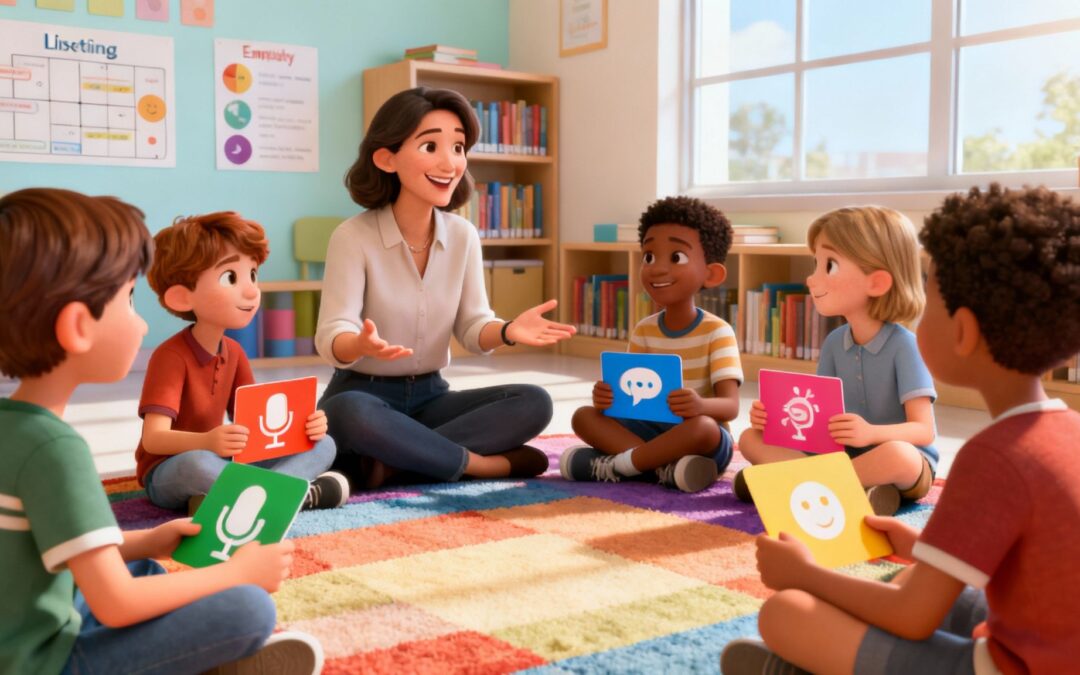
In today’s dynamic K-8 classrooms, the ability to communicate effectively is more than a ‘soft skill’-it’s the bedrock of learning, collaboration, and emotional well-being. From navigating friendships on the playground to engaging in thoughtful academic discussions, students need practical tools to listen, express themselves, and resolve conflicts peacefully. For educators, parents, and administrators, fostering these abilities can feel like a monumental task, especially when faced with diverse student needs and limited time.
This article cuts through the noise. We’ve compiled 10 powerful, classroom-ready communication skills activity ideas designed to build empathy, foster psychological safety, and create a culture of belonging. Each activity is broken down with step-by-step instructions, practical examples, and differentiation tips for various grade levels, so you can start building a more connected community tomorrow. These aren’t just games; they are foundational practices that equip students with the lifelong skills needed to thrive in school and beyond.
To make communication skills truly stick, it’s essential to move beyond passive learning. The activities detailed here are intentionally hands-on and interactive. Explore how implementing dynamic and participatory methods can enhance the learning experience by reviewing various active learning strategies to boost engagement. By creating an environment where students actively participate, you can ensure these crucial lessons resonate deeply. This guide provides the blueprint for that environment, offering clear, actionable steps for everything from Active Listening Circles to Perspective-Taking Role-Play, empowering you to cultivate stronger communicators in your classroom or home.
1. Active Listening Circles
Active Listening Circles are a structured and powerful communication skills activity designed to foster deep listening and empathy. In this exercise, participants sit in a circle, and only the person holding a designated “talking piece” is permitted to speak. All other members listen with full attention, without interrupting, planning a response, or judging. This simple protocol creates a safe, respectful space where speakers feel heard and validated.
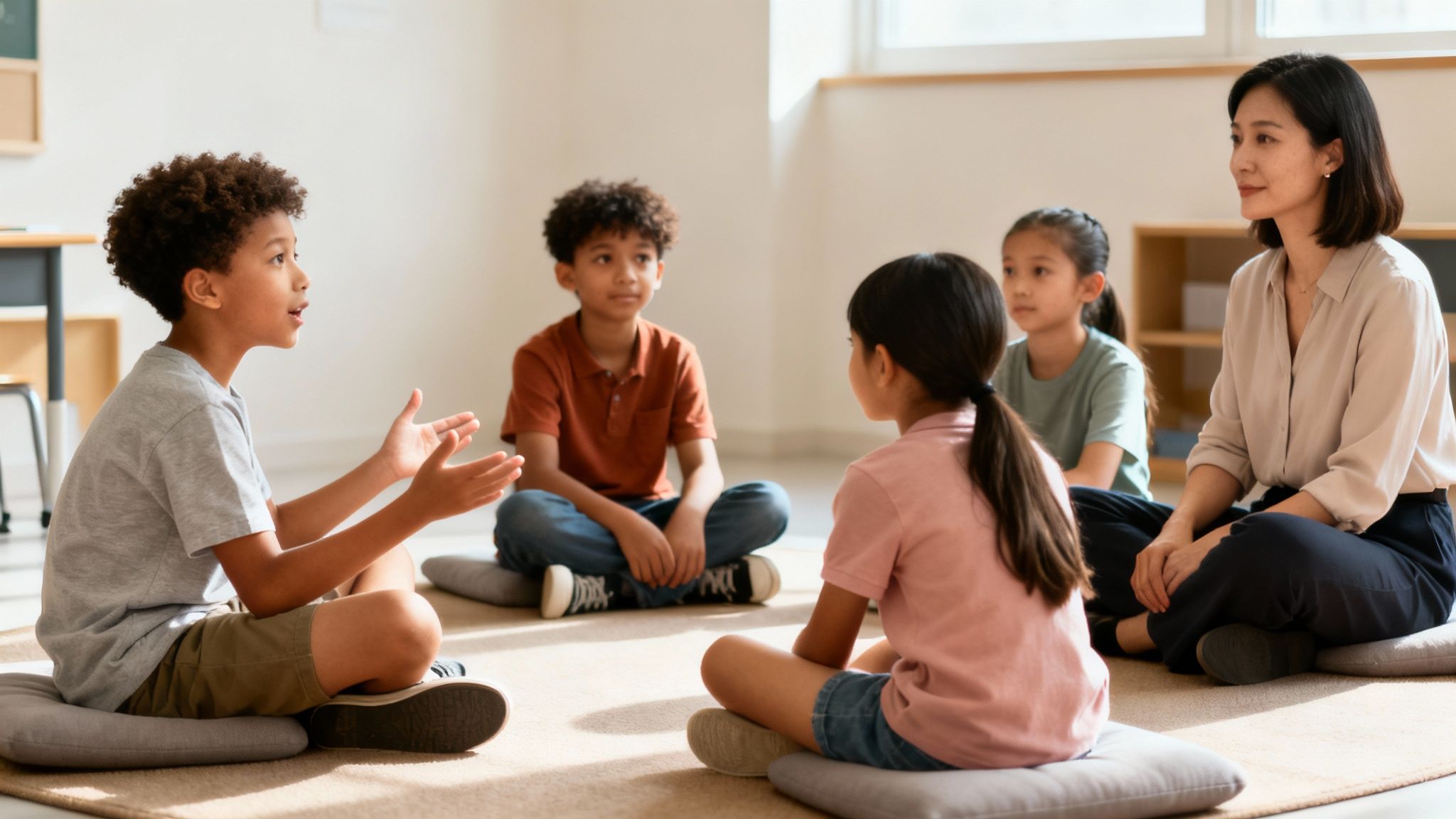
This foundational technique is remarkably versatile. It can be used for morning meetings in a kindergarten class to share weekend news, or as a framework for restorative justice conversations to address peer conflicts in middle school. The focus is not on debate but on understanding, making it an essential tool for building a strong classroom community. A practical example is using a circle to discuss a book character’s choice. A teacher could pass a “talking stone” and ask, “How do you think the character felt when they made that decision?” Each student shares their idea while others listen, building a collective understanding of the character’s motivations without debating who is “right.”
Facilitation Tips & Implementation
To ensure a successful listening circle, facilitators should establish clear guidelines and model the desired behaviors.
- Establish Clear Agreements: Co-create rules with the group, such as “Listen with your heart,” “Speak your truth,” and “What’s said in the circle stays in the circle.”
- Use a Talking Piece: This can be any object, like a decorative stone, a small stuffed animal, or a ball. The talking piece visually designates the speaker and reinforces the “one voice at a time” rule.
- Teach Non-Verbal Cues: Explicitly teach and practice non-verbal active listening skills like making eye contact, nodding, and maintaining an open posture.
- Offer a ‘Pass’ Option: Always give students the option to pass their turn without penalty. This respects their comfort level and builds trust.
- Start with Low-Stakes Topics: Begin with simple prompts like, “Share one good thing that happened this week,” before moving to more sensitive subjects. This builds psychological safety within the group.
By creating a predictable and safe structure, this communication skills activity helps students practice the core components of effective dialogue: speaking honestly and listening with compassion. Explore more in-depth strategies for Active Listening Circles to enhance this practice in your classroom. You can find more listening skills activities on soulshoppe.org.
2. Non-Violent Communication (NVC) Practice
Non-Violent Communication (NVC) is a structured framework that guides individuals to express themselves with clarity and compassion. Developed by psychologist Marshall Rosenberg, this communication skills activity teaches a four-step model: observations, feelings, needs, and requests. By separating objective observations from subjective judgments, NVC helps de-escalate conflict, reduce defensiveness, and foster genuine understanding between speakers.
This powerful approach transforms potentially adversarial conversations into opportunities for connection. It is highly effective in various school settings, from facilitating peer mediations where students resolve their own conflicts to structuring teacher-student conversations during disciplinary moments. Instead of saying, “You’re always interrupting,” a student learns to say, “When I see you talking while I’m sharing (observation), I feel frustrated (feeling) because I need to feel respected (need). Would you be willing to wait until I’m finished before you speak (request)?”.
Facilitation Tips & Implementation
To effectively introduce NVC, break down the four components and allow for ample practice in a safe environment.
- Teach Each Step Separately: Dedicate a mini-lesson to each of the four components: Observations, Feelings, Needs, and Requests. Use sorting activities and real-life scenarios to help students distinguish between them.
- Create Anchor Charts: Display the NVC framework on a classroom anchor chart. Include “feeling words” and “needs” lists to provide students with the vocabulary they need to express themselves accurately.
- Use Role-Playing Scenarios: Practice with low-stakes, relatable scenarios before tackling real conflicts. For example: “Your friend borrowed your favorite pen and didn’t return it.” A student would practice saying, “I see my pen is not on my desk (observation). I feel worried (feeling) because I need to have my things with me (need). Would you be willing to help me look for it? (request).”
- Celebrate the Attempt: Praise students for trying to use the NVC model, even if their phrasing isn’t perfect. The goal is to build the habit of communicating with intention and empathy.
- Connect to Mindfulness: Link NVC to emotional regulation by teaching students to take a calming breath before responding. This pause creates the space needed to choose a compassionate response over a reactive one.
By equipping students with this structured communication skills activity, educators empower them to navigate disagreements constructively and build healthier relationships. You can learn more about the NVC model at The Center for Nonviolent Communication.
3. Perspective-Taking Through Role-Play
Perspective-Taking Through Role-Play is an experiential communication skills activity where participants act out scenarios from different viewpoints to build empathy and understanding. By stepping into someone else’s shoes, students can physically and emotionally experience a situation differently. This powerful exercise helps develop compassion, improve conflict resolution skills, and reduce bullying behaviors.
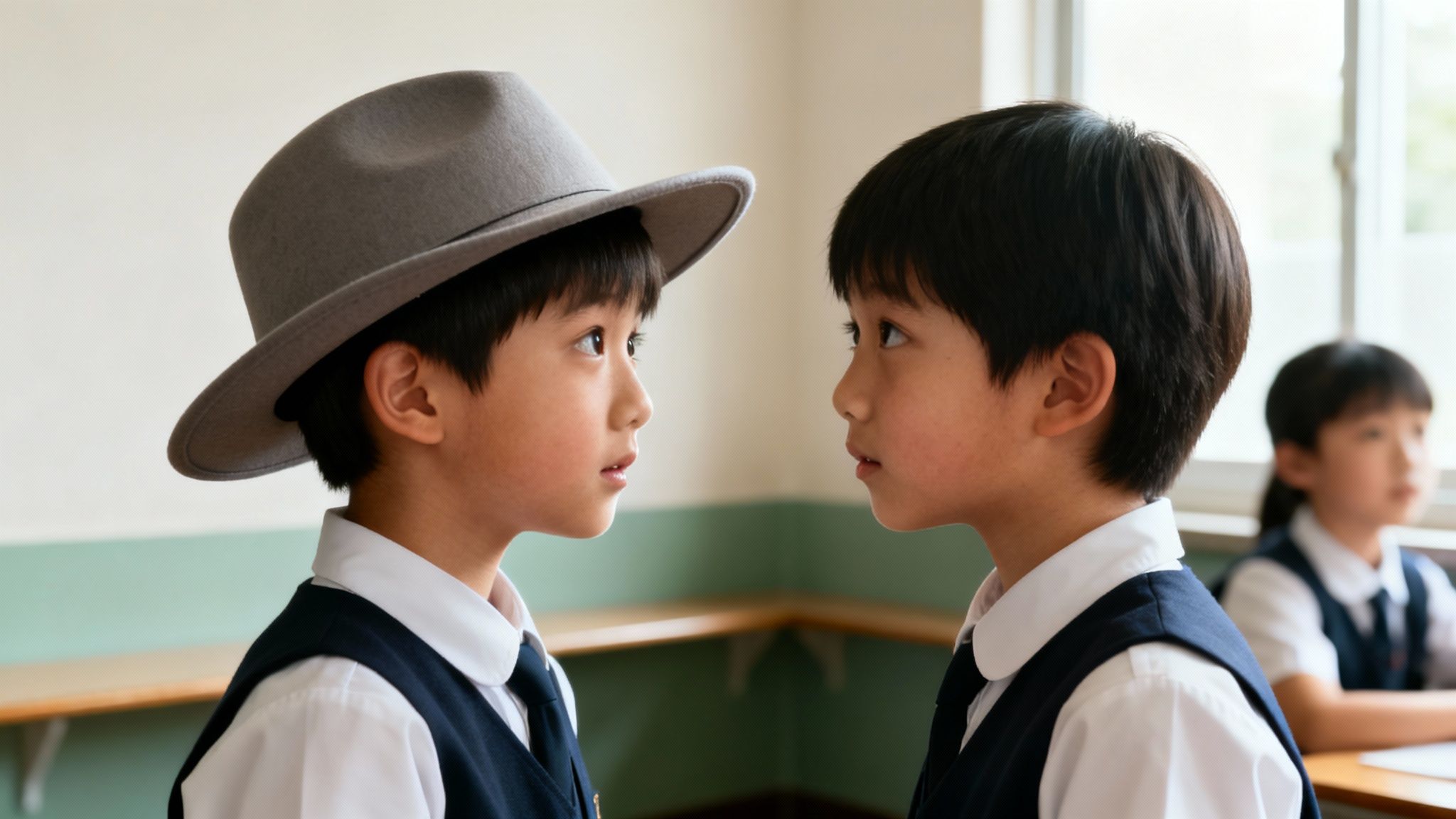
This method is incredibly effective for exploring complex social dynamics. For example, in a middle school classroom, students could role-play a lunch table exclusion scenario from the perspective of the person being excluded, a student doing the excluding, and a bystander. This helps participants understand the internal thoughts and feelings that drive behavior, fostering a more inclusive school climate. To further develop the ability to understand and share the feelings of others, consider exploring resources like ‘Let’s Talk About Empathy’.
Facilitation Tips & Implementation
The success of this communication skills activity depends heavily on creating a safe environment and conducting a thoughtful debrief.
- Establish Psychological Safety: Begin by setting clear expectations for respect and confidentiality. Reassure students that this is a learning exercise, not a performance.
- Brief Participants Privately: Give students their roles and a brief description of their character’s perspective in private. This prevents them from pre-judging other roles.
- Use a ‘Fishbowl’ Format: Have a small group act out the scenario in the center while the rest of the class observes. This can feel safer for participants and provides learning opportunities for the audience.
- Debrief Thoroughly: The post-activity discussion is crucial. Start with observational questions like, “What did you notice?” before moving to emotional reflections like, “How did that feel?”
- Offer an Opt-Out: Always allow students to decline participation or take on an observer role without shame. This respects their boundaries and builds trust.
- Follow Up with Reflection: Encourage students to process the experience through a private journal entry or a written reflection, solidifying their learning.
By embodying different perspectives, students gain a profound understanding of empathy that goes beyond simple definition. Learn more about how to build empathy in the classroom with these targeted strategies.
4. Peer Interview Pairs
Peer Interview Pairs is a structured, one-on-one communication skills activity where students interview each other using prepared questions. Afterward, each student introduces their partner to a larger group, highlighting what they learned. This exercise builds essential social skills by teaching students how to formulate questions, listen for understanding, and find common ground with their classmates.
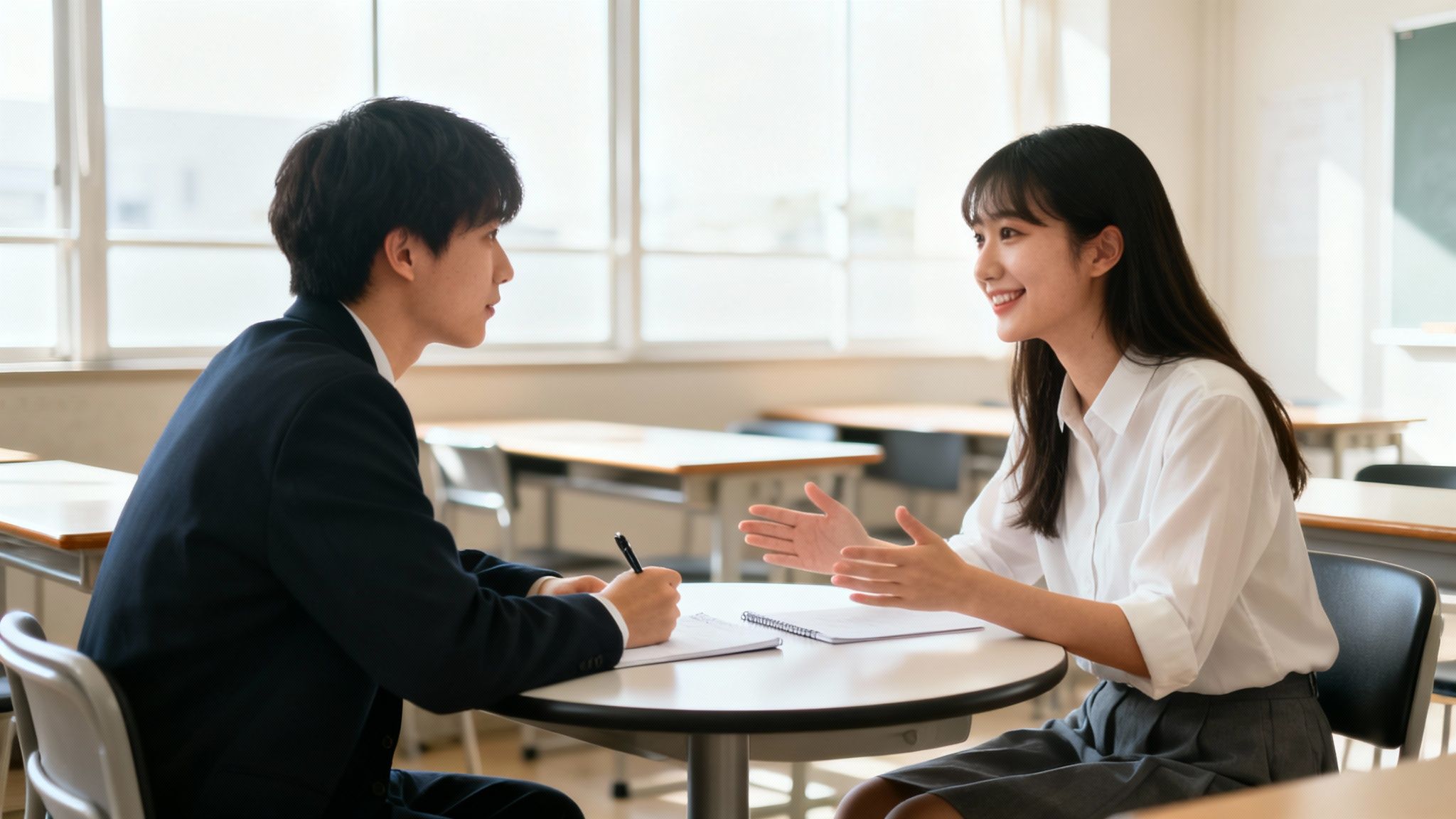
This activity is exceptionally effective as a back-to-school icebreaker, helping to build a positive classroom community from day one. It can also be adapted for specific team-building goals, such as a “Find someone who…” interview variant where students seek out classmates with specific experiences. For a practical example, a teacher could give students the prompt, “Ask your partner about a time they felt proud.” Afterward, one student might share, “This is Maria. I learned that she felt really proud when she finally learned to ride her bike without training wheels last summer.” This simple act fosters connection and validates personal achievements.
Facilitation Tips & Implementation
To maximize the impact of Peer Interview Pairs, facilitators should provide clear structure and actively model effective conversational techniques.
- Provide Specific Questions: Offer 4-5 open-ended questions to guide the conversation, such as “What is something you are proud of?” or “If you could have any superpower, what would it be and why?”
- Model Interviewing Skills: Before students begin, demonstrate a positive interview. Model how to ask a question, listen actively, and use follow-up prompts like, “Tell me more about that,” to encourage deeper sharing.
- Vary Partners Regularly: Repeat this communication skills activity throughout the year with new partners and questions. This helps expand social circles and allows relationships to deepen over time.
- Encourage Follow-Up Prompts: Teach students to go beyond the script by asking their own questions based on what they hear, such as “Why is that important to you?”
- Accept Diverse Responses: Allow for non-verbal students to participate by accepting written or drawn responses. Their partner can then share the drawing or read the written answer when introducing them.
By creating a structured and supportive framework, this activity gives students the confidence to initiate conversations and practice the art of getting to know someone new. Explore more resources for building student connections at casel.org.
5. Fishbowl Discussions
Fishbowl Discussions are a powerful and dynamic communication skills activity designed for focused conversation and active observation. In this exercise, a small inner circle of participants discusses a specific topic, while a larger outer circle observes the conversation silently. This structure allows the outer group to analyze communication patterns, body language, and the flow of dialogue without the pressure of participating directly.
This method is exceptionally effective for managing large groups and modeling healthy dialogue. It can be used to have a student-led panel discuss a class novel’s complex themes, or for staff to model conflict resolution strategies for students to observe. For example, after reading a chapter on a controversial historical event, five students could sit in the “fishbowl” to discuss its impact while the rest of the class takes notes on how often speakers build on each other’s ideas versus interrupting. This makes the communication process itself a key part of the lesson.
Facilitation Tips & Implementation
To maximize the learning potential of a Fishbowl Discussion, the facilitator must provide clear roles and structure for both the inner and outer circles.
- Assign Observation Tasks: Give the outer circle specific things to look for. For example, “Track how many times participants build on someone else’s idea,” or “Note examples of respectful disagreement.” This turns passive listening into active analysis.
- Provide Sentence Starters: Equip the inner circle with sentence starters like, “I’d like to add to what [Name] said…” or “I see that differently because…” This helps scaffold the conversation, especially for younger students or sensitive topics.
- Plan for Rotation: Systematically rotate members from the outer circle into the inner circle every 5-10 minutes. This allows more students to practice their speaking skills while ensuring everyone gets a chance to be an active observer.
- Debrief After Each Round: Before switching roles, facilitate a brief discussion where the outer circle shares their observations. This provides immediate, peer-driven feedback to the inner circle speakers.
- Establish Clear Protocols: Set up a clear, non-disruptive signal for an outer circle member who has a crucial point to add, such as a designated “hot seat” they can temporarily occupy.
By creating distinct roles for speaking and observing, this communication skills activity helps participants develop a deeper awareness of the components of effective dialogue. For more ideas on structuring Socratic seminars, which often use a fishbowl format, visit the Harvard Graduate School of Education.
6. Emotion Identification and Expression Games
Emotion Identification and Expression Games are interactive activities designed to teach students how to recognize, name, and appropriately express their feelings. These exercises build emotional literacy, the crucial ability to understand and communicate about one’s inner world. By using games, charades, and storytelling, students learn that all emotions are valid and develop a vocabulary to describe complex feelings, which is the foundation for self-regulation and empathetic communication.
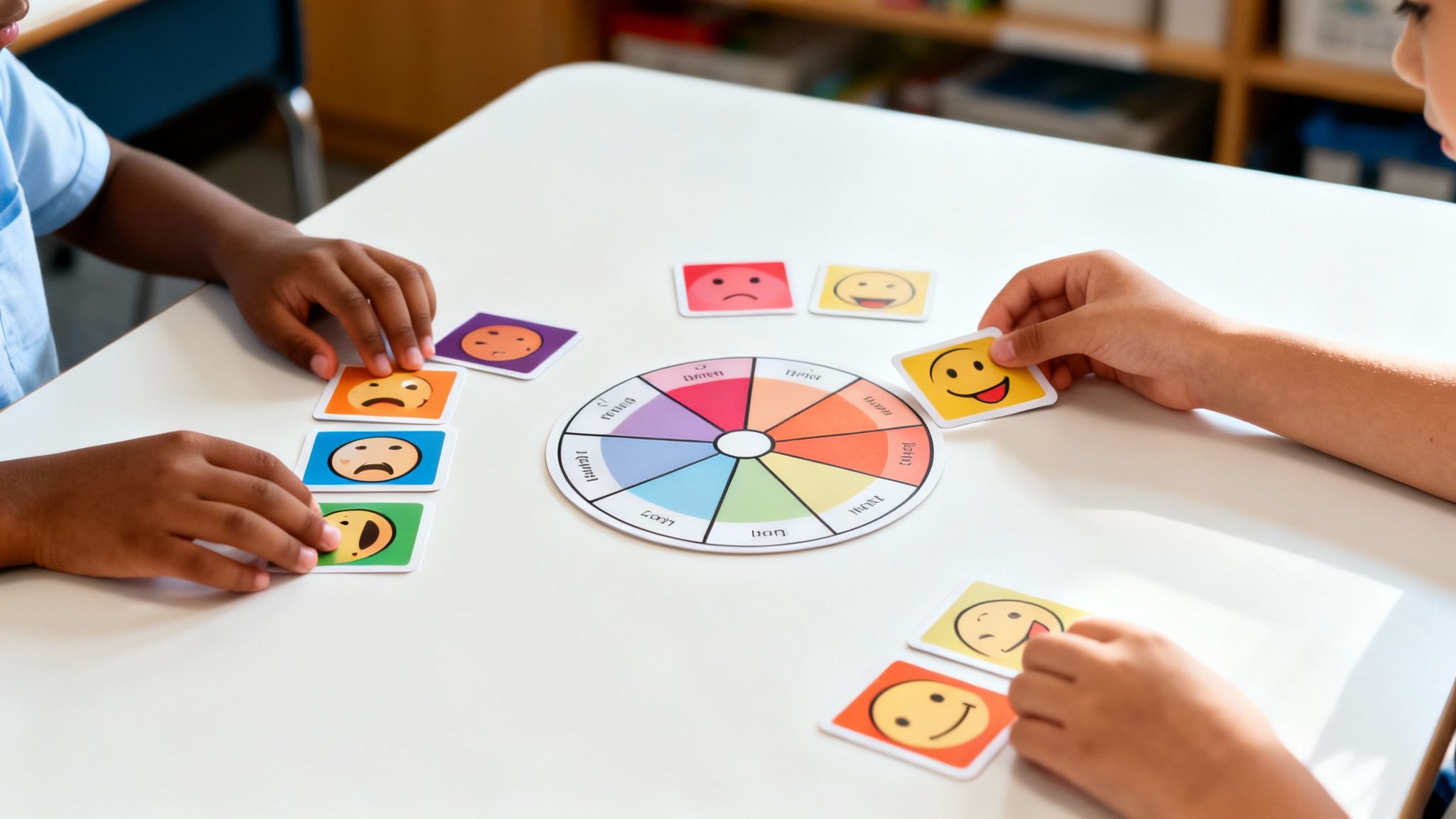
This type of communication skills activity goes beyond simply labeling “happy” or “sad.” It involves connecting emotions to physical sensations, understanding what triggers certain feelings, and learning healthy ways to respond. A practical example is “Feelings Bingo,” where the teacher calls out a scenario like “Your friend shares their favorite toy with you,” and students place a marker on the “happy” or “grateful” square. This directly links life events to specific emotional responses in a fun, low-stakes format.
Facilitation Tips & Implementation
To successfully integrate these games, focus on creating a safe environment where students feel comfortable sharing their emotional experiences without judgment.
- Expand the Vocabulary: Move beyond basic emotions. Introduce nuanced feelings like “disappointed,” “anxious,” “proud,” and “relieved.” Use a feelings wheel or anchor charts with diverse representations to make these concepts visible.
- Connect to Body Sensations: Guide students through body scan activities. Ask questions like, “Where do you feel excitement in your body?” or “What does worry feel like?” This helps them recognize emotional cues before they become overwhelming.
- Model Emotional Expression: Regularly name your own emotions in a constructive way. Saying, “I’m feeling a little frustrated because the projector isn’t working, so I’m going to take a deep breath,” models healthy coping for students.
- Use Visual Frameworks: Implement tools like the Zones of Regulation, which uses colors to help students identify their level of alertness and emotional state. This provides a simple, shared language for self-check-ins.
- Normalize All Feelings: Emphasize that it’s okay to feel angry, sad, or scared. The goal is not to eliminate these emotions but to learn how to manage them in a way that is safe and respectful to everyone.
By making emotional exploration a regular, playful part of the classroom routine, this communication skills activity equips students with the tools they need for self-awareness and empathy. You can learn more about building emotional intelligence from resources inspired by Daniel Goleman’s work.
7. Feedback Sandwich and Peer Feedback Protocols
Feedback Sandwich and Peer Feedback Protocols are structured methods designed to help students give and receive feedback effectively. This communication skills activity teaches a balanced approach, like the “sandwich” method (praise-critique-praise), or uses clear frameworks like “I like, I wish, I wonder” to ensure comments are kind, specific, and constructive, fostering a growth mindset and maintaining psychological safety.
These protocols transform feedback from a potentially daunting experience into a supportive and helpful exchange. Whether used for peer-editing essays in a language arts class or offering suggestions after a group presentation, these techniques provide students with the language to express themselves clearly and respectfully. For a practical example, after a student shares a drawing, a peer could say, “I really like the bright colors you used for the sun (praise). One part was a little confusing; maybe the house could be a little bigger so I can see the door (critique). But I love the happy feeling of the whole picture (praise).”
Facilitation Tips & Implementation
To build a strong feedback culture, facilitators must teach, model, and practice the process consistently. This ensures that feedback remains a positive tool for growth.
- Model Receiving Feedback: Demonstrate how to receive feedback gracefully and without defensiveness. Thank the person giving the feedback and ask clarifying questions if needed.
- Provide Sentence Starters: Post visible sentence stems to guide students. Examples include: “One thing that worked well was…” “I was confused when…” or “Have you considered…”
- Insist on Specificity: Teach students to move beyond generic comments like “good job.” Model specific praise like, “Your introduction clearly stated your main argument, which made your essay easy to follow.”
- Start with Low-Stakes Topics: Practice giving feedback on something simple and fun, like a drawing or a short story, before applying the protocol to graded assignments.
- Emphasize Feedback as Care: Frame feedback as an act of kindness and a way to help a classmate succeed. Establish clear agreements about maintaining a respectful and supportive tone.
8. “I” Statements and Assertive Communication Practice
“I” Statements are a cornerstone communication skills activity that teaches students to express feelings and needs without blaming others. This technique shifts the focus from accusatory “you” statements (e.g., “You always take my crayons”) to assertive and non-confrontational “I” statements (e.g., “I feel frustrated when my crayons are taken without asking”). This simple but powerful framework empowers students to advocate for themselves respectfully and de-escalate potential conflicts.
This foundational skill is crucial for conflict resolution and building healthy relationships. It helps children connect their emotions to specific actions, fostering self-awareness and personal responsibility. For example, instead of a student yelling, “You never include me!” they can learn to say, “I feel left out when I see everyone playing a game and I’m not invited.” This phrasing opens the door to conversation rather than defensiveness.
Facilitation Tips & Implementation
To effectively teach and embed the use of “I” statements, consistent modeling and practice are key.
- Introduce a Simple Formula: Use an anchor chart to display the formula: I feel [emotion] when [specific action happens] because [reason]. This visual aid helps students structure their thoughts.
- Start with Simplified Language: For younger students (1st-2nd grade), begin with a basic “I feel ______ when you ______” structure. Focus on identifying the feeling and the action that caused it.
- Role-Play Extensively: Create scenario cards with common classroom conflicts (e.g., someone cuts in line, a friend shares a secret). Have students practice responding with “I” statements in a low-stakes, supportive environment before a real conflict arises. A practical scenario: One student pretends to grab a toy from another. The second student practices saying, “I feel angry when the toy is snatched from my hands because I was in the middle of playing with it.”
- Acknowledge and Celebrate Use: When you hear a student use an “I” statement, praise their effort, even if it’s not perfectly executed. This positive reinforcement encourages continued practice.
- Connect to Listening Skills: Remind students that after sharing an “I” statement, it’s just as important to listen to the other person’s perspective. This prevents the tool from being used to simply make demands.
By making this a regular part of classroom dialogue, you provide students with a lifelong tool for assertive and empathetic communication. You can discover more about the transformative power of this tool by exploring The Magic of ‘I Feel’ Statements for Kids.
9. Community Agreements and Restorative Circles
Community Agreements and Restorative Circles represent a powerful, collaborative communication skills activity where students co-create behavioral norms and use structured dialogue to address conflict. Instead of relying on punitive measures, this process focuses on repairing harm, restoring relationships, and fostering accountability. By giving every member a voice, circles build a strong sense of community and teach essential communication skills.
This approach is highly adaptable for various school situations. It can be used proactively at the beginning of the year to establish shared classroom expectations or reactively to address issues like bullying or exclusion. For example, if a group project fails because some students didn’t contribute, a teacher could facilitate a restorative circle. Instead of assigning blame, the teacher asks, “What happened during the project?” and “What do we need to do differently next time to make sure everyone feels supported?” This focuses on fixing the process, not punishing the people.
Facilitation Tips & Implementation
Effective restorative circles depend on thoughtful preparation and a commitment to the process from all participants.
- Co-Create Agreements: Begin the school year by facilitating a circle where students brainstorm and agree upon their own classroom rules or norms. This creates shared ownership and accountability.
- Use a Talking Piece: Just like in listening circles, a talking piece ensures that one person speaks at a time and that everyone is heard without interruption.
- Ask Powerful Questions: Guide the conversation with restorative questions like, “What happened?” “Who has been affected, and how?” and “What needs to be done to make things right?”
- Ensure Voluntary Participation: True restoration cannot be forced. It’s crucial, especially for those who were harmed, that participation is voluntary.
- Start with Low-Stakes Circles: Build the group’s capacity and trust by holding circles on simple, positive topics before attempting to resolve a serious conflict. This establishes the circle as a safe space.
- Build in Follow-Up: After a circle, check in with participants to ensure the agreed-upon resolutions are being honored and to offer further support if needed.
By shifting the focus from punishment to repair, this communication skills activity teaches empathy, responsibility, and problem-solving. You can explore more conflict resolution strategies for students to support this practice.
10. Mindful Listening and Meditation Practices
Mindful Listening and Meditation Practices are a powerful communication skills activity focused on building the internal foundation for effective dialogue. These structured exercises teach students to quiet their minds, pay attention to the present moment, and listen to themselves and others without judgment. This practice cultivates the self-awareness and emotional regulation essential for clear communication and conflict resolution.
This approach integrates mindfulness directly into the social-emotional fabric of the classroom. It can look like a two-minute breathing exercise before a difficult test, a “body scan” to help students identify where they feel anxiety, or a loving-kindness meditation to build empathy for peers. A practical example is a “mindful minute” before class discussions. The teacher can ask students to close their eyes and listen for all the sounds they can hear inside and outside the classroom for one minute. This simple act trains their brains to focus and be present, preparing them to listen better to their peers.
Facilitation Tips & Implementation
To successfully integrate mindfulness, it’s crucial to create a safe, optional, and consistent routine.
- Start Small and Build: Begin with very brief sessions (1-2 minutes) and gradually increase the duration as students become more comfortable. A short daily practice is more effective than a long weekly one.
- Normalize Distractions: Teach students that it is normal for their minds to wander. Use gentle cues like, “If you notice your mind has drifted, just gently guide it back to your breath.”
- Offer Variety: Provide different types of practices. Some students may prefer guided breathing exercises, while others might connect more with mindful movement or listening to a calming sound.
- Use Gentle Language: Employ a calm, soothing tone. Always make closing eyes an option, never a requirement, as some students may feel unsafe doing so.
- Connect to Communication: Explicitly link the practice to social skills. Say, “Practicing this quiet focus helps us become better listeners when our friends are talking.”
- Provide an Opt-Out: Allow students to opt out without shame. They can sit quietly or read a book, which respects their comfort level and builds trust in the process.
By fostering present-moment awareness, this communication skills activity helps students manage their internal state, which is the first step toward engaging in respectful and empathetic conversations with others. Find more resources for classroom mindfulness at Mindful.org.
Top 10 Communication Skills Activities Comparison
| Title | Implementation complexity | Resource requirements | Expected outcomes | Ideal use cases | Key advantages |
|---|---|---|---|---|---|
| Active Listening Circles | Low–Medium (needs facilitation) | Minimal: seating space, time, facilitator | Increased empathy, psychological safety, belonging | Morning meetings, classroom check-ins, staff debriefs, family conversations | Low barrier, validates voices, builds listening skills |
| Non‑Violent Communication (NVC) Practice | Medium–High (requires coaching) | Training, curriculum time, facilitator coaching | Reduced conflict, clearer needs expression, emotional vocabulary | Peer mediation, disciplinary conversations, parent workshops | Teaches needs-based language, reduces blame, supports self-advocacy |
| Perspective‑Taking Through Role‑Play | High (skilled facilitation, safety needed) | Prep time, scenario design, trained facilitator, optional props | Deep empathy, reduced bullying, memorable behavior change | Bullying prevention, social skills lessons, workshops | Experiential learning, kinesthetic engagement, high retention |
| Peer Interview Pairs | Low (straightforward structure) | Question prompts, brief time, teacher monitoring | Increased peer connection, questioning and listening skills | Beginning-of-year community building, buddy systems | Low-pressure, scalable, quickly builds relationships |
| Fishbowl Discussions | Medium–High (logistics and rotation) | Space for concentric seating, time, facilitator guidance | Modeled dialogue, improved observation, balanced participation | Large-group discussions, modeling conflict resolution, panels | Ensures equitable voice, teaches both speaking and observing |
| Emotion Identification and Expression Games | Low–Medium (ongoing reinforcement) | Visual aids, cards/games, lesson time | Greater emotional literacy, better self-regulation, shared language | SEL lessons, morning check-ins, differentiated instruction | Engaging, multisensory, supports diverse learners |
| Feedback Sandwich & Peer Feedback Protocols | Medium (practice to internalize) | Sentence starters, modeling, practice time | Growth mindset, constructive peer culture, improved work quality | Peer review, presentations, collaborative projects | Builds resilience, specific actionable feedback, transferable skill |
| “I” Statements & Assertive Communication | Low–Medium (repetition required) | Anchor charts, role-plays, teacher modeling | Reduced defensiveness, clearer boundaries, better self-advocacy | Conflict resolution, classroom management, family conversations | Teachable, reduces blame, foundational for healthy discourse |
| Community Agreements & Restorative Circles | High (time and buy‑in intensive) | Trained facilitators, sustained time, community commitment | Restored relationships, reduced recidivism, shared norms | School-wide culture change, serious conflicts, restorative justice programs | Builds ownership, accountability without exclusion, long-term culture shift |
| Mindful Listening & Meditation Practices | Low–Medium (consistent practice needed) | Minimal materials, facilitator training, regular time slots | Reduced reactivity, improved attention, stronger self-awareness | Daily check-ins, transitions, regulation before discussions | Portable, improves listening quality, foundational for SEL skills |
From Activity to Culture: Weaving Communication into Your Community’s Fabric
The journey through this curated collection of activities, from Active Listening Circles to Mindful Meditation Practices, provides a powerful toolkit for nurturing essential life skills. We’ve explored how a single communication skills activity can open doors to deeper understanding, empathy, and connection. Yet, the true potential of these exercises is unlocked when they move beyond isolated lesson plans and become the very heartbeat of your classroom, school, or home environment.
The goal isn’t just to do an activity; it’s to cultivate a culture where the principles of effective communication are lived out daily. It’s about transforming a classroom from a place where students simply coexist into a community where they actively support and uplift one another.
Synthesizing the Core Lessons
The activities shared in this guide are more than just games; they are practical, hands-on labs for social-emotional learning. Each one targets a crucial component of the communication puzzle:
- Listening to Understand, Not Just to Reply: Activities like Active Listening Circles and Fishbowl Discussions shift the focus from formulating a response to truly absorbing what another person is saying and feeling.
- Speaking with Intention and Compassion: Tools like Non-Violent Communication (NVC) and “I” Statements give students a concrete framework for expressing their needs and feelings without blame or accusation.
- Embracing Diverse Perspectives: Perspective-Taking Through Role-Play and Peer Interview Pairs build the cognitive and emotional muscle of empathy, helping students see the world through others’ eyes.
- Building and Repairing Relationships: Community Agreements and Restorative Circles provide proactive and reactive strategies for establishing a foundation of respect and mending relationships when harm occurs.
The common thread woven through every communication skills activity is the development of self-awareness and social awareness. Students learn to recognize their own emotional triggers and, in turn, become more attuned to the emotional states of their peers. This dual awareness is the foundation of a psychologically safe and supportive learning environment.
Actionable Next Steps: From Implementation to Integration
Moving from a single activity to an embedded cultural practice requires intention and consistency. Here’s how you can begin that process, whether you are a teacher, administrator, or parent:
- Start Small and Build Momentum: Don’t feel pressured to implement everything at once. Choose one communication skills activity that addresses a current need in your community. For example, if you notice frequent misunderstandings on the playground, start with “I” Statements. Master it, celebrate the small wins, and then introduce another.
- Model the Behavior Consistently: Children learn more from what you do than what you say. Model active listening when a student is upset. Use “I” statements when you need to set a boundary. Acknowledge your own mistakes and apologize. Your actions give these skills life and legitimacy.
- Create Rituals and Routines: Integrate these practices into your daily schedule. Start the day with a quick Active Listening Circle check-in. Use the Feedback Sandwich protocol during peer-editing sessions. Make Restorative Circles the default process for addressing conflict. Consistency turns a novel activity into a natural habit.
A teacher in a 4th-grade classroom noticed students were quick to tattle. Instead of punishing, she introduced a weekly “Problem-Solving Circle” using NVC principles. Students learned to frame their issues as unmet needs (“I feel frustrated when I can’t find the red marker because I need it to finish my project”). This simple ritual transformed tattling into a collaborative, solution-focused process.
Ultimately, the power of a communication skills activity lies in its ripple effect. When a child learns to truly listen, they become a better friend. When they learn to express their needs assertively, they are less likely to resort to aggression. When they can see another’s perspective, they become a force for compassion and inclusion. You are not just teaching communication; you are nurturing the empathetic, resilient, and collaborative leaders our world so desperately needs.
Ready to take the next step in building a culture of empathy and respect in your school? Soul Shoppe provides dynamic, in-school programs and assemblies that bring these communication skills to life, empowering students and staff with the tools to prevent bullying and build a kinder community. Explore our programs at Soul Shoppe to see how we can help you turn these activities into a transformative school-wide movement.